Right now, someone in your city is searching “plumber near me” or “tree service [your city].” There are three spots at the top of that page. Only three. Every call from that search goes to one of those three businesses.
You’re either in them or you’re not.
Local SEO is what gets you there. Not general SEO. Not national rankings. The specific work of making Google confident that when someone in your service area needs what you do, your name shows up first.
This guide covers the whole system: your Google Business Profile, reviews, citations, location pages, local links, and how to track whether it’s working. If you build this right and stay consistent, you will get more calls without paying per lead.
How Google Decides Who Shows Up in the Local Pack
Google uses three factors to rank local results: Relevance, Distance, and Prominence.
Relevance is how well your profile and website match what the person searched. Distance is how close your business is to the searcher. Prominence is how trusted and established Google thinks you are based on reviews, links, and citations.
Here’s the important part: Distance is the one factor you cannot control. You serve the areas you serve. Your job is to win on Relevance and Prominence, because those are the levers.
Most contractors ignore both. They set up a Google Business Profile in 2019, never touch it, have 14 reviews, and wonder why a competitor with 11 trucks is below them in the results. The answer is almost always that the competitor did the Relevance and Prominence work and they didn’t.
Relevance means Google clearly understands what you do and where you do it. Prominence means Google has seen enough signals from enough sources to trust you. Build both, consistently, and the rankings follow.
Optimize Your Google Business Profile for Local Search
Your Google Business Profile (GBP) is the foundation of local SEO for contractors. Every other piece of this system supports it. But most contractors leave it half-built.
Start with completion. If you open your GBP dashboard and look at your profile, how much is blank? Most contractors have filled in their name, phone, and address. They’ve left the business description generic, missed half the service categories, uploaded three photos, and never touched the attributes section. Google weighs completeness. A complete profile outranks an incomplete one when everything else is equal.
Primary category: Be specific. “Plumber” ranks better than “Contractor” when someone searches for a plumber. If you do multiple trades, pick the one that drives your most revenue as the primary category, then add the rest as secondary categories.
Service area: You can set up to 20 cities or ZIP codes. Fill them all. If you serve 12 towns, list all 12. This tells Google exactly where you’re relevant.
Business description: Write 200-300 words. Include your core services and the cities you serve naturally in the text. Don’t stuff keywords. Write like you’re explaining your business to someone who just moved to town.
Services list: Every service you offer should be its own line item in the Services section. Each one is a keyword opportunity. “Water heater replacement” is different from “water heater installation” and “tankless water heater installation.” List all three. Do this for every service you offer.
Photos: Upload at least 25 photos. Trucks, crew, job sites, before/after, equipment, office if you have one. Businesses with more photos get more engagement, and engagement signals matter to Google. Update photos monthly.
Attributes: Check every attribute that applies. “Veteran-owned,” “background-checked technicians,” “licensed and insured,” “family-owned.” These build trust with searchers and signal legitimacy to Google.
Google Posts: Use the Posts feature weekly. It doesn’t take long. One sentence about a recent job, a seasonal offer, or a tip for homeowners. Posts show activity, and Google likes active profiles.
Reviews: The Local SEO Multiplier
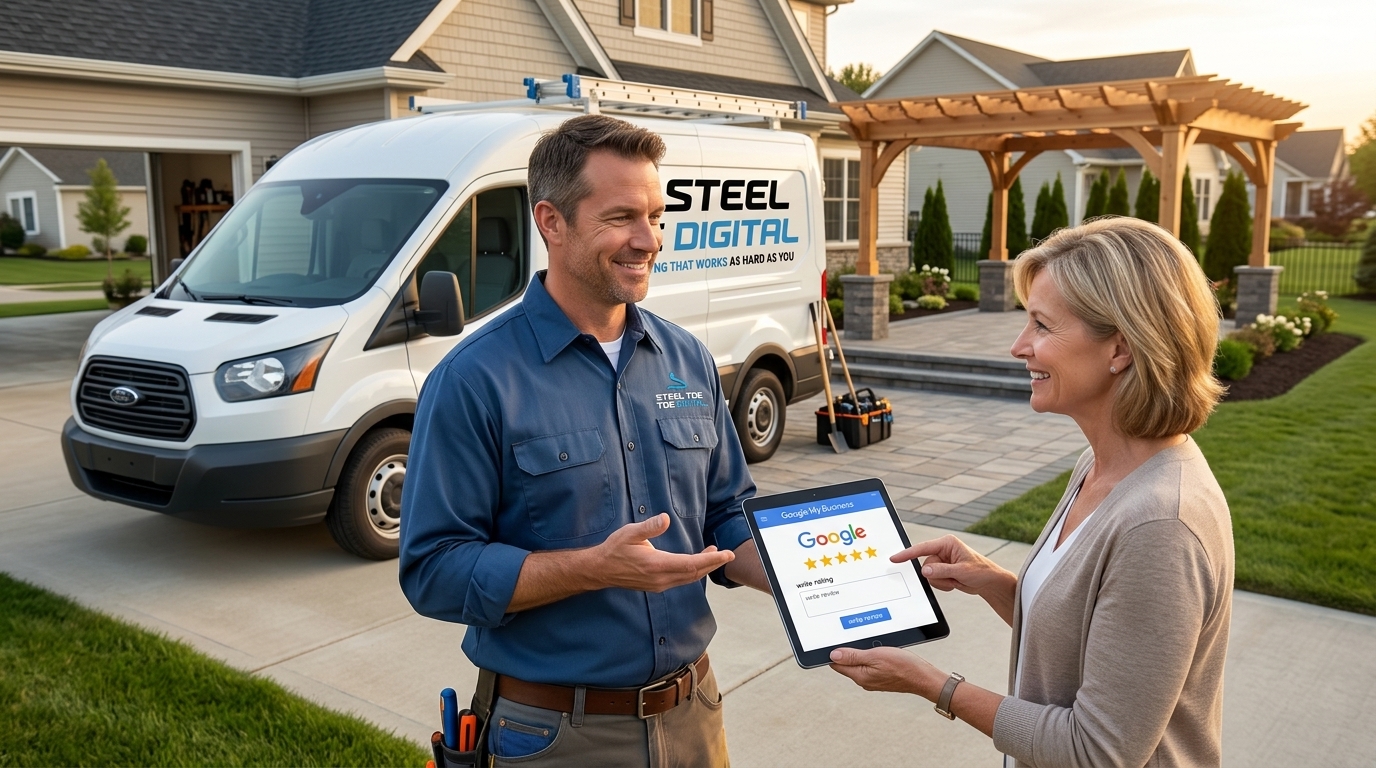
Reviews are the single highest-leverage activity in local SEO. They affect your ranking directly. They also convert the people who find you. A contractor with 80 reviews at 4.8 stars gets more calls than one with 20 reviews at 5.0, even if the second one is better at the actual work.
The contractors I’ve worked with who grew fastest had one thing in common: they made review requests a standard part of every job completion. Not a once-in-a-while thing. Not something they remembered when business was slow. A built-in step, every time, for every customer.
Here’s what works:
Text-based requests. Send a text with a direct link to your Google review page within 24 hours of job completion. Text messages have open rates around 90%. Email is around 20%. If you’re emailing review requests, you’re leaving most of them unread.
Ask in person. When the job is done and the customer says “looks great,” that’s the moment. Ask them directly. “It would really help us out if you left us a Google review. I can text you the link right now.” Most people will say yes.
QR code on invoices and leave-behinds. Print a QR code that goes directly to your Google review page. Put it on your invoice, on a business card, on a yard sign if you use them. Every touchpoint is a chance.
Follow up. If someone didn’t leave a review after the first ask, a second text two or three days later is fine. Keep it short: “Hey, just wanted to follow up on the review request I sent. It means a lot to us. Here’s the link.” Most of your second-ask conversions come from people who intended to do it but forgot.
Respond to every review. Every one. Thank the positive ones. Respond professionally to the negative ones. Google tracks engagement. A business owner who responds to reviews is more active than one who doesn’t, and active profiles rank higher.
The target is 1-2 new reviews per week, consistently. At that pace, you’ll have 50-100 reviews in a year. That’s enough to put you ahead of most competitors in most markets.
Build Local Citations That Stick
A citation is any place online where your business name, address, and phone number appear together. Google uses citations to verify that your business is real and that your information is consistent.
Inconsistent citations hurt you. If your address is “123 Main St” on Google but “123 Main Street” on Yelp, that’s a signal Google notices. If your phone number changed two years ago and it’s still the old number on six directories, you have a citations problem.
The fix is NAP consistency: Name, Address, Phone. Every listing needs to match exactly. This sounds tedious because it is. But it’s foundational.
The core directories for contractors:
- Google Business Profile
- Yelp
- Facebook Business Page
- Better Business Bureau
- Angi (formerly Angi and HomeAdvisor)
- Nextdoor
- Houzz
- Thumbtack
- Apple Maps
- Bing Places
Industry-specific directories by trade:
Plumbers: PHCC (Plumbing-Heating-Cooling Contractors Association), PlumbingDirectory.com
Tree services: TCIA (Tree Care Industry Association), the ISA Arborist directory
Home inspectors: InterNACHI and ASHI
Septic contractors: NOWRA.org and your state’s environmental licensing directory
Getting listed on the industry association directory for your trade does two things: it’s a citation for local SEO and it’s a credibility signal to customers who know what those certifications mean.
Tools for citations: BrightLocal, Whitespark, and Yext all let you find and manage your citations across dozens of platforms. BrightLocal’s Citation Audit tool is where I’d start. It shows you where you’re listed, where you’re not, and where your information is wrong.
Your Website’s Role in Local SEO
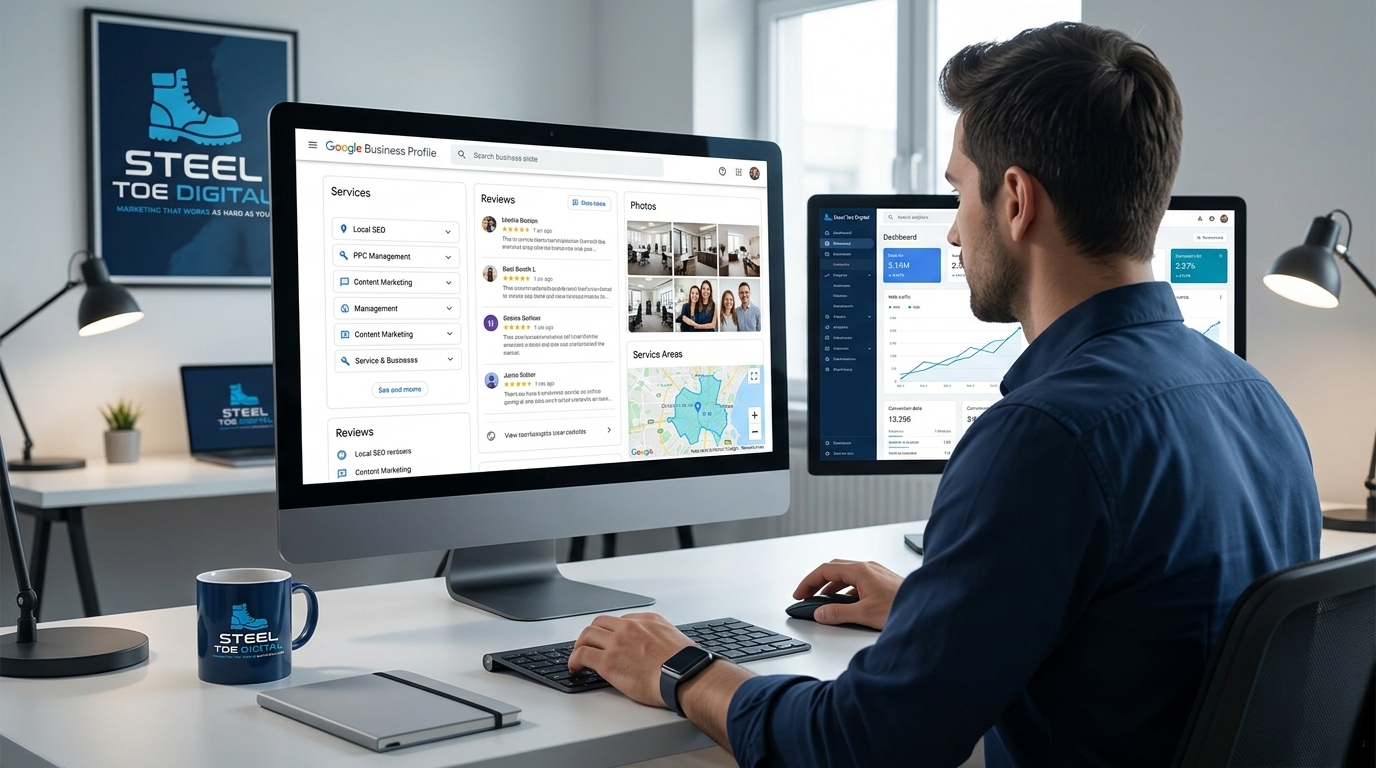
Your website and your Google Business Profile work together. Google pulls signals from your website to decide how to rank your GBP. A weak website makes it harder to rank, even if your profile is strong.
The most important website tactic for local SEO is location pages. If you serve multiple cities, each city should have its own page.
The URL structure looks like this:
- /plumber-austin-tx/
- /tree-service-round-rock/
- /septic-company-cedar-park/
Each page should have 400-600 words of real content. Not just the city name swapped into a template. Real content: what services you offer in that city, any local context that’s relevant (neighborhoods, landmarks, common job types in that area), a testimonial from a customer in that city if you have one, and a clear call to action.
What to avoid: Google calls thin, duplicated city pages “doorway pages” and penalizes them. If the only difference between your Austin page and your Round Rock page is the city name, that’s a problem. Each page needs to be meaningfully different.
Schema markup: Add LocalBusiness schema to your site, plus service-specific schema on each service page and location schema on each city page. Schema tells Google exactly what your page is about, in language search engines read directly. Most WordPress SEO plugins (Yoast, Rank Math) handle this. If you’re not sure whether your site has schema, check with Google’s Rich Results Test.
Page speed and mobile: Most contractor searches happen on phones. If your site loads slowly on mobile or looks bad on a small screen, you’re losing customers before they read a word. Google uses Core Web Vitals as a ranking signal. For trades websites, aim for a Largest Contentful Paint under 2.5 seconds and a Cumulative Layout Shift under 0.1. Run your site through Google’s PageSpeed Insights to see where you stand.
For a deeper look at what a high-converting contractor website needs, see our guide to home service website design.
The Local Link Building Playbook for Contractors
Links from other websites to yours tell Google that other people trust you. Local links (from businesses and organizations in your service area) are especially valuable for local SEO.
You don’t need hundreds of links. A small number of relevant, local links outperforms a large number of irrelevant ones. Here’s where to get them:
Chamber of commerce. Most local chambers have a business directory on their website. Paid membership typically includes a listing and a link. The cost is usually $200-$500 per year. The link alone is worth that in most markets.
Supplier and vendor pages. If you buy materials or equipment from a local supplier, ask whether they have a “preferred contractor” page or partner directory. Many do. Your supplier has a relationship with you already. This is an easy ask.
Realtor and property manager partnerships. Realtors and property managers need trusted contractors for referrals. If you’re already doing work for real estate clients, ask them to list you on their website as a preferred vendor. A link from a realtor’s website is local and relevant.
Local event sponsorships. Sponsor a Little League team, a school fundraiser, or a community event. Many of these have websites that list sponsors with links. A link from a .org domain in your service area carries real weight.
Local news and community sites. If you did something newsworthy (rescued someone, donated a service, hit a business milestone), pitch a local news site or neighborhood blog. A feature story gets you a link and brand exposure in the same move.
“Best of” lists. Many local publications run annual “best of” lists. Submit your business. Getting on a “Best Plumbers in [City] 2026” list on a local publication’s website gives you a citation and often a link.
Building links takes longer than the other tactics in this guide. But the payoff compounds. A link you earn in January helps you in January, and in June, and in December, and next year.
Tracking Your Local SEO Progress
If you don’t measure it, you don’t know whether it’s working. These are the four tools that matter:
Google Business Profile Insights. Inside your GBP dashboard, Insights shows you how many people found your profile, how many clicked for directions, how many called directly from the profile, and how many visited your website. Track these monthly. You’re looking for a trend upward over time.
Google Search Console. This is a free tool from Google that shows which search queries are sending traffic to your website, how often you appear in results, and how often people click. Search Console is where you find out whether the location pages you built are actually ranking. If you don’t have it set up, add it today.
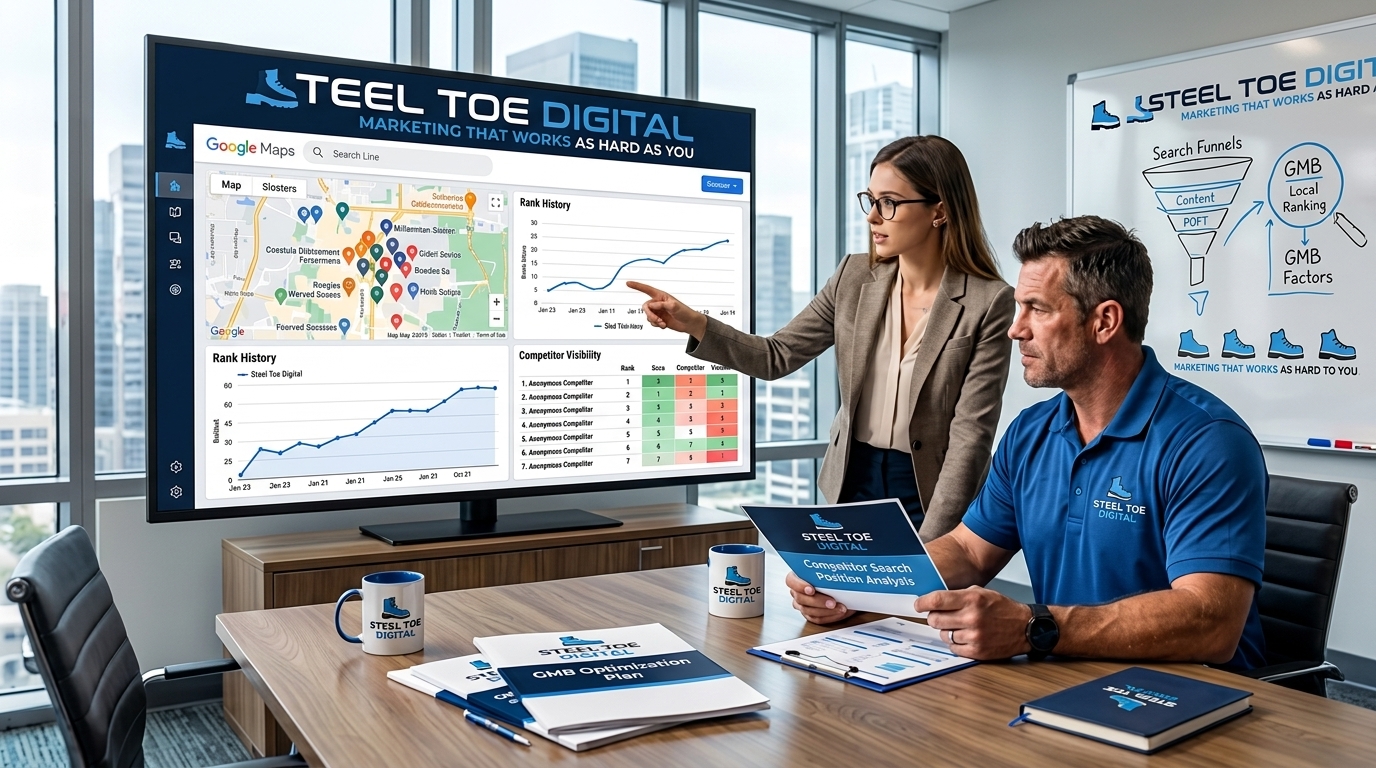
BrightLocal rank tracker. Your GBP doesn’t rank the same way across your entire service area. Someone searching from the north side of town gets different results than someone searching from the south side. BrightLocal’s grid tracker shows you where you rank at different geographic points across your area. It’s the clearest picture of your true local reach.
Monthly baseline. Before you make any changes, take a screenshot of where you rank. Write down the date. Then track monthly. SEO results move slowly enough that it’s easy to forget where you started. A written baseline prevents that.
How Long Until Local SEO Works?
This is the question every contractor asks. The honest answer depends on where you’re starting, how competitive your market is, and how consistently the work gets done. Here are realistic timelines based on what I’ve seen:
GBP profile improvements: 30-60 days. Fill in everything, update your photos, add your services list. You’ll often see movement in GBP Insights within a month.
Review momentum: 60-90 days. Once you’re consistently getting 1-2 reviews per week, Google starts to see the pattern. Your star count goes up, your ranking follows.
Citation cleanup: 60-90 days. Fix NAP inconsistencies across your listings and Google updates its understanding of your business over 2-3 months.
Location pages and content: 3-6 months for a newer website, 1-3 months for an established site with existing authority. New pages take time to get indexed, crawled, and ranked.
Full local dominance: 6-12 months of consistent execution. This is not a “set it and forget it” system. The contractors who reach the top of the Maps pack and stay there are the ones who treat it as ongoing work, not a one-time project.
Anyone who tells you they can get you to the top of local search results in 30 days is lying. The work takes time. But it compounds. Every review, every link, every piece of content adds to a foundation that keeps generating calls.
For a complete breakdown of contractor SEO strategy beyond the local piece, see our full contractor SEO guide.
Local SEO vs. Google Local Services Ads: Which One First?
This comes up constantly, so it’s worth addressing directly.
Google Local Services Ads (LSAs) are the “Google Guaranteed” listings at the very top of the page, above the Maps pack. You pay per lead, and Google verifies your license and insurance before you can run them. Cost per lead varies by trade and market but typically runs $20-$80 for most contractor categories.
Local SEO is not paid. You earn the ranking. Once you’re there, the calls cost you nothing per lead.
The honest answer is: do both, in the right order.
Start with LSAs if you need leads now. They turn on faster. You can have calls coming in within a week of getting approved. But you’re paying for every one, and if you stop paying, the calls stop immediately.
Build local SEO in parallel. It takes longer to show results, but once it’s working, it keeps working. The goal is to reach a point where your organic local rankings are generating enough call volume that you can reduce or stop LSA spend. Most of my clients who’ve done both end up running leaner on paid because the organic system is carrying the load.
If budget is a constraint and you can only do one, choose based on timeline. Need jobs this month: LSAs. Building a long-term asset: local SEO.
For more on the paid side of contractor marketing, see our guide to digital marketing for home services.
Local SEO by Trade: What’s Different
The core system is the same across trades. But some details change depending on what you do. Here’s what to know:
Plumbing: High search volume, high competition in most markets. Reviews matter more here than in any other trade because homeowners are comparing three or four plumbers before calling. Getting above 50 reviews is the baseline to compete in most mid-size markets. See our full local SEO for plumbers guide for the plumbing-specific playbook.
Tree service: Highly seasonal. Your review velocity needs to match your busy season. Build reviews fast in spring and fall when you’re running jobs every day. The off-season is when you work on content and links, so you’re positioned when the calls start. See our tree service SEO guide for more.
Septic and land clearing: Smaller search volumes per keyword, but also less competition. It’s often easier to rank for septic searches than plumbing searches in the same market. Citations to industry-specific directories (NOWRA, state environmental boards) carry extra weight because they’re hard to get and Google knows it. See our septic company SEO guide and land clearing SEO guide for the specifics.
Home inspectors: The association directories are especially important here. InterNACHI and ASHI are the two main ones. Buyers searching for home inspectors often filter specifically for certified inspectors, so your association membership showing up in your GBP and your website is a direct conversion factor. See our SEO for home inspectors guide.
If you do general contracting or remodeling, the playbook is the same as above. The keywords are more competitive and the buying cycle is longer (someone planning a kitchen remodel takes months, not days), so content and review velocity become even more important.
The Three Mistakes That Keep Contractors Off Page One
These aren’t edge cases. They’re the same issues I see across almost every contractor business that’s stuck below the top three in local results.
Mistake 1: Inconsistent NAP. Your name, address, and phone are different across directories. Your GBP says one phone number, your Facebook says another, your Angi profile has an old address. Google sees the inconsistency and doesn’t know which version to trust. Clean it up.
Mistake 2: No review system. Reviews don’t happen by accident at scale. Contractors with 100 reviews didn’t get lucky. They built a process. If you’re not asking every customer systematically, you’re leaving reviews on the table. That means you’re leaving rankings on the table.
Mistake 3: One-page website serving a dozen cities. If your website has one page and it says “serving the greater metro area,” you have no location-specific relevance signals for any of those cities. Google can’t rank you for “plumber Round Rock” if your website never mentions Round Rock. Build the pages.
Fix all three and you’ll move. It’s not complicated. It’s just work.
Frequently Asked Questions
What is local SEO and how is it different from regular SEO?
Regular SEO focuses on ranking in national or broad search results. Local SEO focuses specifically on appearing in results for searches that include a location or are made by someone near your business. For contractors, local SEO means showing up in the Google Maps pack and in organic results for searches like “plumber in [city]” or “tree removal near me.” The tactics overlap but local SEO puts heavier weight on your Google Business Profile, reviews, and citations.
Can I rank in a city where I don’t have a physical office?
Yes, but with limits. Google’s local ranking algorithm uses distance as a factor, so you’ll rank more easily in cities where you have a physical location. For service-area businesses that operate from a home address or single location, you can set your service area to cover the cities you serve. You won’t rank as strongly in cities far from your base, but you can rank in nearby cities by building location pages on your website and getting reviews from customers in those areas.
How much does local SEO for contractors cost?
Cost varies depending on whether you do it yourself, hire an in-house person, or work with an agency. DIY is mostly time and tool costs. BrightLocal runs about $39-$49 per month. An agency that specializes in contractor SEO typically charges $800-$2,500 per month depending on scope, market size, and how many locations you serve. Expect 3-6 months before you see meaningful ranking movement, and 6-12 months to fully compete at the top of the Maps pack.
Should I use a PO Box address for my Google Business Profile?
No. Google’s guidelines prohibit PO Box addresses. Your GBP address should be your actual business address: your office, shop, or home if you run a home-based service business. If you use a home address and don’t want it visible to the public, you can hide the address in GBP and show only your service area. That’s the right setup for most service-area businesses.
What’s the fastest way to improve my local ranking?
The fastest single tactic is completing your Google Business Profile fully and starting a consistent review request process. GBP completeness improvements show ranking movement in 30-60 days. Adding reviews consistently compounds from there. These two steps cost almost nothing and produce results faster than any other part of the local SEO system. After that, citation cleanup and location pages are the next highest-impact steps.
Do Google reviews actually affect my ranking?
Yes. Google has confirmed that reviews are a local ranking factor. The number of reviews, the recency of reviews, and the overall star rating all play a role. Review velocity (how fast you’re accumulating reviews) matters too. A business that gets 3 reviews a week is more active than one that got 50 reviews three years ago and nothing since. Recent, consistent reviews signal that your business is active and trusted.
Ready to Rank When Your Customers Search?
If you’ve read this far, you know what the system looks like. Now the question is whether you build it yourself or get help.
SteelToe Digital builds local SEO systems for contractors. We’ll audit where you stand right now, show you what’s holding you back, and build the foundation that gets you into the Maps pack and keeps you there.
No pitch. No pressure. Just a clear look at where you rank and what it would take to move.