There are exactly 3 spots in the Google Maps pack when someone searches “plumber [your city].” Those 3 spots get the lion’s share of every call made from that search. The rest of the results page (organic listings, ads, directories) splits what’s left.
If you’re not in the pack, you’re fighting over scraps.
Local SEO for plumbers is the system that gets you into those 3 spots and keeps you there. It’s not the same as national SEO. It doesn’t require you to compete with every plumbing company in the country. It requires you to be the most credible, most reviewed, best-optimized plumber in your city. That’s a much more winnable fight.
This guide covers every piece of the system: your Google Business Profile, reviews, your website, citations, and city pages. Work through all of it and you’ll outrank most of your competitors inside 6 months.
Why Local SEO Is the #1 Marketing Investment for Plumbers
Most plumbing searches have location intent baked in. “Emergency plumber near me.” “Water heater installation in [city].” “Drain cleaning [zip code].” People aren’t browsing. They have a problem right now, and they’re searching for someone close enough to fix it.
Google knows this. That’s why the Maps 3-pack appears above every other result for local searches. It’s the first thing your potential customer sees. According to Google’s own data on local search behavior, the Maps pack captures the majority of clicks on local service searches. Organic results below it and paid ads above it both see less engagement than those 3 map pins.
The cost math is also different. Plumbing leads from organic local SEO typically run $30-$60 per lead once the system is built. Google Ads and Local Services Ads run $80-$250 per lead depending on your market and the service type. Both have a place in a full marketing system, but SEO builds equity over time. You pay to build it once. After that, it compounds.
A plumber in a competitive market who’s been running a clean SEO strategy for 2 years isn’t paying per lead anymore. Their profile generates calls because of work done 18 months ago. That’s the difference between a marketing expense and a marketing engine.
See how plumber SEO fits into a full marketing strategy beyond just local rankings.
The 3 Local SEO Ranking Factors Google Uses for Plumbers
Google’s local algorithm uses three factors to decide who gets into the Maps pack: relevance, distance, and prominence.
Relevance is how well your Google Business Profile matches what someone searched. If someone searches “drain cleaning near me” and your profile is set up as a general contractor with no mention of drain cleaning, Google won’t rank you. Your profile needs to match what you actually do.
Distance is how far you are from the person searching. Google weights proximity heavily for local searches. This is largely outside your control (you can’t move your shop), but you can build out service area pages and citation coverage across your full market to establish your geographic footprint.
Prominence is how well-known and credible your business is. This is where most of the SEO work happens. Reviews, citations, backlinks, your profile completeness, your website authority: all of it signals to Google that you’re the real deal. Prominence is the factor you have the most control over, and it’s where most plumbers have the biggest gaps.
Distance you can’t change. Relevance and prominence you can. That’s where to put your energy.
Google Business Profile: The Foundation of Local Plumber SEO
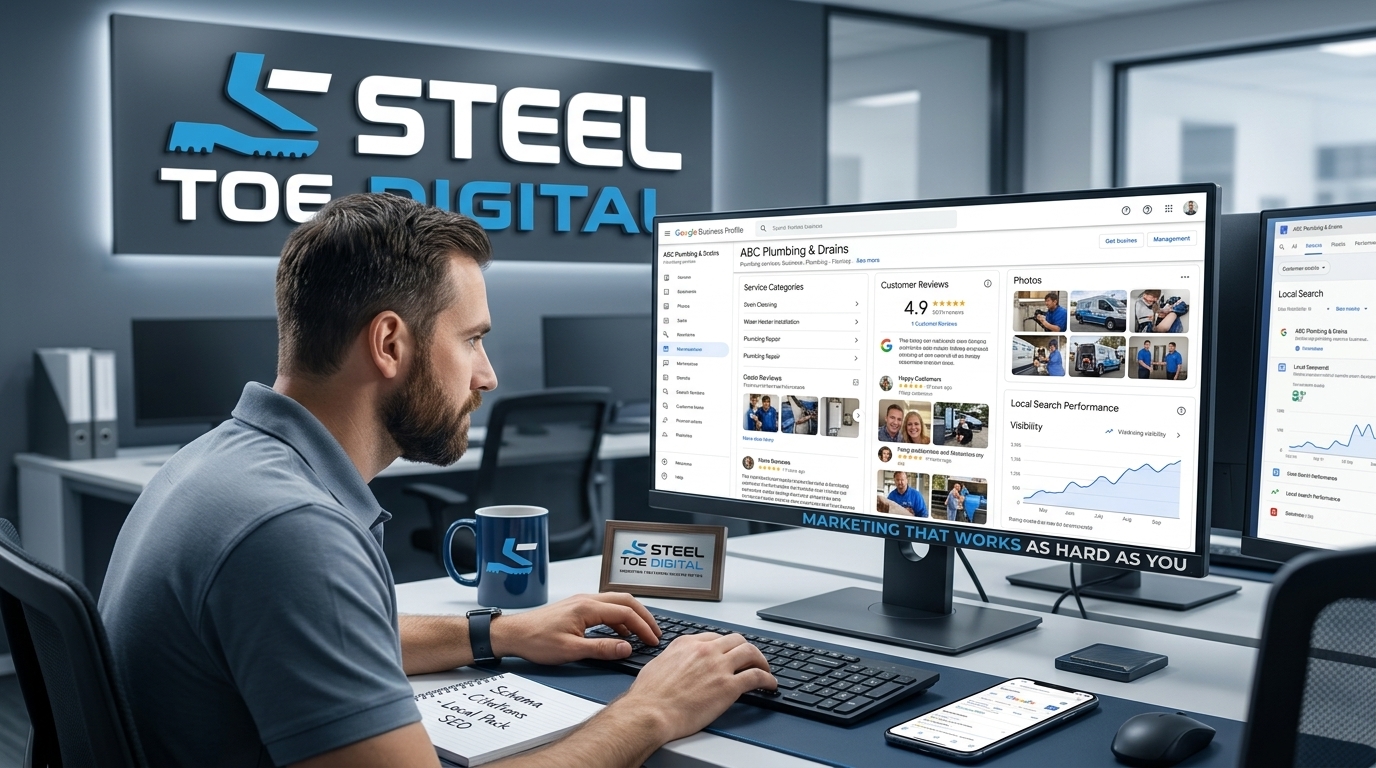
Your Google Business Profile (GBP) is the single most important asset in your local SEO strategy. It’s what shows up in the Maps pack. It holds your reviews. It’s where Google forms its first impression of your business.
Most plumbing companies have a GBP set up wrong. Here’s what correct looks like.
Primary category: “Plumber.” Not “Plumbing Contractor,” not “Home Repair Service,” not “Contractor.” The primary category is the single most important relevance signal you send Google. It needs to be “Plumber.”
Secondary categories: everything that applies. Add Water Heater Installation, Drain Cleaning, Sewer Service, Gas Installation Contractor, whatever matches your actual service mix. Don’t add categories for services you don’t offer. Each one you add correctly expands the searches you’re eligible to rank for.
Service area: list every city and town you serve. Google allows up to 20 service areas. Use them. Include your primary city, surrounding suburbs, and any specific towns where you want to be found. If you serve 12 towns, list all 12.
Services menu: add each service individually. Don’t just write “Plumbing Services” as one item. Add Water Heater Repair, Water Heater Installation, Drain Cleaning, Leak Repair, Pipe Replacement, Toilet Repair, Sewer Line Inspection, each as its own entry with a short description. This is a direct relevance signal.
Photos: minimum 20, and keep adding them. Before-and-after shots of completed jobs. Your trucks. Your crew. Your shop or office. Profile photos of the owner and key techs. Real photos outperform stock every time. Profiles with more photos get more profile views. That’s not a guess. It’s consistent across every account we’ve worked on.
Weekly posts. Google Business Profile has a posts feature most plumbers ignore entirely. Mix in a tip (“three signs your water heater is about to fail”), a completed job photo, or a seasonal offer. It takes 10 minutes a week and signals active management to Google.
Q&A: pre-populate it. Go into your own profile and ask the 10 questions your customers ask most often. Then answer them. “Do you offer same-day service?” “Are you licensed and insured?” “Do you service [specific city]?” If you don’t answer them yourself, anyone can (and often does, with wrong information).
Reviews: Quantity, Quality, and Velocity
Reviews are a prominence signal. More reviews, higher average rating, and consistent new reviews over time all push your GBP higher in the Maps pack.
The baseline competitive threshold in most markets: 50+ reviews at 4.7 stars or above. Below that, you’re starting from a deficit in any city with real competition. In markets with multiple established plumbers, the leaders have 150-300+ reviews. You need a system to close that gap.
Review velocity matters more than most people realize. A profile that got 80 reviews in 2021 and has gotten 3 since ranks lower than a profile with 40 reviews that’s been getting 4-6 new ones every month. Google reads recency as a signal of business health. A burst of reviews followed by silence looks like a purchased batch, which Google discounts. Consistent velocity looks organic, because it is.
Text-based review requests outperform everything. Send a text to every customer within 24-48 hours of a completed job with a direct link to your Google review page. Email works too, but open rates are lower and the friction of opening a second app kills conversions. Keep the message short: thank them for the job, tell them you’re trying to grow your business, and give them the direct link. Don’t ask them to “leave a review if they’re happy.” Ask them directly.
Respond to every review, positive and negative. Responding to positive reviews takes 30 seconds and signals to Google that the profile is actively managed. Responding to negative reviews professionally does two things: it shows potential customers that you handle problems like an adult, and it gives you one more chance to include your city and service keywords naturally in your own words.
For more on building a sustainable review strategy, see our guide to plumbing company reviews.
Building Your Plumbing Website for Local SEO
Your GBP does the work in the Maps pack. Your website does the work in organic rankings below the map. You need both. They reinforce each other.
The most common website mistake plumbers make: one “Services” page that lists everything. That page ranks for nothing because it’s not optimized for anything specific. Google can’t figure out what it’s about. A visitor looking for drain cleaning service lands on a page about everything and bounces.
Build a dedicated page for each service. Water heater installation gets its own page. Drain cleaning gets its own page. Sewer line repair gets its own page. Each page targets the specific keywords someone would search when they need that service. Each page links to your GBP, your contact form, and your city pages.
Build a dedicated page for each city you serve. If you serve 10 cities, you should have 10 city pages. Each one is written for that city specifically: local references, the types of jobs common in that area, reviews from customers in that location, and answers to city-specific questions (permit requirements, local utility companies, etc.). Thin city pages with 100 words of generic content don’t rank and can hurt you. Real city pages with 400+ words of locally relevant content do rank.
Schema markup. Add LocalBusiness and Plumber schema to every page. This is structured data that tells Google exactly what kind of business you are and where you operate. Most plumbing websites don’t have it. It takes 30 minutes to add with the right tool or a developer, and it’s a direct signal to Google.
Mobile speed. Run your site through Google PageSpeed Insights{:target=”_blank”}. If your mobile score is below 70, you have a problem. A slow site doesn’t rank well, and more importantly, it loses visitors before they ever call you.
NAP consistency. Your Name, Address, and Phone number need to match exactly across your website and your GBP. Same format, same abbreviations, same phone number. Inconsistencies confuse Google’s local algorithm.
Our full guide on plumber website design covers site structure in more detail.
Local Citations for Plumbers
A citation is any listing on the web that includes your business name, address, and phone number. Google uses citations to verify that your business is real and that your information is accurate. The more consistent and widespread your citations are, the more confident Google is about ranking you.
Must-have directories: Google Business Profile (already covered), Yelp, Angi, HomeAdvisor, Better Business Bureau, Facebook Business, Houzz, and Nextdoor. These are the high-authority directories Google checks first. If you’re not in all of them with accurate information, start there.
Industry directories: Get listed in the PHCC member directory{:target=”_blank”} (Plumbing-Heating-Cooling Contractors National Association). Industry association listings carry extra authority for local service businesses because they’re hard to fake.
Consistency is everything. If your GBP says “123 Main Street” and Yelp says “123 Main St” and Angi says “123 Main Street, Suite A,” those are inconsistencies. They’re small, but they add up. Google’s algorithm reads inconsistent NAP data as a signal that the business information may not be reliable.
Use a tool like BrightLocal{:target=”_blank”} or Whitespark to audit your existing citations, find inconsistencies, and identify directories where you’re missing. The audit usually surfaces 10-20 problems worth fixing.
Expanding Your Reach with Service Area City Pages
If you serve a 30-mile radius but your GBP shows your shop in the center of town, you’ll naturally rank stronger near your physical location. City pages on your website are how you extend that reach to every suburb and town you want calls from.
A well-built city page does several things. It tells Google you serve that location. It gives potential customers in that city a landing page written for them. It builds the geographic authority your GBP alone can’t provide.
What makes a city page work:
The page needs to be at least 400 words, and the content needs to be about that city, not a template with the city name swapped in. Mention the neighborhoods you’ve worked in. Reference the types of homes common in the area (older homes with galvanized pipes, new construction, etc.). List reviews from customers in that city. Answer questions specific to that location.
For example, a city page for a suburb outside a major metro might mention permit requirements for that city’s building department, common plumbing issues in the area’s housing stock, and how quickly you can reach customers there. That’s content someone in that city actually wants to read. A template with “[City Name] Plumber” swapped in 12 times is not.
Internal linking. Each city page should link to your relevant service pages, and each service page should link back to your city pages. This creates a web of internal links that distributes authority across the site and helps Google understand your full service geography.
For a broader look at how this strategy applies across multiple trades, see our guide on local SEO for contractors.

How Long Does Local SEO Take for Plumbers?
This is the question every plumber asks before committing, and it deserves a straight answer.
For a plumbing company starting from zero (unclaimed GBP, few reviews, no city pages, citation mess), expect meaningful progress in the Maps pack around months 3-5 with consistent execution. Top-3 placement in competitive markets often takes 6-12 months.
If you already have a claimed GBP, 30+ reviews, and a decent website, you’re starting from a stronger baseline. You might see movement in 60-90 days.
If you’re competing against companies with 200+ reviews, active citation coverage, and city pages already built out, you’re in a longer fight. It’s winnable, but don’t expect overnight results. Anyone who tells you they can get you to page 1 in 30 days is selling something that doesn’t exist.
The work compounds. A plumbing company that builds this right in year one keeps getting returns in years two and three without spending more. That’s the math that makes local SEO worth the investment.
Frequently Asked Questions
How do I get my plumbing company to rank #1 on Google Maps?
Ranking #1 in the Maps pack requires strength across all three Google ranking factors: relevance (a complete, correctly categorized GBP), distance (proximity to searchers in your market), and prominence (reviews, citations, and website authority). There’s no shortcut to the top. Companies that hold the #1 spot consistently have strong review velocity, fully built-out profiles, and local citation coverage across the major directories. Most reach that position between months 6-12 of consistent optimization work.
How many reviews do I need to rank locally?
The number depends on your market. In smaller cities with less competition, 25-40 reviews at 4.5+ stars may be enough to rank in the top 3. In major metros, the companies holding the top spots often have 150-400+ reviews. The more important factor is velocity: consistent new reviews each month signal to Google that your business is active and earning trust. Aim for at least 4-6 new reviews per month as an ongoing practice.
Can I rank in a city where I don’t have an address?
Google’s local algorithm uses your verified business address as a proximity anchor. You will naturally rank stronger near your physical location. For cities outside your immediate area, you need to extend your reach through service area city pages on your website, citation coverage in those markets, and a service area designation on your GBP. You won’t outrank a plumber who has a shop inside that city, but you can rank well enough to capture a meaningful share of searches there.
What’s the difference between local SEO and Google Ads for plumbers?
Google Ads puts you at the top of results immediately and charges you per click. Local SEO puts you in the Maps pack and earns you organic calls without a per-click cost, but it takes months to build. Ads stop the moment you stop paying. SEO keeps working as long as you maintain it. Most plumbing companies benefit from running both: ads for immediate call volume while SEO builds in the background. Once the SEO is producing leads consistently, you can reduce ad spend or keep both channels running for maximum coverage. See our full breakdown of Google Ads for plumbers to understand how the two channels compare.
What’s the fastest way to improve my local SEO rankings?
The fastest wins are: claiming and completing your GBP if you haven’t already, fixing NAP inconsistencies across your main directory listings, and starting a consistent review request process. These three steps have moved companies multiple positions in the Maps pack within 30-60 days because they fix fundamental gaps. After that, the longer-term work (city pages, citation building, service page content) takes time but builds durable results. There’s no version of this that works overnight, but there’s also a clear sequence of what to do first.
Ready to Claim Your Spot in the Google Maps 3-Pack?
If you’re consistently losing calls to competitors who have worse reputations but better Google rankings, local SEO is the fix. SteelToe builds local SEO systems for plumbing companies: GBP optimization, review systems, city pages, citation cleanup, and everything else that puts you at the top and keeps you there.
We’ll look at your current rankings, your GBP, and your competition and show you exactly where you stand before you commit to anything.
No pitch. No contract. Just a straight look at your numbers.