
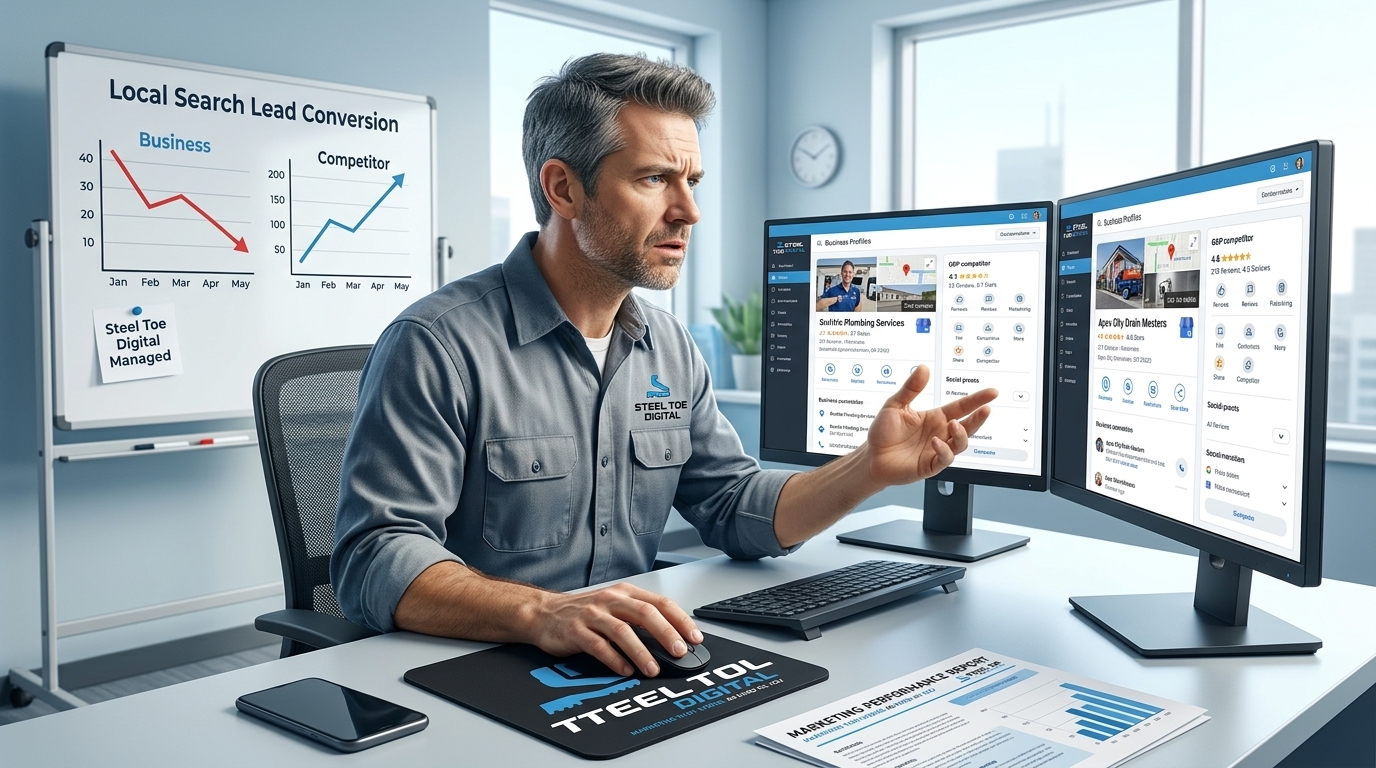
Someone in your city just searched “plumber near me.” They saw two results: one with 4.9 stars and 180 reviews, and one with 3.7 stars and 22 reviews. They didn’t read a single word of either profile. They called the first one.
Google reviews for plumbers aren’t a nice-to-have. They’re a ranking factor and a conversion tool at the same time. Most plumbers sit between 20 and 50 reviews and wonder why a competitor with half their experience keeps getting the call. The answer is almost always reviews.
This post is about building a system. Not asking once when you remember. A system that runs after every job and compounds over time.
Why Google Reviews Matter More for Plumbers Than Most Trades
People don’t vet their plumber the way they vet a contractor for a $50,000 addition. The pipe is leaking right now. The toilet is overflowing right now. The decision happens in about 30 seconds.
In that window, reviews do all the selling. The customer has no time to read your website, check your license, or call your references. They look at your star rating and your review count, and they call.
There’s also the ranking side. Google’s local algorithm weighs review quantity and rating directly. A plumber with 150 reviews at 4.8 stars will consistently outrank a competitor with 30 reviews at 5.0 stars in most markets. More reviews, more recency, higher rating: all of it pushes you up the map.
If you want to understand how reviews fit into the bigger SEO picture, our guide to local SEO for plumbers covers the full ranking system.
The Right Time to Ask Is Immediately After the Job
Most plumbers ask too late. The job closes, the tech drives away, and two days later someone sends a review request email that lands under three promotional messages and a bill.
The window for getting a review is about 60 minutes after job completion. The customer just watched your tech fix the problem. They’re relieved. They’re satisfied. They’re thinking about you right now.
That’s the moment. Not tomorrow. Not after they’ve moved on to the next thing.
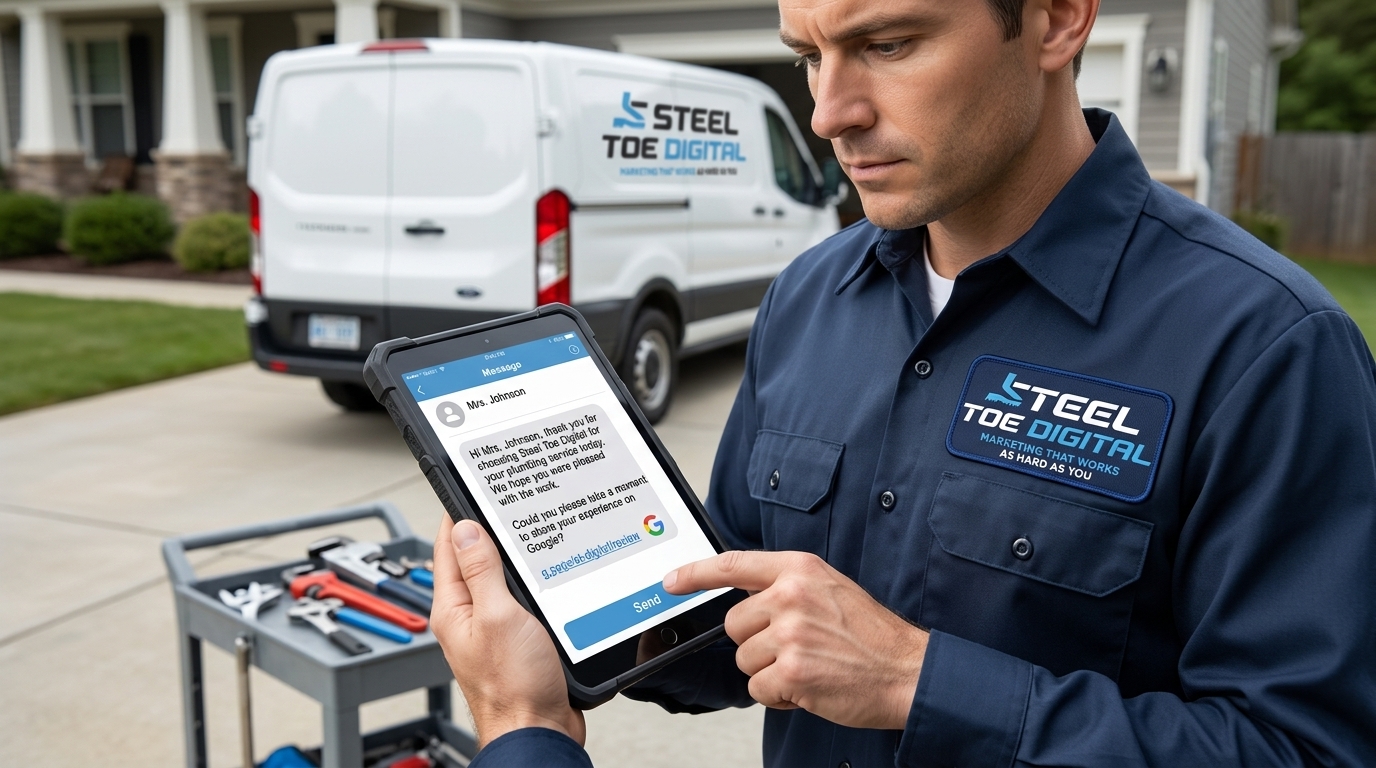
The fastest method: your tech sends a personal text from their own phone before they leave the driveway. No app needed. Just a direct message with the Google review link. “Hey, it was great working with you today. If you have a minute, here’s a link to leave us a review: [link]. It really helps us out.” That’s it. No formal language. No corporate tone.
If your tech isn’t comfortable doing that, set up an automated text to fire within 60 minutes of job close. More on the tools for that below.
How to Create Your Google Review Link
Go to your Google Business Profile, click “Get more reviews,” and copy the link. That’s the version to use.
If you want to build it manually: https://search.google.com/local/writereview?placeid=[your-place-id]. Find your Place ID through Google’s Place ID Finder. Copy it once, save it, and use it everywhere.
The link needs to be one tap. If the customer has to search for your business, find the right location, and figure out where to click, most of them will quit halfway through. Remove every step between them and the review box.
Use a URL shortener to clean up the link. Add it to your tech’s phone as a contact note they can paste. Put a QR code in your invoice or on a card your tech leaves behind. Make it as easy as clicking a button.
The 3-Touch Review System
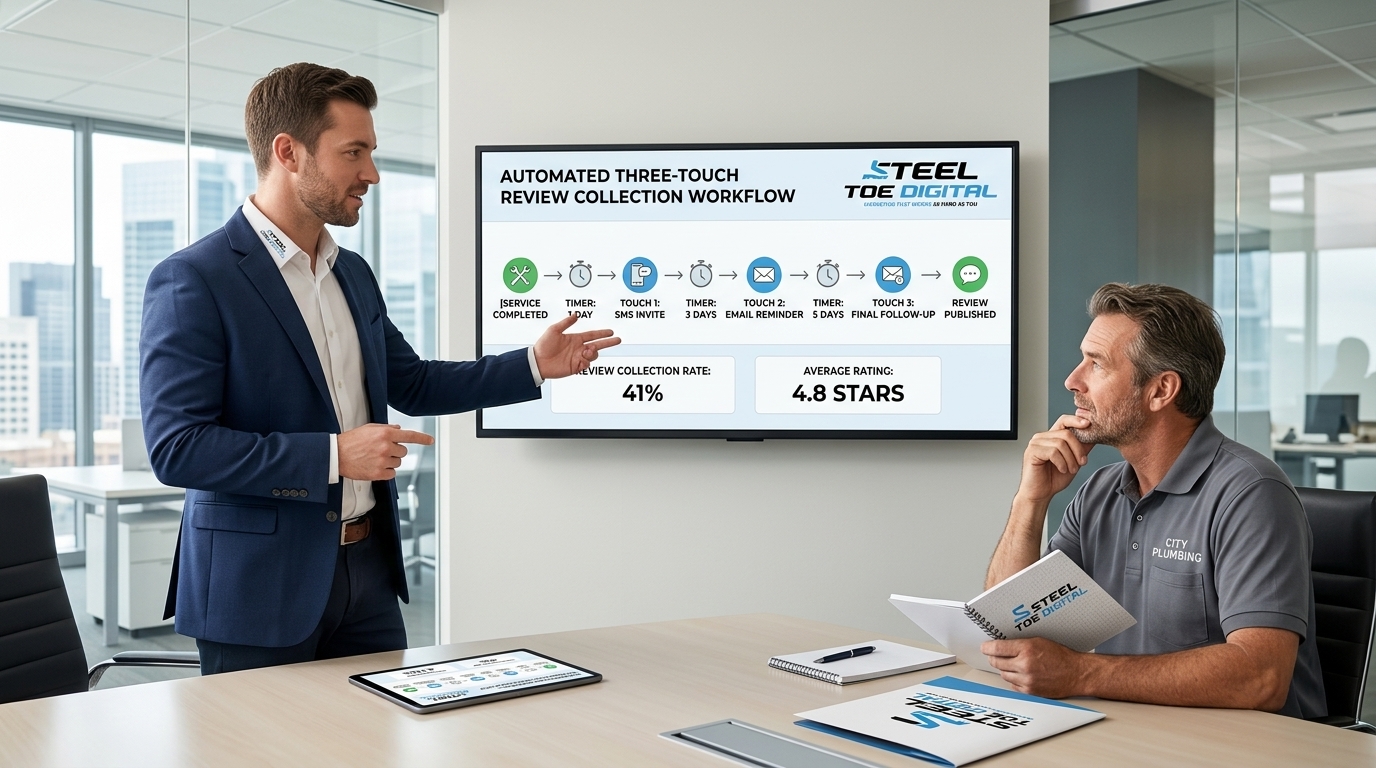
One ask isn’t enough. Three is the right number. More than three and you’re burning the relationship.
Touch 1: Text at job close (within 1 hour). Direct link. Short message. Personal tone. This is your best shot and it should go out before the tech is back on the highway.
Touch 2: Email at 24 hours (if no review yet). A brief thank-you note with the review link included. Not a formal request. Just a follow-up that feels natural. “Thanks again for having us out yesterday. If you have a moment, we’d love to hear about your experience: [link].”
Touch 3: Text at 72 hours (last touch). “We noticed you hadn’t had a chance yet. No pressure at all, but if you get a minute, here’s the link: [link]. It really helps small businesses like ours.” This one is the lowest pressure of the three and often converts people who meant to do it and forgot.
After three touches, stop. You’ve asked. If they don’t review, they don’t review. Pushing past three damages the relationship and, depending on frequency, can come across as spam.
Tools That Automate the Follow-Up
You don’t need to manage this manually. There are tools built specifically for this, and most of them integrate directly with the field service software you’re already using.
NiceJob integrates with Jobber, ServiceTitan, and Housecall Pro. It runs the sequence automatically after job close and routes customers to Google by default. Pricing runs around $75-$175 per month depending on your plan.
Podium is SMS-first and built for local businesses. It has strong conversion rates on review requests and also handles customer messaging in one inbox. Runs $200-$400 per month at the tier most service companies use.
Grade.us handles multi-platform review management and is useful if you want to track reviews across Google, Yelp, Facebook, and BBB in one place. Around $110-$200 per month.
Jobber and ServiceTitan both have review automation built into higher-tier plans. If you’re already paying for one of those platforms, check your plan before adding a separate tool.
The ROI math is simple. If a tool costs $150 per month and it produces 4 extra reviews per month, you’ve paid $37.50 per review. Two of those reviews convert a new job. At a $450 average ticket, you’ve returned 6x on the spend. That’s not a marketing expense. That’s a machine.
Our plumber marketing guide covers how review tools fit into a broader marketing stack if you want to see how it all connects.
How to Handle Negative Reviews Without Making It Worse
Every plumbing company gets a bad review eventually. What matters is how you respond.
Respond within 24 hours. Every single time. The person who left the review may not care. But every future customer who finds your profile will read that response. Your job is to speak to them, not the person who complained.
The formula: acknowledge the experience, take responsibility without arguing the facts, offer to make it right offline. “We’re sorry to hear your experience fell short of what we aim for. We’d like the opportunity to make it right. Please call us at [number] and ask for [name] directly.” That’s the whole response.
Do not argue. Do not point out what the customer got wrong. Do not explain your side in a public review response. It never works and it reads as defensive to everyone watching.
If the review is fake or violates Google’s policies, you can flag it for removal through your Google Business Profile dashboard. Google won’t remove it just because it’s negative, but reviews that contain false claims, use competitor names, or violate their content policies can be flagged and reviewed. It’s not guaranteed, but it’s worth doing.
The bigger lesson: a plumber with 150 reviews and one 2-star review with a professional response is more trustworthy than a plumber with 40 reviews and a perfect score. Real businesses get complaints. How you handle them is what people are actually evaluating.
Reviews on Other Platforms
Google is the priority. But other platforms still matter for specific audiences.
Yelp has strict rules about not soliciting reviews directly. Don’t ask customers to leave you a Yelp review. What you can do: make sure your Yelp page is fully built out, has accurate information, and has photos. Customers who find you on Yelp organically and have a good experience will often leave reviews on their own.
Facebook is worth asking about explicitly in your follow-up. Older homeowners use Facebook more than Google for local service research. A quick “If you’re on Facebook, we’d love a review there too” in your follow-up text covers this without extra work.
Angi reviews matter if you’re running leads through that platform. They show in your Angi profile and affect how prominently you’re featured. If you’re paying per lead on Angi, clean up your profile and make sure your review count is competitive with the others in your category.
BBB still gets traffic from homeowners in the 50+ demographic. If your profile exists, keep it updated. A pattern of negative BBB complaints with no responses will cost you jobs even if your Google reviews are strong.
Review Velocity: Why Consistency Beats Bursts
Getting 80 reviews in a month after running a campaign looks suspicious to Google’s algorithm. A steady 4-6 new reviews per month for 18 months is a much stronger signal.
Google is looking for ongoing customer interaction as a sign that your business is active and legitimate. A business that collected 300 reviews in 2021 and hasn’t had a new one since looks dormant, even if the rating is high. Recency matters.
This is why a system beats a campaign. You don’t want to push hard for reviews once, hit a number, and stop. You want a low-friction process that produces reviews after every job, indefinitely.
Even when you reach 200 or 300 reviews, keep the system running. The companies that stay at the top of Google Maps in competitive markets are the ones that collect reviews consistently for years, not the ones that hit a target and coasted.
For the full breakdown of how reviews interact with your local rankings, see our plumber SEO guide.
FAQ
Can I ask customers for Google reviews?
Yes. Google explicitly allows businesses to ask customers for reviews. What you cannot do is offer payment, discounts, or anything of value in exchange for a review. You also cannot ask only happy customers: you have to make review requests available to all customers, not just the ones you think will rate you well.
What if someone leaves a fake negative review?
Flag it through your Google Business Profile. Go to your reviews, find the review, click the three dots, and select “Flag as inappropriate.” Google will investigate reviews flagged for policy violations. The process can take several weeks, and removal isn’t guaranteed, but it’s your best option. A polite, professional public response is also worth writing in the meantime.
How many Google reviews do I need to rank in the local pack?
It depends on your market. In a smaller city or suburban area, 50-80 reviews at a 4.5+ rating can put you in the top 3. In a competitive metro area, you may need 150 or more to compete with entrenched players. Review count is one factor. Your Google Business Profile completeness, review recency, and website authority all play a role too.
Can I respond to my own Google reviews?
Yes, and you should. Responding to positive reviews shows you’re engaged and appreciates customers. Responding to negative reviews shows future customers how you handle problems. Both matter. Responses also signal to Google that your business is active.
Should I offer a discount in exchange for a review?
No. Google prohibits incentivizing reviews, and so does the FTC. If a customer leaves a review because you gave them $20 off their next service call, that’s a violation of Google’s review policies. It can get your reviews removed and your profile penalized. Just ask. Most satisfied customers will help if you make it easy.
50 Reviews. 100 Reviews. 200 Reviews. Let’s Get You There.
A review system that runs after every job is one of the highest-ROI things a plumbing company can build. SteelToe Digital sets it up and shows you how to keep it running without adding anything to your plate.
If you want to see what your current review profile looks like compared to your top competitors, let’s take a look.
No pitch. No contract. Just an honest look at where you stand.
Related reading: Plumber SEO: How to Rank Higher on Google | Plumber Marketing: The Full Playbook | Local SEO for Plumbers