The best tree service in your market isn’t necessarily the one getting the most calls. The one with the best marketing is.
That’s a frustrating truth for companies that have spent a decade building a real reputation. You do great work. Your crews show up. Your customers are happy. But a company that’s been around for three years with a polished Google profile and 200 reviews is getting the call before you do.
This guide covers every marketing channel that works for tree services in 2026: what drives calls, what drives jobs, and what’s worth your money versus what’s a waste of it. We’ll rank them by ROI so you can build in the right order.
How Customers Find Tree Services in 2026
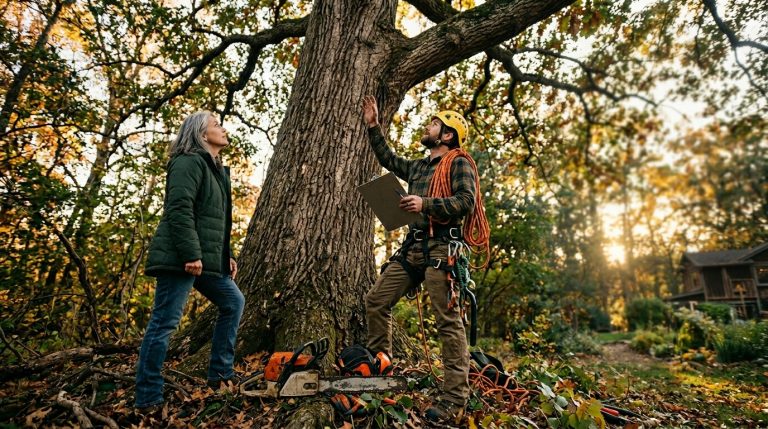
Most tree service calls start the same way. Someone looks outside, sees a dead limb over the roof, and picks up their phone.
They open Google Maps. They look at the first three results. They read a few reviews. They call the one that looks trustworthy.
That’s the full decision path for most residential tree work. Google Maps drives the majority of new customer calls for tree services. Referrals and Nextdoor are second. Angi and similar lead platforms are a distant third, and they share your lead with three other companies the moment you pay for it.
The other thing customers are evaluating: trust. You’re not fixing a faucet. You’re bringing chainsaws within 20 feet of someone’s house, their car, and their power lines. Homeowners are making a safety decision as much as a price decision. Your marketing either builds that trust or it doesn’t. There is no neutral.
The opportunity here is real. Most tree service companies still rely almost entirely on word of mouth. That’s a ceiling. The companies pulling away from the pack right now are the ones building systems that generate calls without waiting for someone to refer them.
Channel 1: Local SEO (Your Compounding Lead Machine)
Local SEO is the highest-ROI marketing channel available to a tree service company. It’s also the one that takes the longest to build and the one most companies underinvest in.
Here’s what it actually means: when someone in your service area searches “tree removal near me” or “tree trimming [your city],” you show up in the Google Maps 3-pack. That spot generates calls every day without a cost-per-click attached to it.
The three things that drive local SEO results for tree services:
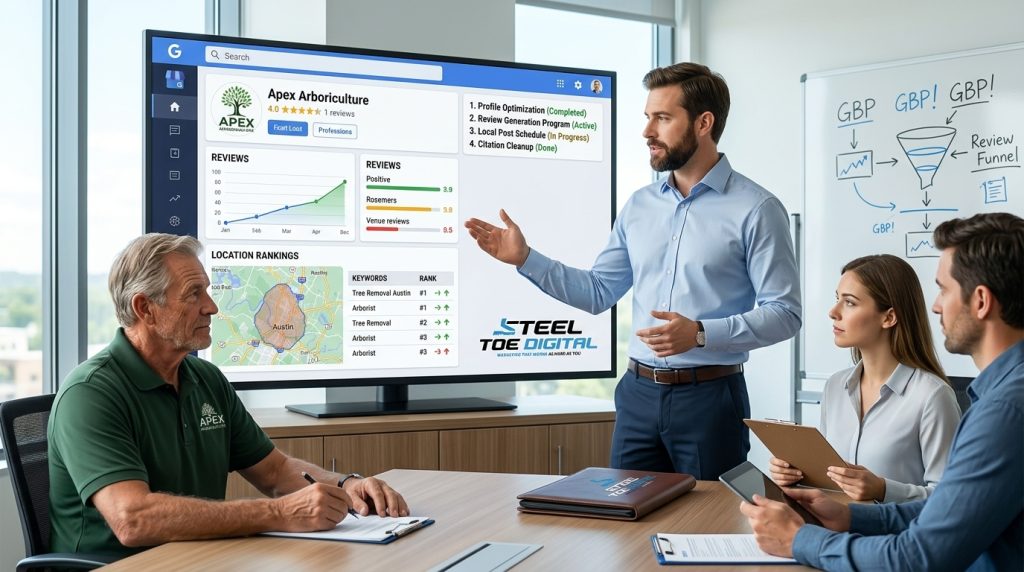
Your Google Business Profile. This is where most of your calls will come from before your website ever ranks. Your GBP needs to be fully built out: every service listed, photos of real job sites, hours, service areas, and a response to every review. Google uses it as a primary signal for local rankings.
Reviews. Volume and recency both matter. A company with 150 reviews at 4.7 stars beats one with 40 reviews at 4.9 almost every time. Two new reviews per month is the minimum to stay competitive. The companies that dominate their markets are getting 5-10 per month through automated systems.
Service and location pages on your website. A page for tree removal, a page for tree trimming, a page for stump grinding, a page for emergency service, and if applicable, a page for land clearing. Then location pages for your core service areas. This is how you rank for specific searches that are ready to book.
Timeline: most tree service companies see meaningful local ranking movement between months 3 and 6 with consistent execution. Full market dominance in a competitive area takes 9-18 months.
For a full breakdown of what drives rankings for tree service companies, see our guide to tree service SEO.
Channel 2: Google Local Services Ads
Google Local Services Ads (LSAs) are the pay-per-lead product that sits above regular Google Ads in search results. They work differently from standard PPC: you pay per lead, not per click, and the Google Guaranteed badge comes with the listing.
For tree services, that badge matters more than it does in most trades. The safety and trust factor that drives customer decisions is exactly what the Google Guaranteed badge signals. It tells the customer Google has vetted your business: license verified, background check cleared, insurance confirmed
The math on LSAs for tree services:
- Cost per lead: $30-$80 in most markets, depending on service type and competition
- Budget to start: $500-$1,000/month for steady volume in a mid-sized market
- Busy markets (major metros): $1,500-$2,500/month to compete
LSAs are not a set-it-and-forget-it product. Your ranking within LSAs is driven by review score, responsiveness, and dispute rate. Companies that respond to leads fast and maintain high ratings climb the ranking. Companies that let leads sit go to the bottom.
For a deeper comparison of how Google Ads and LSAs work together for tree services, see our guide to Google Ads for tree service companies.
Channel 3: Your Website
Your website does two jobs. It converts traffic that comes from every other channel. And it ranks in Google for service-specific and location-specific searches.
Most tree service websites fail at both.
The things your site needs that most tree service sites are missing:
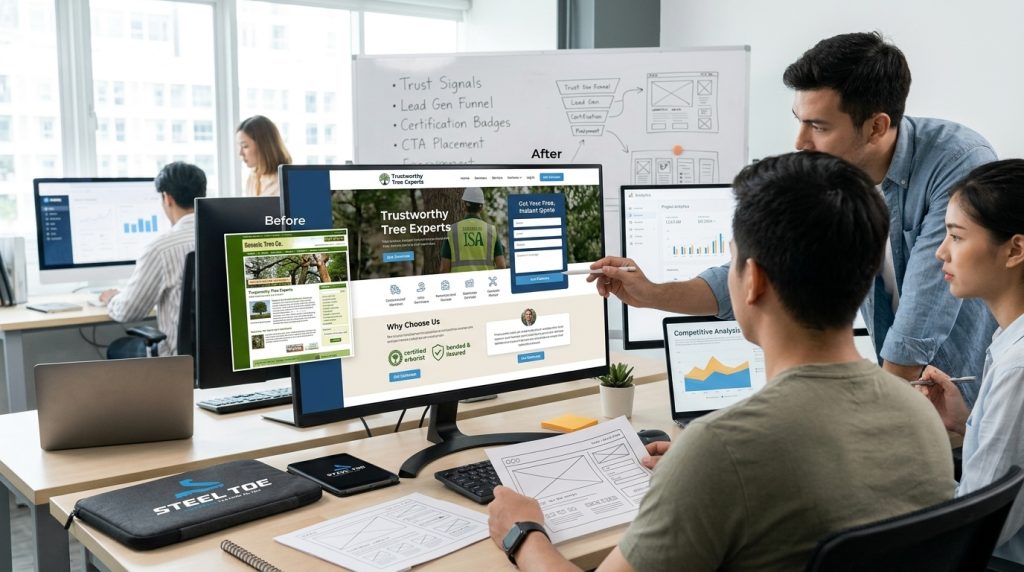
ISA certification. If you have an ISA-certified arborist on your team, that certification needs to be on your homepage, your about page, and every service page. Most homeowners don’t know what ISA means before they find your site. By the time they leave, they should know it means you’re not a crew with a saw and a pickup truck.
Liability insurance callout. Make it visible. “$2 million in liability coverage” is a headline, not a footnote. This is a direct response to the safety objection that’s running through every potential customer’s head.
Before/after photo gallery. Real jobs, real results. Not stock photos. If you’ve done a dramatic removal or a complex trimming job, show it. Customers are making a visual decision about your work before they call.
Emergency service CTA. A call-to-action for emergency work needs to be on every page. “Storm damage? We answer 24/7.” That line, with a phone number, should be visible without scrolling on mobile.
Individual service pages. One page for tree removal. One for tree trimming. One for stump grinding. One for emergency services. One for land clearing if you offer it. Each page should be 600-1,000 words built around a specific keyword and specific customer question.
For a complete breakdown of what a high-converting tree service website needs, see our guide to tree service website design.
Channel 4: Reviews and Reputation
Reviews are both a trust signal and a ranking factor. They do double duty.
Here’s the threshold that matters: 100 reviews at 4.8 stars or above makes you nearly unbeatable in most markets. Not because Google rewards 100 reviews specifically, but because a competitor who shows up with 23 reviews next to your 110 reviews loses the trust decision before the customer even reads what you do.
Most tree service companies have 20-40 Google reviews. That’s a low bar to clear.
The companies that reach 100+ reviews aren’t doing it by remembering to ask. They’re using automated follow-up: a text message that goes out 24-48 hours after a job is complete, with a direct link to your Google review page. Tools like NiceJob and Podium connect to your scheduling software and send that message automatically.
At two new reviews per month, you’re staying even. At five per month, you’re climbing. At ten per month, you’re pulling away from competitors who aren’t running any system at all.
One more thing: respond to every review. The response is public. A thoughtful response to a 2-star review tells the next customer reading it more about your company than the review itself.

Channel 5: Nextdoor
Nextdoor is one of the most underused marketing channels for tree service companies.
Here’s why it works: neighbors recommend services to each other constantly on Nextdoor. After a storm, after seeing a neighbor’s tree get taken down, after spotting a problem with their own trees, people post and ask for recommendations. Those posts drive real calls.
The companies that win on Nextdoor aren’t paying for visibility. They’re the ones that showed up before the storm, engaged with the community, and got mentioned when someone asked.
What an active Nextdoor presence looks like in practice:
- Claim your business page and keep it current
- Set up alerts for posts that mention tree work, storm damage, or yard questions in your coverage area
- Respond fast when someone asks for a tree service recommendation
- After a big job, ask the homeowner to mention you on Nextdoor if they’re happy with the work
The window before storm season is when this investment pays off. If your name is already in the community, it comes up when neighbors ask after the storm. If you’re not there yet, you’re not in the conversation.
Channel 6: Storm Response Marketing
Storm response is the most underused growth lever in tree service marketing. And it has a narrow window.
When a significant storm hits your area, a specific set of things happen in sequence. Trees come down. Homeowners start calling. The search volume for “emergency tree removal” spikes. The window for maximum response is 48-96 hours.
The companies that build a storm response protocol in advance capture a disproportionate share of that demand. The ones that don’t scramble to keep up with their regular schedule while leads go somewhere else.
A storm response marketing playbook:
Facebook and Instagram ads to affected zip codes. Storm damage is visible. Target the areas that got hit, use a simple message (“Storm damage? We’re in your area now.”), and run the ads the same day.
Google Maps ads targeting affected areas. When someone searches “emergency tree removal” post-storm, you need to appear. Increase your LSA and Google Ads budget the moment a major storm is confirmed in the forecast.
Email to your past customer list. “Did last night’s storm cause any damage? We’re running crews in your area this week and have availability.” This is the cheapest lead you can generate. The person who’s already hired you once will call you again before they search Google.
Yard signs at every job. If you’re running 15 jobs in a neighborhood post-storm, put a sign at every one. The neighbors watching you work are your next customers.
Channel 7: Property Manager and HOA Partnerships
Residential one-off jobs pay the bills. Commercial and HOA contracts build the business.
Property managers oversee dozens or hundreds of units. Apartment complexes, commercial properties, condominium associations. Each property has trees. Trees need maintenance, trimming, and occasional removal. A single property manager relationship can generate 4-12 jobs per year on a single property, repeated annually.
HOAs manage common areas with significant tree canopy in many neighborhoods. A contract to maintain the common area trees for an HOA is recurring revenue that doesn’t require any marketing to keep.
How to build these relationships:
Direct outreach. A letter or postcard to property management companies in your area, addressed to the operations or facilities contact. Not a generic flyer. A specific offer: “We handle commercial tree maintenance for properties across [your service area]. Here’s what that looks like and what it costs.”
LinkedIn. Property managers are on LinkedIn. You can find them by company, filter by location, and connect directly. A short message that acknowledges their specific type of property and your experience with similar ones.
Referrals from landscapers. Landscapers who don’t offer tree services regularly need to refer that work somewhere. Build relationships with 3-5 landscaping companies in your area and you’ll see referrals coming both directions.
This channel takes longer to build than any other, but once you have 3-5 commercial or HOA relationships, they become a predictable floor under your revenue.

Offline Marketing for Tree Services
Digital marketing drives most of the growth for tree service companies today. But the offline channels are more effective for tree services than for most trades, because the work is visible.
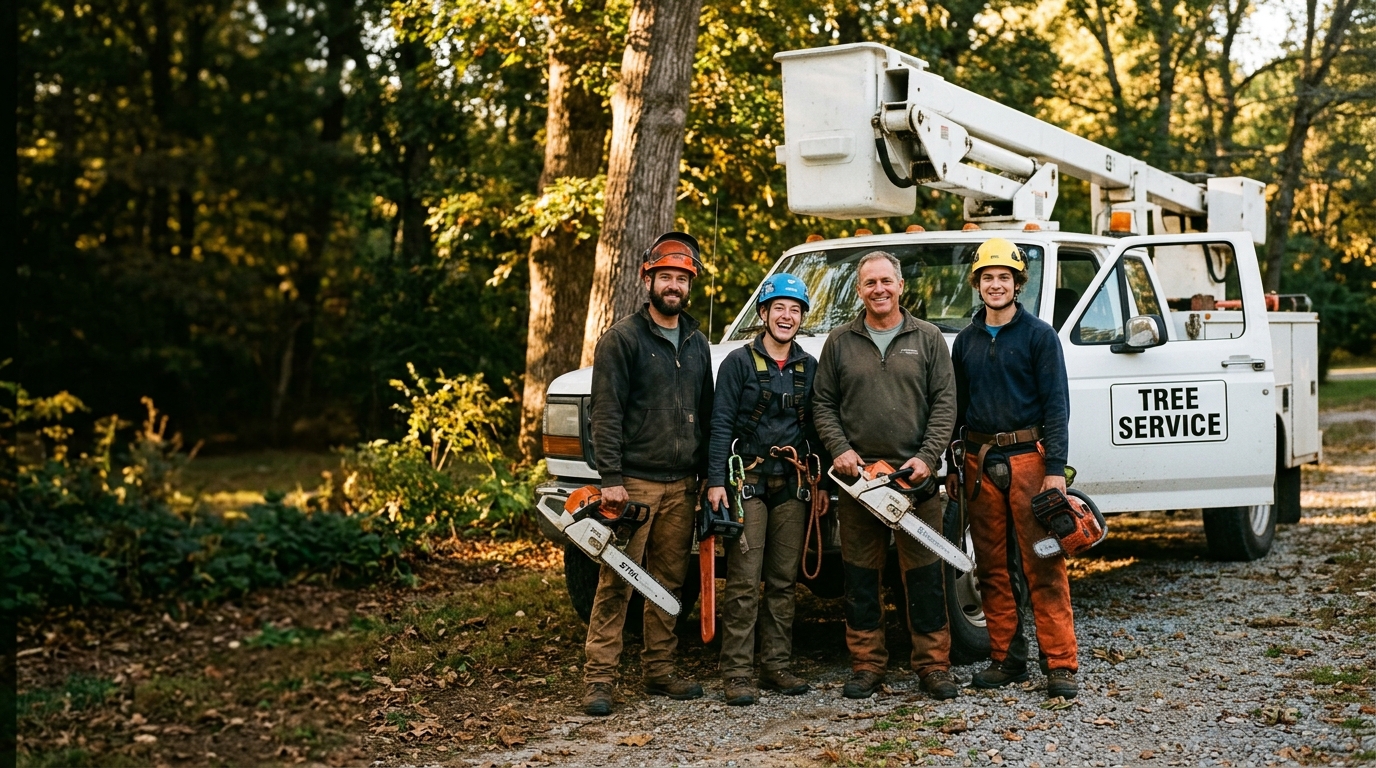
Truck wraps and equipment branding. Every time your crew shows up on a job, you’re advertising to everyone on the street. A well-branded truck and chipper turn every job site into a billboard. The neighbor three houses down who’s been thinking about that oak in their backyard sees your truck and your phone number. That call costs you nothing.
Yard signs after removals. Put a sign at every job site with your name, phone number, and one or two lines about what you do. Ask customers if you can leave it up for a few days. In a neighborhood where you’ve done 10 jobs, you may have 10 signs visible at once.
Canvassing the neighborhood after a big job. When you finish a significant removal, door-knock the four or five houses closest to the job. “We just finished removing the large oak down the street. We noticed you have a couple trees that might need attention. Mind if we take a quick look?” The conversion rate on this is higher than almost any other lead source because the proof of your work is visible from where you’re standing.
Sponsoring local events during peak season. Little league sponsorships, local fair presence, community events. The brand recognition this builds is slow and hard to measure, but in smaller markets it pays off over years.
Tree Service Marketing Budget Guide
Here’s how to think about budget allocation by stage of business:
| Stage | Monthly Budget | Priority |
|---|---|---|
| Starting out (under $400K revenue) | $300-$800 | GBP optimization + reviews + basic website |
| Growing (400K-$1M revenue) | $800-$2,500 | Local SEO + LSAs + yard signs |
| Scaling ($1M+ revenue) | $2,500-$7,000 | Full-channel: SEO + LSA + Google Ads + storm marketing + commercial outreach |
A few caveats that matter more than the numbers:
The right budget depends heavily on your market. A tree service in rural Montana needs different spend than one competing in suburban Houston. Competition level, service area size, and average ticket price all change the math.
Don’t start in the middle. If you’re at the starting stage, spending $2,500/month before your GBP is fully built and you have 50+ reviews is wasted money. Build the foundation first.
Marketing budget should come from revenue, not loans. If you can’t sustain the spend for 6 months without seeing ROI, you’re starting too big.
For a broader look at how marketing spend fits into a contractor’s growth strategy, see our guide to marketing for contractors.
FAQ
How do tree service companies get customers?
Most tree service customers come from Google Maps searches, referrals from past customers, and Nextdoor recommendations. The companies getting the most calls are dominating Google Maps with strong reviews, an optimized Google Business Profile, and local SEO on their website. Word of mouth builds slowly and hits a ceiling. Google Maps scales.
What’s the best marketing channel for a tree service?
For most tree service companies, Google Business Profile and local SEO give the highest return on investment over time because you’re not paying per lead. Google Local Services Ads are the best paid channel because the Google Guaranteed badge directly addresses the safety and trust concerns customers have about bringing crews near their homes. Start with GBP optimization and reviews before spending on ads.
How much should a tree service spend on marketing?
Typical ranges: $300-$800/month at the early stage, $800-$2,500/month for growing companies, and $2,500-$7,000/month for companies actively scaling. These ranges vary by market size and competition. The floor for any serious marketing effort is roughly 5-8% of revenue, but the right number depends on your growth goals, your market, and how much room there is to take share from competitors.
Is Google Ads worth it for a tree service?
Standard Google Ads can be expensive in tree service because the keywords are competitive and cost-per-click can run $15-$40 for removal terms. Google Local Services Ads are a better entry point for most tree service companies because you pay per lead rather than per click, and the Google Guaranteed badge improves conversion. Once your budget supports it, running both LSAs and search ads together captures more of the page.
How do I get more tree service leads?
The fastest path to more leads is fixing your Google Business Profile and starting a review generation system. Most tree service companies have thin GBP listings and under 30 reviews. Getting to 75+ reviews with a fully built-out profile moves you up in the Maps 3-pack, and the phone starts ringing without any ad spend. That’s where to start. See our full guide to tree service leads for a step-by-step breakdown.
Ready to Build a Marketing System That Brings in Work Year-Round?
Seasonal slowdowns are real. But they’re not inevitable. A well-built marketing system fills your pipeline during slow months and pushes volume during busy ones.
SteelToe Digital builds marketing systems for tree service companies that want to grow past referrals and word of mouth. We’ve worked in the trades from the ground up. We know what a full crew schedule looks like and what happens when January hits.
If you want to see where you stand and what it would take to move up, we’ll tell you straight.
Get a Free Strategy Call
No pitch. No contract. Just a clear look at what’s working, what’s not, and what the path forward looks like.