
Most home inspectors get 80% or more of their business from Realtor referrals. That works until one Realtor retires, moves to a new brokerage, or discovers your competitor who shows up faster and sends cleaner reports.
That’s not a future risk. That’s a real vulnerability sitting in your business right now.
This guide covers every marketing channel that gets home inspectors booked: Realtor relationships, local SEO, your website, reviews, Google Ads, content, and email. Not every inspector needs all of them. But every inspector needs more than one.

Why Home Inspection Marketing Is Different From Other Trades
You’re not replacing water heaters. You’re not cleaning ducts. Home inspection is a one-time service per transaction, which means you need a constant flow of new clients to keep your calendar full.
That creates a specific business model problem. The two people who can send you work are the buyer (direct) and the Realtor (referral). Both matter. Both behave differently.
Buyers are increasingly searching Google before asking their agent for a recommendation. A 2024 survey by the National Association of Realtors found that over 40% of recent buyers did at least some of their own research before relying on agent referrals for service providers. That number is higher for first-time buyers who don’t have established agent relationships yet.
Realtors are faster to book and higher in volume, but you have zero control over their decisions. That’s the trade-off. Build both channels or accept that your business runs on someone else’s whim.
Channel 1: Realtor Relationships (Your Foundation)
Realtor referrals still drive the majority of home inspection bookings in most markets. That’s not changing fast. But how you build and maintain those relationships determines whether your name is the first one Realtors mention or the backup they call when their usual inspector is booked.
Most inspectors try to build Realtor relationships by cold-calling offices or dropping off donuts. That works occasionally. These approaches work better:
Offer continuing education presentations. Most states require Realtors to complete CE credits annually. Home inspectors can apply to deliver accredited CE courses on topics like “What Realtors Need to Know About Inspection Reports” or “Common Deal-Killers and How to Spot Them.” You get 45 minutes in front of 20-30 agents who remember your name because you taught them something useful.
Join your local REALTOR Association as an affiliate member. It costs money. It’s worth it. You get access to networking events, committee participation, and the ability to sponsor things that put your name in front of agents regularly.
Send sample reports. Realtors refer inspectors based on one thing: confidence that the report won’t create a problem for the deal. A sample report that’s clearly written, well-organized, and easy to explain to a buyer is a better pitch than anything you’d say in person. Send it with a one-paragraph intro.
Be reliably fast. Realtors will trade a slightly higher price for a faster turnaround and better communication every time. If you can turn a report in 24 hours and send a real-time update when you’re wrapping up, you become the easy choice.
How many Realtor relationships do you actually need? For most solo inspectors running 10-15 inspections a month, 20 active Realtors who send 1-2 referrals per month each is a full schedule. Start there. Then build backup.
Channel 2: Local SEO (The Channel Most Home Inspectors Ignore)
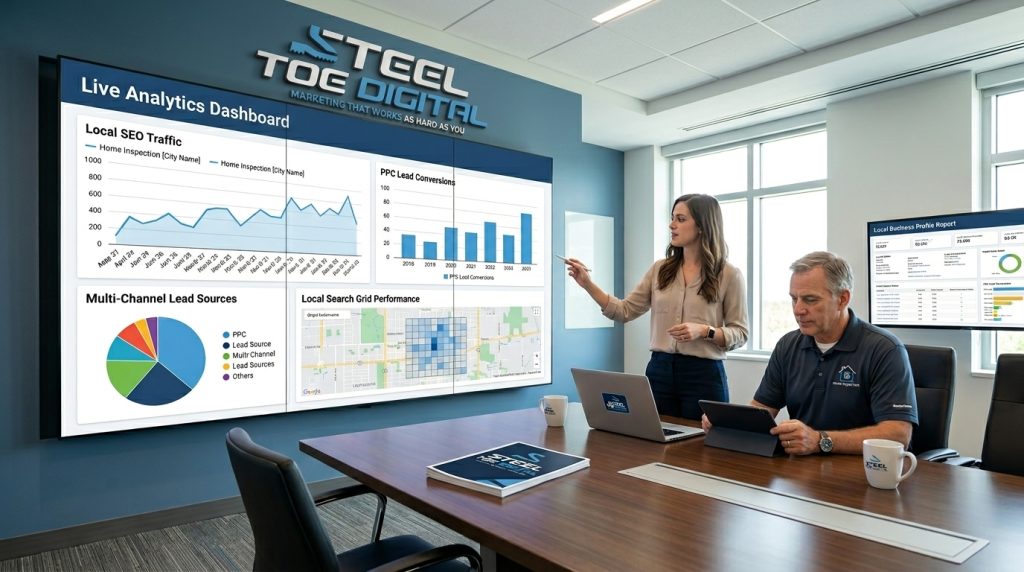
Buyers are searching “home inspector [city]” directly on Google, and that search volume is growing. The companies showing up for those searches are not always the best inspectors. They’re the ones with better local SEO.
Local SEO for home inspectors has one core advantage over most trades: the competition is thin. Most home inspection companies have minimal online presence. That means a focused 6-12 month SEO effort can put a small company on page 1 in mid-size markets without a massive investment.
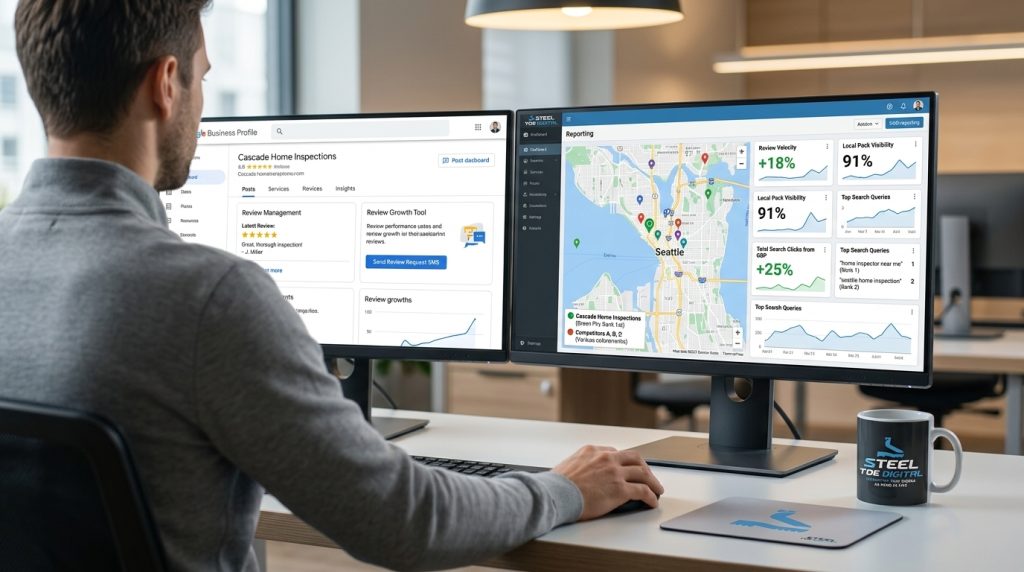
The foundation is your Google Business Profile. It needs to be fully built out: all services listed, photos of your equipment and reports, regular posts, and a steady stream of Google reviews. Without that foundation, none of the other SEO work matters much.
Beyond your profile, the ranking factors that matter most for home inspectors are:
- Reviews: volume and recency
- Website authority: how many credible sites link to yours
- On-page content: does your website clearly describe the services you offer and the cities you cover
For a full breakdown of what local SEO involves and what to expect in terms of timeline and cost, see our complete guide to SEO for home inspectors.
Channel 3: Your Website
Most home inspector websites do one thing: confirm you exist. That’s not enough to convert a buyer who found you on Google at 9pm the night before they want to schedule.
The inspectors who convert website visitors into booked jobs have a few things in common:
Online booking. This is the single biggest conversion differentiator in this industry. Most home inspectors still require a phone call to schedule. Buyers don’t want to call. They want to pick a time slot, pay a deposit, and be done. An online booking system running 24/7 converts at a higher rate than a phone number and a contact form.
A sample report download. Your report is your product. If buyers can see it before they book, they can evaluate the quality of your work before making a decision. A good sample report builds confidence. A bad one reveals a problem you should fix before it costs you business.
Certifications displayed prominently. InterNACHI and ASHI certifications matter to buyers who are doing research. Put them above the fold. Explain what they mean in one sentence.
A clear service list with prices. Buyers want to know what they’re getting and roughly what it costs before they call. Hiding pricing creates friction.
For a detailed breakdown of what a high-converting home inspector website needs, see our guide to home inspector website design.

Channel 4: Reviews (Especially on Google)
A buyer comparing two home inspectors on Google is going to choose the one with more reviews and a higher average rating. That’s not a guess. That’s how buying decisions work when the buyer doesn’t have a personal referral to rely on.
The target for a home inspection company building a strong local presence: 50+ Google reviews at 4.8 stars or higher. That number puts you in a position where skeptical buyers who run a quick search see a clear quality signal.
Getting there requires a system, not a one-time push. After every report delivery, send an automated request for a Google review. Use a short-link that takes the client directly to your review page with one tap. Do this for every single inspection, every time.
Also worth building: Zillow and Yelp profiles with reviews. Buyers often search these platforms independently, especially buyers who found their agent through Zillow. A strong presence on both gives you coverage across the channels buyers actually use.
Channel 5: Google Ads
Google Ads work for home inspectors for one reason: the intent of the searcher. Someone typing “home inspector near me” or “home inspection [city]” is not browsing. They need an inspector, usually within the next few days.
Compared to other trades, home inspection CPCs are relatively low. Expect to pay $15-$45 per click depending on your market, versus $60-$120 for plumbing or HVAC in the same area. That lower cost per click can translate to a cost per lead in the $40-$90 range for well-run campaigns.
Google Local Services Ads (LSAs) are available for home inspectors in most markets. LSAs show at the very top of search results above the regular paid ads. You only pay per call, not per click. The Google Guaranteed badge on your listing signals that Google has verified your business and insurance. For home inspectors willing to go through the verification process, LSAs are worth testing.
The risk with Google Ads is that they require ongoing management. A campaign that isn’t monitored produces wasted spend fast. If you’re going to run ads without a professional managing them, start with a low daily budget ($20-$30/day), focus on your most specific local keywords, and review your search term reports weekly.
For a full walkthrough of how to set up and run profitable campaigns, see our Google Ads guide for home inspectors.
Channel 6: Content Marketing
Most home inspectors don’t have content marketing. That’s an opportunity.
Buyers searching for answers to common questions about home inspections find generic articles from real estate portals. If you publish clear, useful answers on your own website, you can rank for those searches and bring buyers directly to you.
The posts worth writing:
- “What does a home inspector look for?” (high volume, low competition in most markets)
- “How long does a home inspection take?” (same)
- “How much does a home inspection cost in [your city]?” (highly local, low competition, high buyer intent)
These posts serve two purposes. They rank on Google and drive direct traffic. They also give buyers who’ve already found your site a reason to stay longer and trust you more before booking.
YouTube is underused in this industry. A 5-minute video titled “What to expect at your home inspection” costs you one afternoon to film and edit. A buyer who watches that video before booking arrives at the inspection with realistic expectations and already trusting your expertise. That’s a referral more likely to happen after a smooth experience.
Channel 7: Email to Past Clients
Home inspections repeat on a longer cycle than most trades, but they do repeat. Every time a past client buys or sells a home, they need an inspector again. Every time they want a maintenance check, they need an inspector. If you’re not in their inbox occasionally, they’ll search Google and find whoever’s ranking that day.
Two emails per year to your past client list is enough:
The first: a check-in after 18-24 months. “It’s been about two years since we inspected your home. If you’re thinking about selling, or if you want a maintenance inspection before anything becomes a bigger issue, we’d love to help.”
The second: a referral ask. “Know anyone buying or selling this spring? If they need an inspector, we’d appreciate the referral.” Simple. No pitch. No newsletter. Just a real message from a business owner.
Build your list from day one. Every client email address you collect is an asset that costs nothing to maintain.
Home Inspection Marketing Budget Guide
Where you put your dollars depends on what stage your business is in.
| Stage | Monthly Budget | Priority |
|---|---|---|
| Starting (under $500K/yr) | $200-$600 | Google Business Profile + website + Realtor outreach |
| Growing ($500K-$1M/yr) | $600-$1,500 | Local SEO + Google Ads + review automation |
| Scaling (over $1M/yr or multi-inspector) | $1,500-$4,000 | Full channel stack + content marketing + email |
The starting stage is deceptively powerful. A fully built Google Business Profile, 20 solid reviews, and 15 active Realtor relationships built through genuine outreach can fill a solo inspector’s schedule without spending a dollar on ads. Get that working before you spend on anything else.
The growing stage is where most home inspection companies are when they first look at marketing seriously. SEO starts delivering leads in months 4-9 depending on your market. Google Ads fill the gap in the meantime.
The scaling stage makes sense when you have multiple inspectors or want to build the brand asset that makes your business more valuable if you ever sell it. At that point you’re building infrastructure, not just booking jobs.
FAQ
How do home inspectors get more clients?
The fastest path is building relationships with 15-20 active Realtors in your market. Past that, Google Business Profile optimization with steady review generation brings direct search traffic. Google Ads can accelerate lead flow while longer-term channels like SEO are building. Most growing inspection companies use all three simultaneously.
What is the best marketing for home inspectors?
Realtor relationships have the highest volume ceiling in most markets. But they’re also the most fragile channel because you don’t control the referral. The best home inspection marketing combines a strong Realtor network with direct channels: local SEO, Google Ads, and a website that books online. That combination builds stability no single-channel approach can match.
How much should a home inspector spend on marketing?
A solo inspector growing from 5 inspections per week to 10 can do it on $400-$800 per month focused on SEO and review generation, plus time invested in Realtor outreach. Multi-inspector operations typically spend $1,500-$3,500 per month when including paid ads and professional SEO management. The right number depends on your market size, your growth goals, and what your current lead flow looks like.
Is Google Ads worth it for home inspectors?
In most markets, yes. Home inspection CPCs are lower than most trades, and the buyer intent is high. Expect to spend $40-$90 per booked inspection from Google Ads when campaigns are well managed. At a typical average ticket of $350-$500, that math works. LSAs are worth testing first because you only pay per call, not per click. See our full breakdown of Google Ads for home inspectors for specifics.
How do home inspectors compete with larger inspection companies?
Speed, communication, and reviews. Larger companies often have slower turnaround and less personal follow-through. A solo inspector who delivers a detailed report within 24 hours, answers texts same-day, and has 80 five-star Google reviews beats a regional franchise with 10 inspectors and a mediocre online presence in most buyers’ minds. Reviews are the great equalizer in this industry.
Less Referral Dependency. More Booked Inspections.
Your Realtor relationships got you here. Home inspection marketing done right means those relationships are one channel among several, not the only thing standing between you and a slow week.
SteelToe Digital builds marketing systems for home inspection companies that want to grow beyond their Realtor network. We’ll look at where you stand right now: your Google presence, your website, your review count, and what your competitors are doing that you’re not.
Get a Free Strategy Call
No pitch. No contract. Just a clear look at where your leads are coming from and where they could be.