Someone just bought 12 acres outside of town. They need it cleared before the builder breaks ground. They pull out their phone, search “land clearing near me,” and start clicking through the results. They’ll request a quote from whoever looks like they can handle the job.
That’s the decision you’re competing for. And your website either wins it or hands it to someone else.
Land clearing is a high-ticket, visual service. Customers need to see that you have the equipment, the experience, and the crew to handle their project. A generic website that lists a phone number and a few bullet points won’t do it. This post covers exactly what a land clearing website needs to turn visitors into quote requests.
What Visitors Decide in the First 10 Seconds
Before a visitor reads a single word of your copy, they’ve already formed an opinion. If your site looks like it was built in 2015, they assume your operation runs that way too.
The first thing your site needs to answer, fast: Can you handle a job like mine?
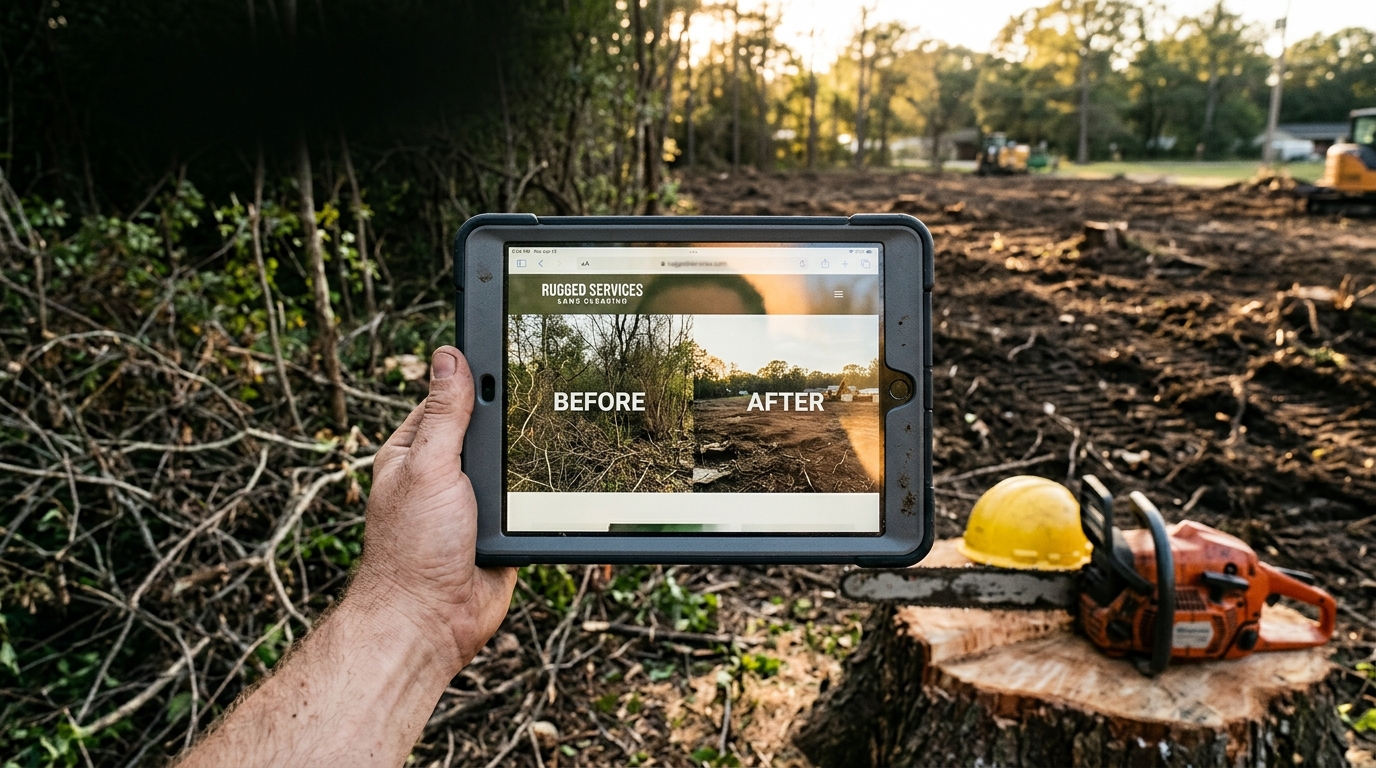
That means your homepage needs to show, not tell. Put a real job photo above the fold. Acreage cleared, equipment on site, the scope of the work. One strong before-and-after image does more than three paragraphs about your commitment to quality.
Below that, make your service area clear. Land clearing customers are not searching nationally. They need someone within a reasonable drive of their property. State the counties or regions you serve in plain language, on the homepage, near the top. If a visitor has to hunt for it, they’re already gone.
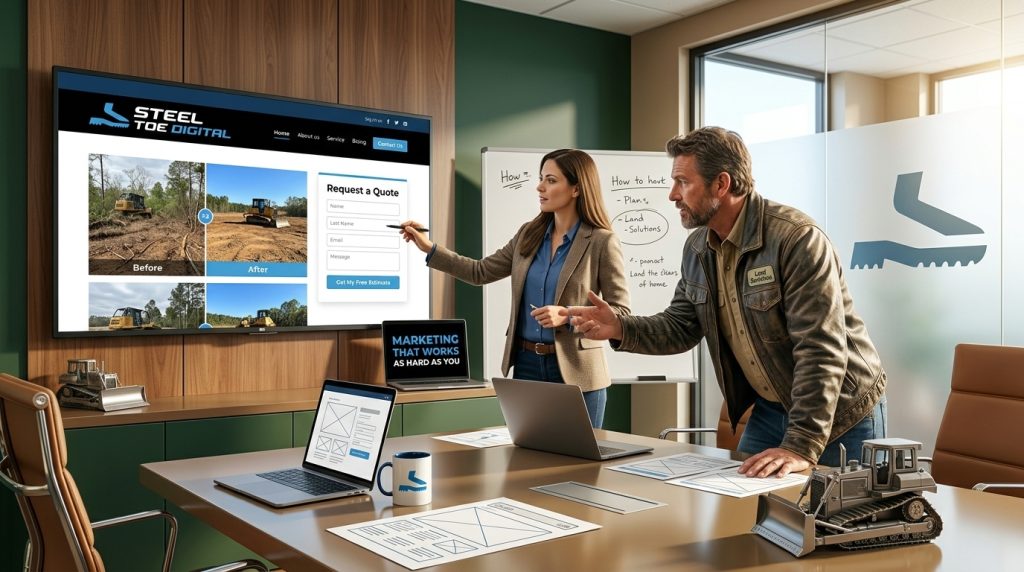
Your primary call to action should be visible without scrolling: a “Get a Free Estimate” button that goes directly to a quote request form. Not a contact page. Not a phone number buried in the footer. A form, built to capture the job details you need to call them back.

The Pages a Land Clearing Website Actually Needs
Most land clearing sites are missing pages that buyers are actively searching for. This matters for SEO because each page targets a different search term. It also matters for conversion because a visitor searching “forestry mulching near me” should land on a page about forestry mulching, not your homepage.
Here’s the full list:
- Home – Equipment, service area, primary CTA
- Land Clearing – Full lot clearing, acreage, scope of work
- Forestry Mulching – Separate page; different buyer intent
- Stump Grinding and Removal – Standalone service
- Brush Clearing – Residential and rural
- Lot Clearing for Construction – Written for builders and developers
- Project Portfolio – Before/after, acreage, project type
- Service Area – Coverage map or counties served
- About – Equipment list, years in business, licensing
- Contact / Request a Quote – Dedicated form page
- Blog – Supports SEO over time
The lot clearing for construction page deserves special attention. Builders and developers are a different buyer than a homeowner clearing a back pasture. They want to know your turnaround time, your ability to stage around active construction, and whether you carry enough insurance to work on a permitted site. Write that page for that buyer specifically.
For more on getting found when builders and homeowners search, see our full guide to land clearing SEO.
Your Portfolio Page Is Your Highest-Converting Asset
Land clearing is one of the most visual trades in the industry. The transformation is dramatic. A wall of trees and brush becomes a buildable lot. Before and after photos are not optional. They are the single strongest conversion tool on your site.
For each portfolio entry, include: acreage, project type, timeline, and whether the client was a homeowner, builder, or developer. That last detail matters more than most people think. A builder looking at your portfolio wants to see builder projects. A homeowner wants to see a residential clearing job that looks like their property.
Drone footage changes the equation entirely. A ground-level photo shows one angle of a job. An aerial shot shows scale. If you don’t have a drone operator, hire one on your next big project. The footage you get from a single job can fuel your website and your social media for months.
Short video walk-throughs of completed clearings also convert well. Sixty seconds of a clean, freshly cleared lot with your equipment in the background does more for trust than any testimonial. It shows you were actually there, doing the work.
The Equipment Page Closes the Sale Before You Pick Up the Phone
Most land clearing companies skip the equipment page. That’s a mistake.
Buyers want to know one thing before they call: can this company handle a job like mine? A homeowner clearing 2 acres has different concerns than a developer who needs 50 acres done in 30 days. Your equipment list answers that question without you having to repeat it on every call.
List what you own with photos. Bulldozers, forestry mulchers, skid steers, stump grinders, dump trucks, grapple trucks. If you have specific brands or machine specs that signal scale, include them. A Fecon mulching head or a Caterpillar D6 tells an experienced buyer something that “heavy equipment” doesn’t.
Put a clear statement about project scale: “Our equipment handles projects from 1 to 200 acres” or whatever your actual range is. Set expectations before the call, and you’ll spend less time on calls that were never going to close.
A Quote Request Form That Doesn’t Kill the Lead
The form on your website is where most land clearing sites lose money. Either there’s no form and visitors have to call, or the form asks for so much information that people abandon it halfway through.
Keep it to six fields:
- Name
- Phone number
- Project type (dropdown: land clearing, forestry mulching, stump grinding, brush clearing, lot prep)
- Approximate acreage (optional)
- County or address
That’s it. You don’t need their life story. You need enough to call them back and have a useful first conversation. The more fields you add, the lower your form completion rate.
Put the form on its own page at /contact or /get-a-quote. Link to it from your header, your homepage hero, and the bottom of every service page. Every page on your site should have a path to that form that takes no more than one click.
Trust Signals That Land Clearing Customers Actually Look For
Land clearing involves heavy equipment operating on someone’s property. That carries real liability. Customers know this. The trust signals that matter for this trade are different from a general contractor or a landscaper.
Show your liability insurance certificate or at least confirm your coverage level on your site. If your state requires a contractor’s license for land clearing, display your license number. These aren’t extras. They’re the baseline for buyers who’ve thought about what happens if something goes wrong.
Beyond insurance and licensing, the trust signals that convert:
- Years in business and total acreage cleared. “18 years in business, over 4,000 acres cleared across three states” is specific. “Experienced company” means nothing.
- Testimonials from both homeowners and builders. These are different buyers with different concerns. Having both signals range.
- Your crew and equipment, with photos. A picture of your actual team, on an actual job site, doing actual work is worth more than a stock photo of a person smiling at a camera.
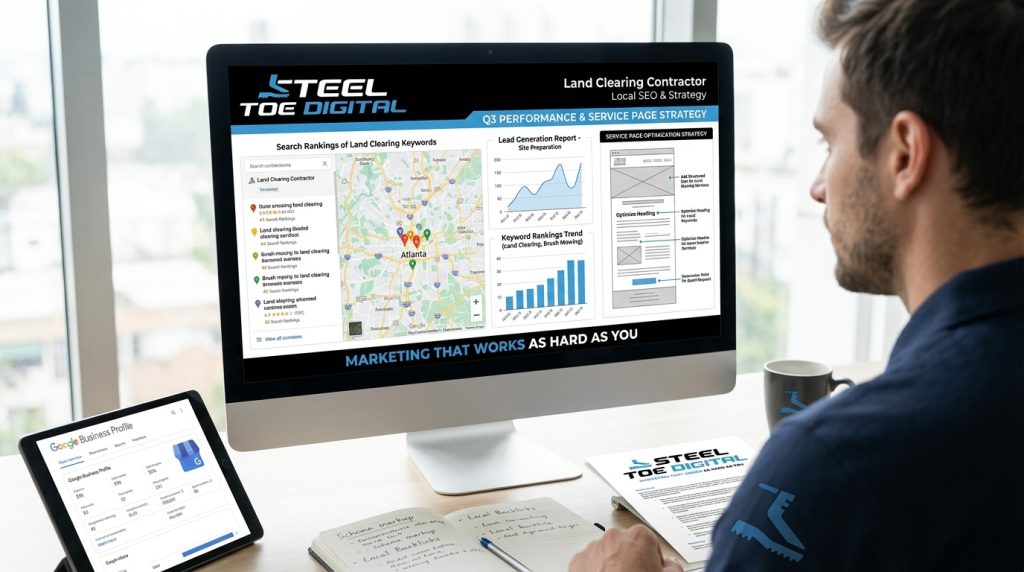
One more thing: Google reviews. If you have under 25 reviews on your Google Business Profile, that’s the first thing to fix before you touch your website. Reviews are trust signals that live outside your site and influence whether you show up in local search at all.
What Your Website Costs to Build (And What Affects the Price)
The range on a land clearing website is wide. A basic brochure site with 5-7 pages runs $2,500-$5,000. A full site with service pages, a portfolio system, SEO optimization, and a working quote form runs $6,000-$12,000. Custom builds with CRM integration and Google Ads landing pages can go higher.
What pushes the price up: number of service pages, portfolio system design, custom photography and video integration, local SEO setup, and whether you want the site built to rank or just built to exist.
A site built to exist costs less upfront and costs you a lot more over time. A site built to rank starts generating quote requests within 3-6 months of launch. That’s the difference between a website as an expense and a website as an engine.
For a broader look at how website design fits into the full marketing picture for home service companies, see our guide on home service website design.
Frequently Asked Questions
How much does a land clearing website cost?
A functional land clearing website with the core service pages and a quote form typically runs $3,000-$8,000. A site built for local SEO with optimized service pages, a portfolio system, and integration with your Google Business Profile runs $6,000-$12,000. The bigger variable is whether you invest in photography and video, which matters more for this trade than most.
Should I list prices on my land clearing website?
Not exact prices. Land clearing varies too much by acreage, terrain, tree density, and debris disposal requirements to publish a flat rate. You can list a starting price (“Projects start at $2,500 for lots up to 2 acres”) to set expectations and filter out price shoppers who aren’t in your range. This also helps with SEO for cost-related searches.
What pages does a land clearing website need?
At minimum: a homepage, separate pages for each service you offer (land clearing, forestry mulching, stump grinding, brush clearing, lot prep for construction), a portfolio page with before-and-after photos, a service area page, an about page, and a quote request form. If you want to rank in local search, each service gets its own page with its own content, not a single “services” page that lists everything.
How do I get my land clearing website to show up on Google?
Local SEO starts with your Google Business Profile, not your website. Claim it, fill it out completely, and get your first 25 reviews before you invest heavily in the site. Then build your service pages around the search terms your buyers actually use: “land clearing [county],” “forestry mulching near me,” “lot clearing for construction [city].” Each page targets one search. See our full breakdown in the land clearing marketing guide and the land clearing leads guide.
Do I need a separate page for forestry mulching?
Yes. Forestry mulching and land clearing are related services but they attract different searches. Someone searching “forestry mulching near me” is looking for that specific process. If you don’t have a dedicated page for it, you won’t show up for that search. Build a page for every service you offer that people are actively searching for.

A Website Built to Generate Land Clearing Quote Requests
If your current site isn’t filling your quote pipeline, it’s not a design problem. It’s a structure problem. The wrong pages, the wrong photos, no clear path to a form. That’s fixable.
SteelToe Digital builds websites for land clearing companies that rank in local search and convert visitors into real quote requests. We know the trade. We know the buyer. We build the site around both. See our services to find out what that looks like in practice.
Get a Free Website Review
No pitch. No contract. Just a look at what your current site is and isn’t doing.