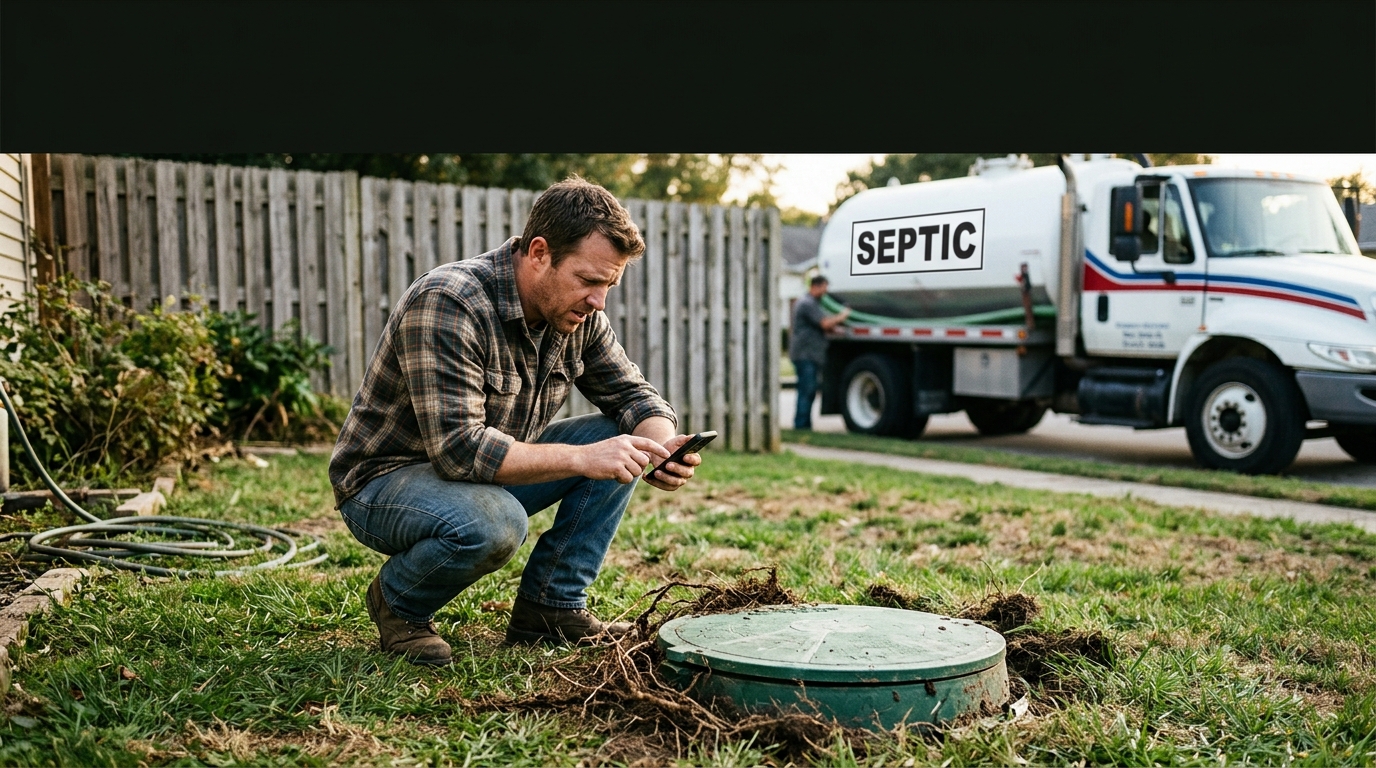
Most septic companies are leaving money on the table with Google Ads. Not because the platform doesn’t work for them. Because they’re either not running it at all, or they set it up once, watched money disappear, and turned it off.
Google Ads works for septic. The CPC is lower than plumbing. The competition is thinner. And the people searching have an immediate problem they need fixed today. That’s the best possible environment for paid search. But there are conditions. If those conditions aren’t met, you’ll burn budget and walk away convinced it doesn’t work. This post covers both sides.
Local Services Ads vs. Search Ads for Septic Companies
There are two ways to pay Google for visibility, and they work differently.
Local Services Ads (LSAs) put you at the very top of the page, above organic results and above regular search ads. You pay per lead, not per click. You also get the Google Guaranteed badge, which signals to the customer that Google has verified your license and insurance. For septic, this matters. People calling about a backed-up system want to know you’re legitimate before they hand over their card.
The LSA process requires a background check, license verification, and insurance documentation. It takes 1-3 weeks to get approved. Once you’re in, the cost per lead typically runs $30-$70 for septic pumping and service calls, depending on your market. That’s lower than most plumbing LSA rates, because fewer septic companies are competing for the same slots.
Search Ads give you more control. You choose the keywords, set your bids, write your ad copy, and send clicks to a landing page of your choice. You pay per click, not per lead. The floor for a competitive market is around $5-$15 per click for septic-related terms. Your conversion rate on the landing page determines what you actually pay per lead.
The practical approach: start with LSAs. Lower risk, pay only for actual leads, Google handles fraud filtering. Add Search Ads when you have the budget and bandwidth to manage both. Running them together increases your visibility at the top of the page and gives you data on which keywords drive the best leads.
Best Keywords for Septic Google Ads
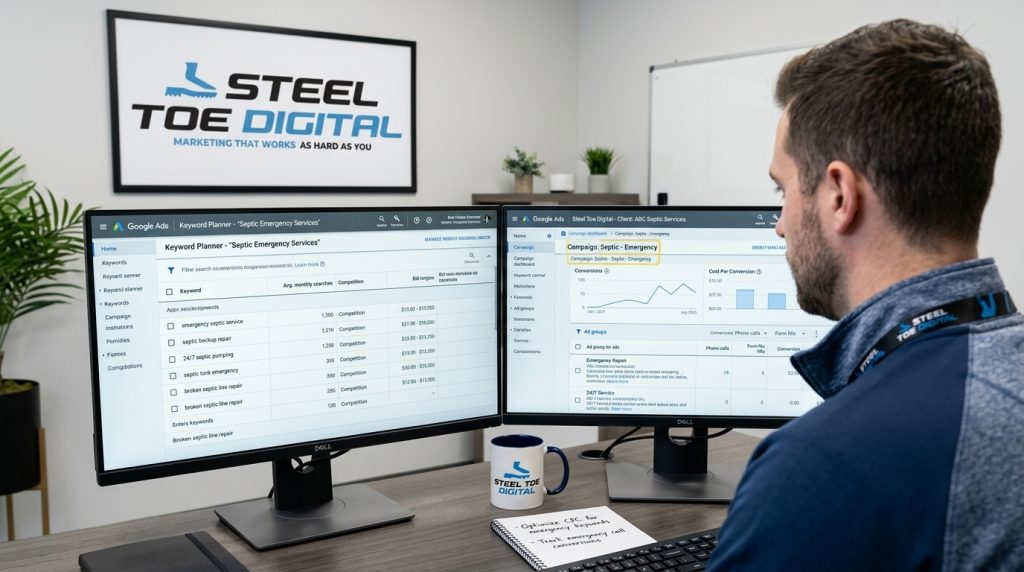
Keyword selection determines whether your budget goes toward real leads or tire-kickers.
High-intent pumping and service calls are your primary targets:
- “septic pumping near me”
- “septic tank pumping [city]”
- “emergency septic service”
- “septic backup”
- “septic tank cleaning [county]”
Installation work targets a longer buying cycle but a much larger ticket:
- “septic system installation [county]”
- “new septic system cost”
- “septic system replacement”
- “perc test [county]”
Negative keywords matter as much as positive ones. Without them, you’ll pay for clicks that will never convert. Add these to every campaign from day one:
- “septic jobs” / “septic careers”
- “septic salary”
- “what is a septic tank”
- “septic system DIY”
- “how to pump your own septic”
- “septic tank design plans”
Someone searching “how to pump your own septic” is not calling you. Someone searching “septic backup emergency” is calling the first person they can reach. Build your campaign around that distinction.
For Search Ads, run phrase match and exact match only. Broad match will spend your budget on searches that have nothing to do with your business. Septic is a small category with a lot of tangential terms. Tight match types protect you.
Septic Google Ads Budget Guide
The right budget depends on your market and what you’re trying to accomplish. These ranges reflect what most septic companies are working with in 2026:
| Market Size | Monthly Budget | Expected Leads |
|---|---|---|
| Rural / small market | $300-$600 | 10-20 leads |
| Mid-size market | $600-$1,500 | 20-50 leads |
| Competitive market | $1,500-$3,000 | 50-100 leads |
A few notes on these numbers. First, they assume your landing page is converting at a reasonable rate (more on that below). A weak landing page will cut your lead volume in half with the same budget. Second, competitive markets vary significantly. If you’re in a densely populated area with five other active septic advertisers, you’ll be toward the high end of cost per click. If you’re the only company running ads in a rural county, your cost per lead will be much lower.
Starting under $300/month is not recommended for Search Ads. You won’t generate enough data to know what’s working, and Google’s algorithm needs time and volume to optimize your campaign. For LSAs, you can start smaller because you’re paying per lead rather than building a click-based campaign.
Give any new campaign 60-90 days before judging performance. The first 30 days are data collection. Optimization happens in months two and three.

ROI Calculation for Septic PPC
Run the math before you decide whether to invest in Google Ads.
The average septic pumping job runs $350-$600. The average new installation runs $5,000-$20,000 depending on system type, soil conditions, and permit requirements. Those two numbers define your acceptable cost per lead.
For pumping and maintenance calls, a cost per lead of $40-$80 makes sense. At a 40% close rate on 20 monthly leads, you’re booking 8 jobs at an average of $450. That’s $3,600 in revenue from $1,200 in ad spend. The ratio is clear.
For installation work, you can tolerate a higher cost per lead because the ticket is much larger. Paying $150-$200 per lead for installation inquiries is still profitable if you close 25-30% of them.
The number that separates a good campaign from a bad one is your close rate on leads. If you’re getting 20 leads a month and booking 1 job, the problem is probably not the ads. It’s the follow-up. Septic calls are often urgent. Someone whose system backed up at 6pm on a Thursday needs to talk to a person, not go to voicemail. If you can’t answer calls quickly, Google Ads will deliver leads you can’t capture.
See how this compares to what you’re currently paying per lead: our full guide to septic leads.
When Google Ads Doesn’t Work for Septic Companies
Paid search gets blamed for failures that usually have nothing to do with the platform. These are the four situations where spending on Google Ads will not produce results.
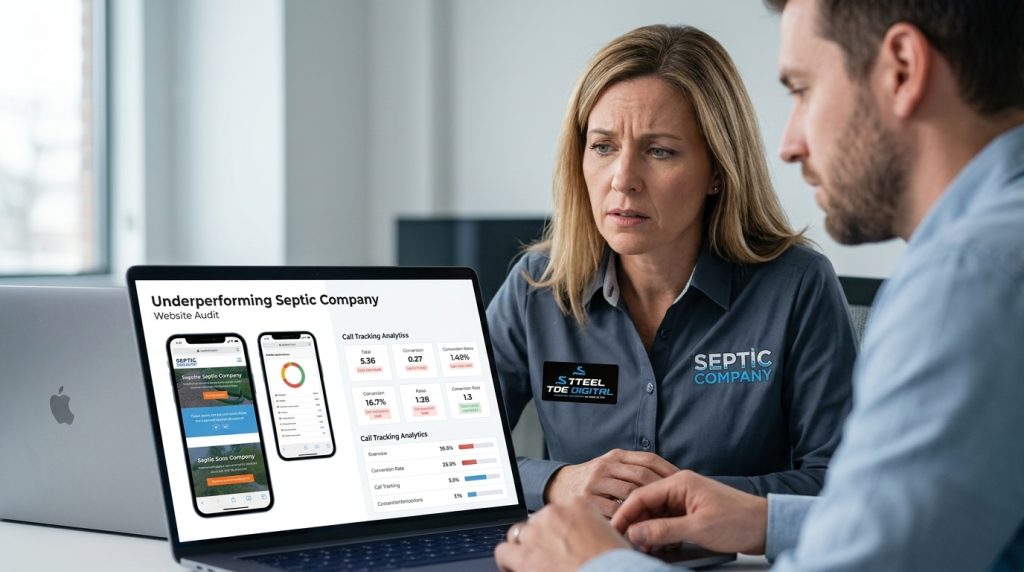
Your website doesn’t convert. Sending clicks to a homepage that loads slowly, looks outdated, and has no clear phone number visible on mobile is burning money. People searching for emergency septic service will click away in 10 seconds if they can’t find your number. You need a dedicated landing page with one goal: get the call. For more on what that page should look like, read our septic company website design guide.
You have no call tracking. If you can’t tell which calls came from Google Ads versus SEO versus Angi versus a yard sign, you can’t measure ROI. Call tracking is not optional for paid search. Google’s own call tracking is free and takes 20 minutes to set up. If you’re not using it, you’re flying blind.
No one answers the phone quickly. Septic emergencies don’t wait. Someone searching “septic backup near me” is already past the patience threshold. If your response time is more than a few hours, your close rate will be poor regardless of lead quality. Google Ads delivers people who want to talk to you now. Your operation has to be able to receive them.
Budget is too low to generate data. Under $200-$300/month, most markets won’t produce enough clicks to know what’s working. You need volume to spot patterns. A $150/month campaign that gets 15 clicks never builds enough signal to improve.
Fix these four things first. Then run ads.
FAQ
How much do Google Ads cost for a septic company?
Cost per click for septic keywords typically runs $5-$15 in most markets. Cost per lead depends on your landing page conversion rate, but most septic companies see $40-$100 per lead for pumping and maintenance calls. Installation leads cost more per lead but produce much larger jobs. Total monthly budgets range from $300-$3,000 depending on market size and goals.
Are Google Ads worth it for a small septic business?
Yes, if the four conditions above are met: a converting website, call tracking, fast phone response, and a budget large enough to generate data. A small rural company running $400-$600/month in a low-competition market often sees very strong ROI because CPC is lower and there are fewer advertisers competing for the same clicks. The key is not comparing yourself to larger markets when setting expectations.
What is Google Guaranteed for septic companies?
Google Guaranteed is the badge that appears on Local Services Ads listings. It tells the customer that Google has verified your business license, insurance, and background check. If a customer is unhappy with a service booked through an LSA listing, Google offers a refund guarantee. For septic companies, getting Google Guaranteed requires submitting license and insurance documentation and passing a background check. The process takes 1-3 weeks. Once you’re verified, the badge significantly increases trust and click-through rates.
Should I run Google Ads or focus on SEO first?
These aren’t competing choices. SEO builds your long-term pipeline. Google Ads produce leads immediately. If you need calls this month, start with LSAs or Search Ads. If you’re building a sustainable business, you need both. The companies that dominate their local markets are typically running Google Ads for immediate volume while their SEO compounds in the background. Read our septic company SEO guide to understand how the two strategies work together.
What’s the biggest mistake septic companies make with Google Ads?
Sending paid traffic to their homepage. The homepage is for people who already know you and want to confirm you’re real. A paid traffic landing page has one job: get the call. Clear headline, phone number above the fold, 3-5 trust signals (Google reviews, years in business, service area), and a single call-to-action. Everything else is distraction.

Want Immediate Septic Leads While Your SEO Builds?
Google Ads can start delivering calls within days of launch, but only if the campaign is set up to convert. SteelToe Digital manages paid search for septic companies that don’t have time to learn ad platforms and can’t afford to waste budget finding out what doesn’t work.
We built our business in the trades. We know what a septic company’s day looks like. We know which keywords book jobs and which ones burn money. For a broader look at how paid search fits into your overall marketing plan, read our septic company marketing guide or see the full range of services we provide at /services.
Get a Free PPC Audit
No pitch. No contract. Just a look at your current setup and what it would take to make it work.