
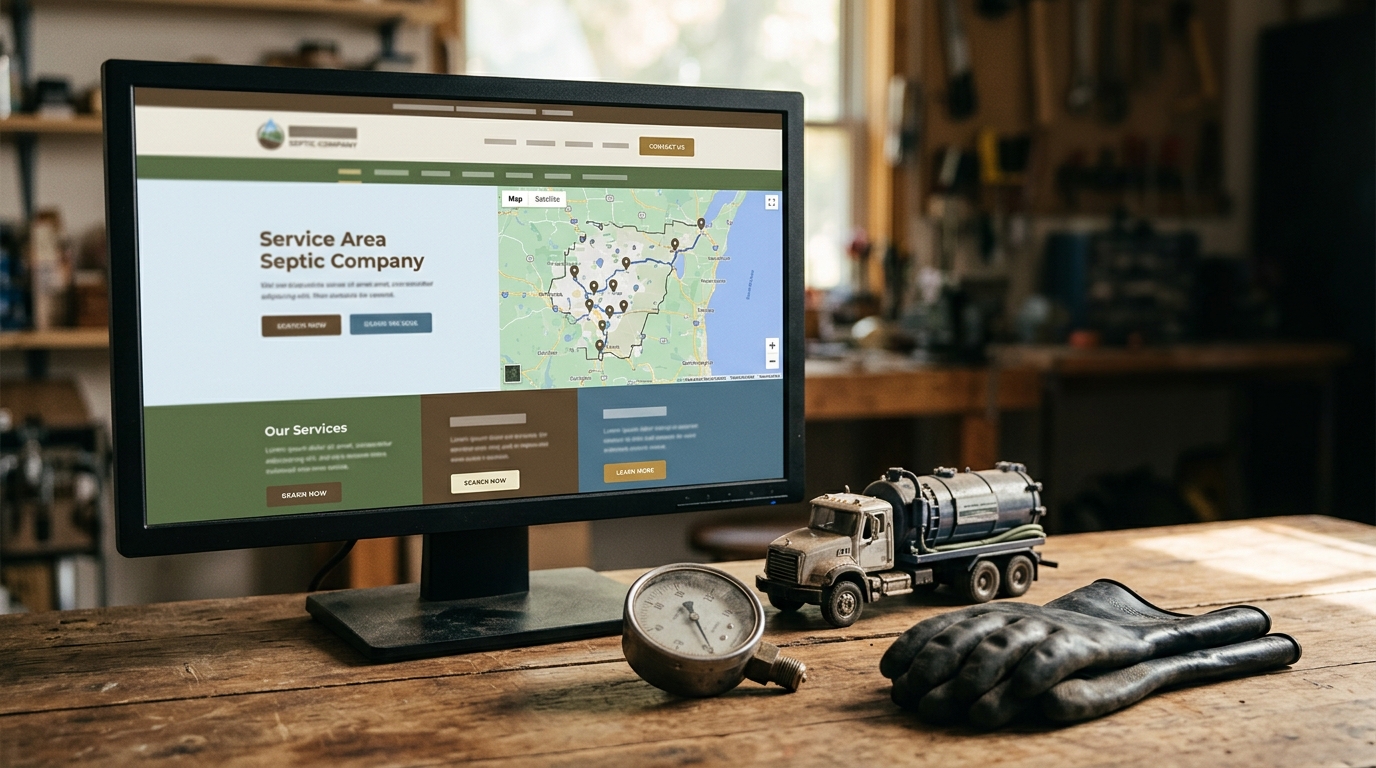
Most homeowners calling a septic company aren’t browsing. Something is wrong. The yard smells. The toilet is backing up. The inspector flagged the system before closing. They’re not comparing options for fun. They need someone they can trust, and they need to reach that person fast.
Your website has about 10 seconds to answer three questions: Do you do what I need? Do you serve where I live? Are you legit? If it doesn’t answer all three immediately, they click back and call your competitor.
That’s the job of a septic company website. Not to look impressive. To convert a stressed visitor into a booked appointment.
Here’s what that actually takes.
What Visitors Need to See the Moment They Land
Before anything else, your homepage has to answer the basics without making anyone scroll.
Phone number at the top. Tap-to-call on mobile. Not buried in a contact page. Not in a footer. At the very top of the screen where a homeowner who’s panicking can find it in under three seconds.
What you do and where you do it. “Septic Pumping, Inspection, and Installation Serving [County], [State]” in the header or the first block of text. If someone has to guess whether you serve their town, they’re gone.
Your state license number. This one matters more for septic than almost any other trade. Homeowners don’t know who’s qualified to touch their system. A displayed license number signals: we’re the real thing. Most competitors skip this. That’s a trust gap you can close in one line of text.
Social proof in the header: your Google rating and review count, years in business, or number of systems serviced. Something concrete. Not “family-owned and dedicated to excellence.” A 4.8 rating with 214 reviews says everything that phrase doesn’t.
Primary CTA button: “Schedule Pumping” or “Request an Inspection.” Not “Learn More.” Not “Explore Our Services.” The action you want them to take, in plain language.
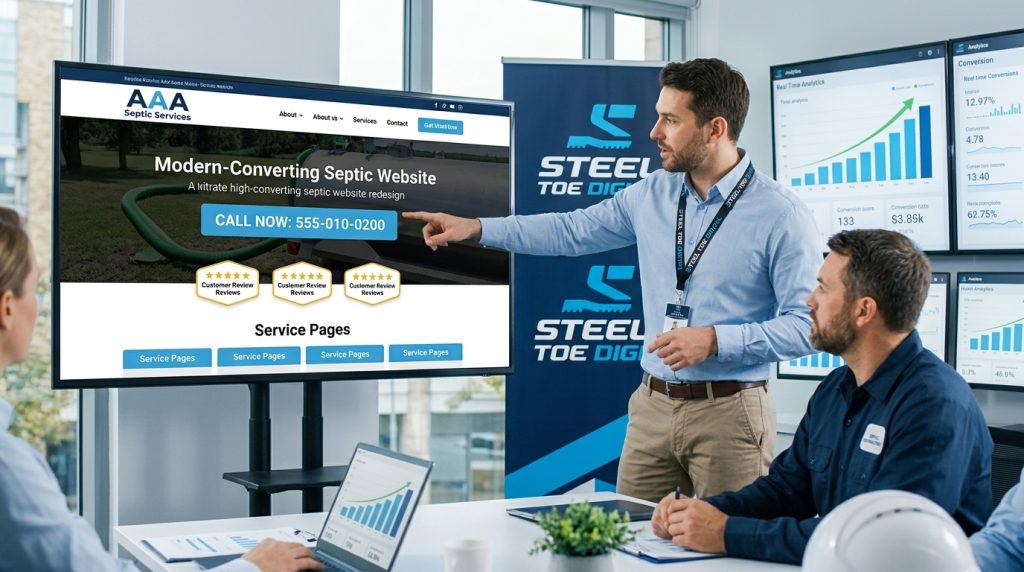
The Pages a Septic Website Actually Needs
A lot of septic websites are one page with a phone number. That’s a business card, not a website. It doesn’t rank. It doesn’t build trust. And it doesn’t give Google anything to work with.
Here’s what a functional septic website needs:
Home: Trust signals, primary CTA, short overview of services, Google reviews.
Septic Pumping: Dedicated page. Your most-searched service deserves its own page.
Septic Inspection: Homebuyers and real estate agents search this constantly. Separate page.
Septic Installation and Repair: High-ticket work. A detailed page here builds confidence for bigger jobs.
Drain Field Services: Drain field problems are often search queries on their own. Page it separately.
Service Area: A list or map of every county and city you serve. This is one of the most important SEO pages on your site and most companies skip it entirely.
About: License number, years in business, owner photo, brief team overview. People want to know who’s coming to their property.
Contact / Schedule Service: Simple form. Name, phone, address, what they need. Five fields max.
Blog: Long-term SEO fuel. Every post is another chance to rank for a question a homeowner is typing into Google. See how this works in our full guide to septic company SEO.
Each of these pages should be easy to find in the navigation. If someone has to hunt for your inspection page, you’ve already lost them.
What Makes a Septic Service Page Actually Convert
A lot of contractors build service pages that read like brochures. “We offer professional septic pumping services using state-of-the-art equipment.” That sentence tells a homeowner nothing useful.
A converting service page is built differently:
H1 with location: “Septic Pumping in [County], [State].” This isn’t just for SEO. It confirms to the visitor in the first second that you serve their area.
Plain-language explanation of the service. What happens during a pump-out? How long does it take? Do they need to be home? Answer the questions a homeowner is already asking in their head before they can type them.
Typical cost range. This is where most septic companies go silent and it costs them jobs. Homeowners who don’t know what to expect call two or three companies to compare. A visible cost range ($250-$500 for a standard pump-out, for example, depending on tank size and access) reduces that anxiety and positions you as the honest operator. It also filters out callers who aren’t your customer.
What to expect on the day. “Our truck arrives within a 2-hour window. We locate and uncover the lid, pump the tank, inspect the baffles, and send you a written report the same day.” That’s the kind of specificity that converts.
FAQ section at the bottom. Two or three questions that homeowners actually ask: how often do I need to pump, what are signs my tank is full, what happens if I ignore it.
Clear CTA. “Schedule a Pump-Out” with a link to the contact form or a phone number. One call to action. Not three.

Trust Signals That Move Septic Customers Off the Fence
Septic work happens on someone’s property, underground, out of sight. Homeowners can’t verify the work afterward the way they might check a paint job or a new light fixture. That’s why trust signals matter more in this trade than in most.
The ones that actually move the needle:
State license number. Displayed in the header or footer. Not buried in a PDF. Front and center.
Insurance. “Fully insured and licensed in [State].” One line. Homeowners who’ve had a bad experience with an unlicensed contractor will notice this immediately.
Google reviews. A live widget showing your current rating and recent reviews. Not a screenshot from 2022. Real, current reviews. If you don’t have a system for generating reviews, that’s a separate problem worth solving. Read how other home service companies build their review base in our septic company marketing guide.
Years in business. “Serving [County] since 2009” means something to a homeowner who’s comparing you to a company that launched last year.
Systems serviced. “Over 3,000 septic systems pumped and inspected across [Region]” is specific enough to be credible. “Thousands of satisfied customers” is not.
Owner photo or team photo. People hire people. A real photo of the person who’s going to show up at their house builds trust a stock image never will.
Your Service Area Page Is More Important Than You Think
Most septic websites don’t have a service area page. They have a line at the bottom of the homepage that says “Serving [County] and surrounding areas.” That’s not enough.
A real service area page lists every city, town, and county you serve. It’s one of the most valuable SEO pages on your site because it tells Google exactly where you work. If someone in a neighboring town searches “septic pumping near me,” a service area page with their city on it is what puts you in the results.
For companies serving multiple counties, consider building individual location pages for your highest-population cities. Each page targets that specific city and drives local rankings for searches in that area. This compounds over time in a way a single homepage never does.
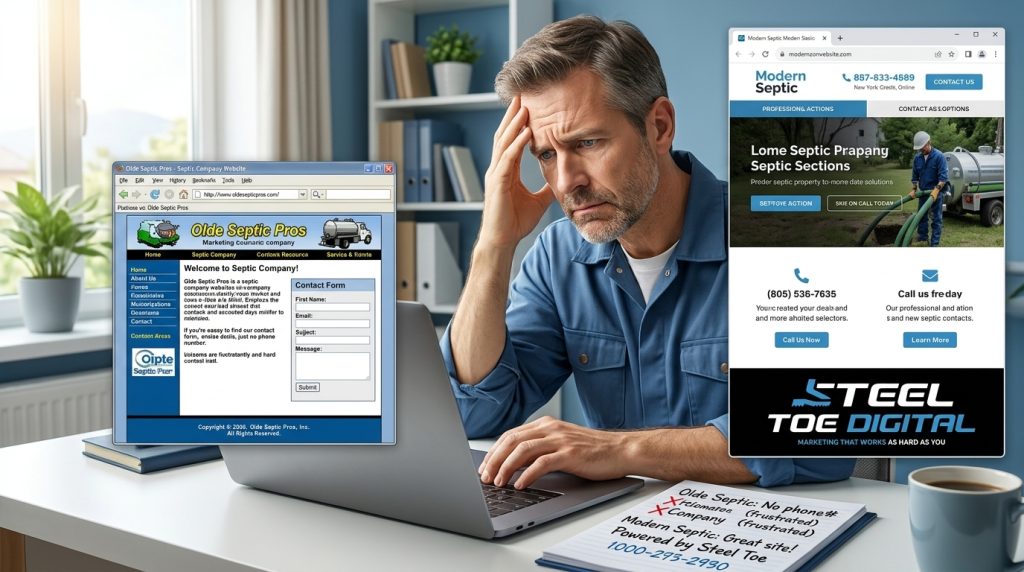
Mobile Is Where Septic Searches Actually Happen
More than 60% of local service searches happen on a phone. For septic, the percentage is probably higher. Nobody sits down at a desktop to research septic companies when their system is acting up. They pull out their phone.
That means:
Tap-to-call in the header. The phone number should be a live link a homeowner can tap once to call. No copying and pasting.
Fast load time. A site that takes 5 seconds to load on a cell connection loses a significant portion of visitors before the page even appears. Image file sizes and page bloat are the usual culprits.
Simple contact form. Name, phone number, address, and what they need. A five-field form on mobile is easy. A fifteen-field form sends people away. The goal is to get enough information to call them back, not to collect their life history before you’ve spoken.
Readable text. If your visitor has to pinch and zoom to read your service descriptions, you’ve built a friction wall between them and a booked job.
This is why template-built sites from a website builder often underperform. They look fine on desktop and fall apart on mobile. Your site needs to be built for the device your customers are actually using.
For a broader look at how website design affects lead conversion across home service trades, see our home service website design guide.
How Your Website Connects to Your Broader Marketing
A website on its own doesn’t generate leads. It converts them. The traffic has to come from somewhere: Google organic search, Google Business Profile, Google Ads, word of mouth.
If you want organic traffic from Google, your site needs consistent SEO work: optimized service pages, regular blog content, and a review generation system. That’s a longer conversation covered in detail in our septic company SEO post.
If you want faster results while SEO builds, paid search is the most direct path. A Google Ads campaign targeting “[city] septic pumping” sends homeowners directly to your booking page. Read how that plays out in Google Ads for septic companies.
Either way, the website is where the conversion happens. If it’s not built to convert, you’re spending money on traffic that goes nowhere. The phone rings fewer times. The jobs that do come in took more money to get.
For the companies getting it right, the math runs the other direction. Their site converts visitors into leads at a high enough rate that every dollar spent on traffic returns two or three in booked work. That’s what a website is supposed to do.
To see what separates top-performing septic companies from the rest, read our breakdown of the best septic companies in America and what their marketing looks like.

FAQ
How much does a septic company website cost?
A basic custom website for a septic company typically runs $2,500-$6,000 for design and build. Ongoing hosting, maintenance, and SEO add $150-$600 per month depending on the scope. Template-based builds cost less upfront but often need to be rebuilt within two to three years when they stop performing. The real cost of a bad website isn’t the build price. It’s the jobs that went to a competitor because your site didn’t convert.
What pages does a septic website need?
At minimum: home, individual pages for each core service (pumping, inspection, installation, drain field), a service area page, an about page, and a contact page. A blog is not optional if you want organic search traffic. Each service page should target a specific search term and include location, pricing context, and a clear call to action.
Should I list prices on my septic website?
Yes, in most cases. A price range for common services, like “$250-$500 for residential septic pumping depending on tank size and access,” reduces the price-shopping calls that waste your time and builds trust with the homeowners who are ready to book. You don’t have to commit to an exact number. A range does the job and makes your site more useful than a competitor’s that says nothing.
Do I need a separate page for every city I serve?
For your top three to five cities by search volume, yes. A dedicated location page for each major city you serve helps you rank for “[city] septic pumping” searches in those areas. For smaller towns, listing them on a service area page is usually enough. The investment pays off fastest in cities where competition is high and search volume justifies the work.
What’s the most common mistake on septic company websites?
No phone number in the header. Homeowners searching for a septic company are often dealing with a problem right now. If your phone number isn’t visible and tappable within two seconds of landing on your site, a significant percentage of those visitors will leave. Tap-to-call in the header is the single easiest conversion improvement any septic website can make.
A Website Built to Book More Septic Jobs
Your site is either turning visitors into booked appointments or letting them walk. There’s not much middle ground in emergency service work.
SteelToe builds websites for septic and home service companies that rank on Google and convert the traffic they get. If you want to see exactly where your current site is losing customers, we’ll take a look at no cost.
Get a Free Website Review
No pitch. No contract. Just a straight look at what your site is doing and what it’s not.