
Most septic companies don’t need to spend much to win on digital. They just need to show up. The bar is that low.
I got my start pumping septic tanks and digging field lines. I know this trade from the inside. And I can tell you the digital marketing side of the septic industry is one of the most uncontested spaces in the trades. Most of your competitors have a website that looks like it was built in 2009, a Google Business Profile they forgot existed, and zero reviews from the last six months. You don’t need a big budget to beat that. You need a system.
This guide covers every marketing channel that actually works for septic companies in 2026, ranked by ROI, with real numbers attached. Work through it in order and you’ll know exactly where to spend your time and money first.
The Reality of How Customers Find Septic Companies
Referrals and Google split the market roughly in half. Established homeowners call whoever their neighbor used. New homeowners search Google because they don’t have a neighbor to ask yet.
That second group is where the opportunity is. When someone moves into a home with a septic system, they need an inspection or a pump-out within the first year. They don’t have a relationship with a local septic company. They type “septic pumping near me” and call whoever shows up first.
In most markets, 2-5 companies are running that search. Most of them have weak online presence. The one that wins is usually the one that made even modest investments in local SEO and Google reviews. That’s not a hard bar to clear.
Every new homeowner in your service area is a lead with a real, immediate need. Rank on Google and you capture most of them automatically.

Channel 1: Local SEO (Your Highest-ROI Investment)
Septic SEO is easier than almost any other trade because the competition is light. Most plumbing companies in your market have been investing in SEO for years. Most septic companies have not. That gap is your opportunity.
For a full breakdown of how septic SEO works, see our guide to septic company SEO. But the core system is four things working together:
Google Business Profile. This is the first thing you need. Fill it out completely: service categories, service area, business hours, photos of your trucks and job sites. Upload new photos monthly. Answer every question that shows up.
Reviews. You need at least 40 before you start showing up consistently in the Google Maps 3-pack. The companies that dominate local search in most septic markets have 60-120 reviews. Most of their competitors have 8.
Your website. Needs to load fast, display your license number, list your services clearly, and show your service area. More on this below.
Service-area content. A page targeting “septic pumping in [your city]” ranks better than a generic home page with no location signals. Build one page per service area you cover.
Timeline: most septic companies see meaningful ranking movement in 3-6 months. In thin markets with almost no competition, sometimes faster. If you’re not seeing movement in 6 months, something is wrong with the execution.
Channel 2: Direct Mail to New Homeowners
This is the most underused tactic in the septic industry. It also has one of the highest conversion rates of any channel because the audience has a verified, immediate need.
When someone closes on a home with a septic system, they need it inspected. Most don’t know this. Most real estate transactions don’t include a septic inspection, so the new owner moves in without knowing the condition of the system. That’s a problem waiting to happen, and you can be the person who warns them.
New homeowner mailing lists are available through title company data and the USPS Every Door Direct Mail program. You can target by zip code and filter for recent property transfers. A simple postcard does the job:
“Moved in recently? Get your septic system inspected before problems start. First-time inspection: $X. Call [number].”
Postcard printing and mailing runs $0.50-$0.80 per piece. If you mail 500 per month and convert 3-5 into inspections, those inspections often turn into pump-outs and filter replacements. The economics work. The key is consistency: do it every month, not once.
Channel 3: Your Website
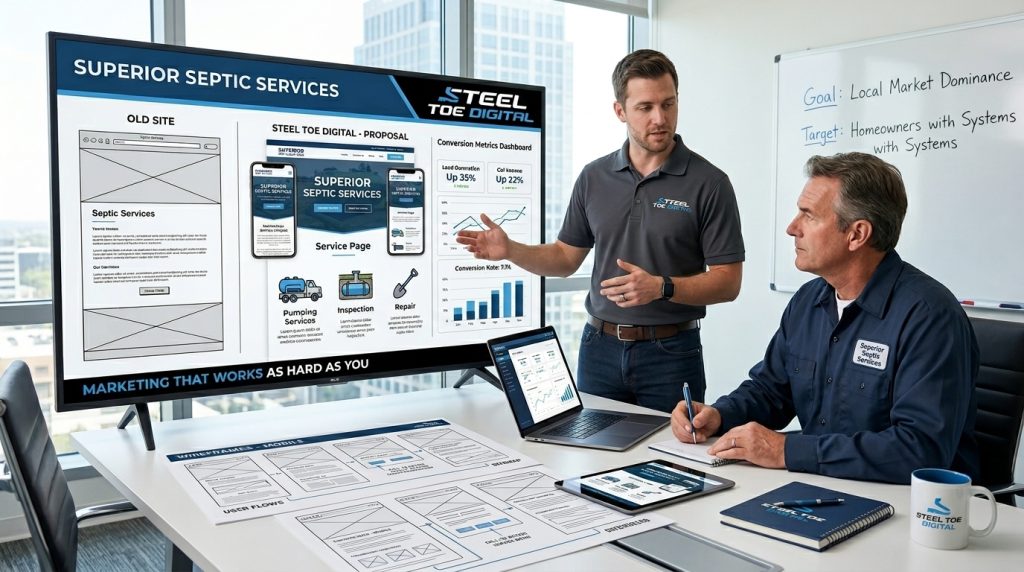
Your website is the floor of your credibility. If it looks outdated, loads slowly, or doesn’t tell a customer in 10 seconds what you do and where you do it, you’re losing jobs to companies with worse septic work than yours.
For a full breakdown of what a septic company website needs, see our guide on septic company website design. The short version:
- Display your state license number. Customers check.
- List every service: pumping, inspections, installations, repairs, riser installations, filter replacements.
- Show your service area by city or county name, not just zip codes.
- Put a phone number at the top of every page.
- Add a short “about” section that tells people how long you’ve been in business and what you specialize in.
A website redesign for a septic company typically runs $2,500-$6,000 depending on how much content needs to be created. That cost pays for itself in 2-3 new installation jobs. Most septic websites we see are leaving far more than that on the table.
Channel 4: Reviews
Septic work is a trust business. You’re showing up at someone’s property to deal with their sewage. They want to know you’re reliable, clean, professional, and honest about what they need.
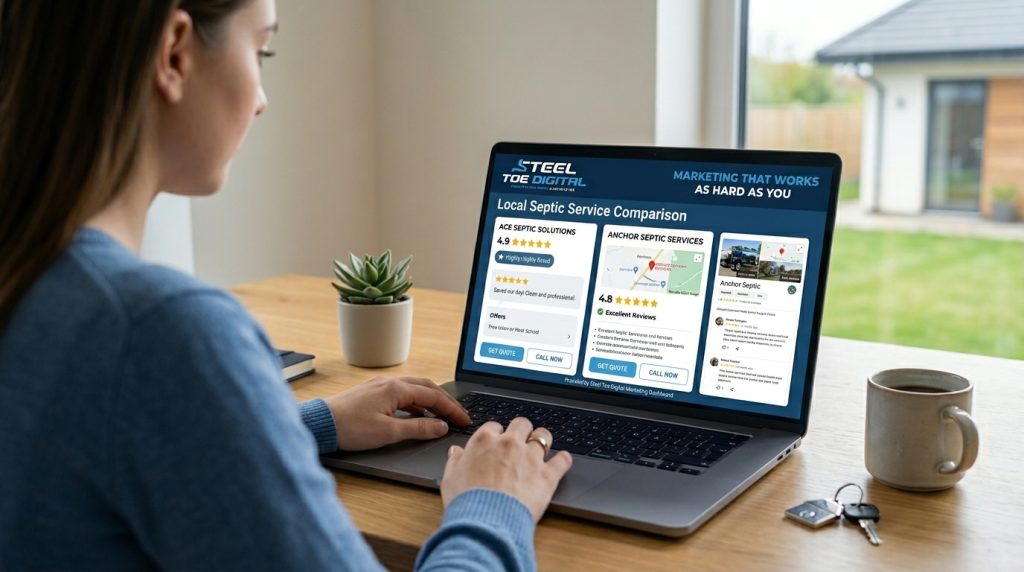
Reviews are the proxy for trust when customers don’t have a referral. Forty reviews at 4.7 stars beats 12 reviews at 5.0 every time when it comes to call volume.
The simplest review system that works:
- Text the customer within 1 hour of completing the job.
- The text includes one sentence thanking them and a direct link to your Google review page.
- That’s it.
A two-person operation doing 5-7 jobs per week can generate 2-3 new reviews per week with this approach. That’s 100+ new reviews in a year. Most septic companies in most markets have fewer than 30 total. Getting to 80-100 reviews moves you to the top of Google Maps for most searches in your area.
Channel 5: Realtor and Home Inspector Partnerships
Every residential real estate transaction involving a septic system is a potential inspection job. In most states, lenders require a septic inspection before closing. Realtors and home inspectors need reliable septic companies they can refer clients to without worrying about the outcome.
A single active Realtor relationship can generate 20-40 referrals per year, depending on how many properties with septic systems they move. A relationship with a busy home inspection company can generate even more.
How to build these relationships:
- Identify the top-producing Realtors in your service area. Most are findable on Zillow or through your local MLS directory.
- Introduce yourself with a printed one-pager: who you are, what you do, turnaround time for inspection reports, your license number.
- Offer a dedicated phone line or priority scheduling for their clients.
- Follow up after every referral with a status update. Realtors move fast. They need to know you’re communicating.
Home inspectors are even easier. They’re already at the property. They often tell buyers “you should get the septic system checked.” You want to be the name they hand over. Bring coffee and a stack of your cards and introduce yourself. Most septic companies have never done this.
Channel 6: Annual Maintenance Reminders
Most homeowners need their septic tank pumped every 3-5 years. Most of them will forget. Most septic companies let them forget and then hope the customer calls back.
Build a maintenance database and send reminders when customers are due. This requires nothing more than a spreadsheet with customer names, job dates, and contact info. A basic CRM like ServiceTitan or Housecall Pro can automate it.
The message is simple: “It’s been 3 years since your last septic pumping. We recommend scheduling before issues start. Reply to book or call [number].”
This tactic adds meaningful revenue from customers you already have without spending a dollar on advertising. A database of 300 past customers, all on a 3-year cycle, means you have 100 potential pump-outs per year just sitting there. Most septic companies are not working this list. It’s the single highest-margin marketing activity you can do.
Channel 7: Google Ads (When You’re Ready to Scale)
Google Ads for septic work tend to be more cost-effective than other trades because fewer companies are bidding on the keywords. Septic-related search terms in most markets run $8-$20 per click compared to $25-$60 for plumbing terms.
Emergency septic calls, specifically “septic backup,” “septic alarm going off,” and “septic tank emergency,” convert at high rates because the need is immediate and non-negotiable.
Google Ads make the most sense once your organic presence is established. If you don’t have a website that converts and at least 40 reviews, you’ll pay for clicks that don’t turn into calls. Get the foundation right first, then use ads to accelerate. For a full breakdown of how to run Google Ads for a septic company, see our guide on Google Ads for septic.
Also worth considering: Google Local Services Ads. LSAs show above standard Google Ads and display your review count directly in the listing. They charge per lead, not per click, and the Google Guaranteed badge reduces the trust barrier for new customers. Cost per lead for septic work through LSAs typically runs $25-$60, depending on your market.

Offline Marketing That Still Works
Truck branding. Your truck is a rolling billboard in every neighborhood you work. A clean magnetic sign or vinyl wrap with your company name, phone number, and website costs $200-$600 and generates impressions every time you drive. Route your trucks through neighborhoods where your target customers live.
Yard signs. After a large installation or repair, ask the homeowner if you can leave a small sign in the yard for 2 weeks. “Septic installation by [Company]. Call for a free inspection: [number].” Neighbors notice construction. A sign converts that curiosity into calls.
Agricultural events and county fairs. Septic companies serving rural markets often overlook the value of local agricultural events. A $300 booth sponsorship puts your name in front of hundreds of landowners who have septic systems and know it. Not a digital play, but the customer base in rural markets still responds to in-person presence.
Septic Marketing Budget Guide
| Stage | Monthly Budget | Where to Focus |
|---|---|---|
| Starting out | $200-$600 | Google Business Profile setup, review generation, basic website |
| Growing | $600-$2,000 | Local SEO, direct mail to new homeowners, maintenance email/text system |
| Scaling | $2,000-$5,000 | Full SEO, Google Ads or LSAs, realtor outreach, truck branding |
The starting budget assumes you’re doing most of the work yourself or with a spouse or office manager. The growing and scaling stages assume you’re paying a marketing partner to handle execution.
One thing that’s true at every stage: most of the highest-ROI activities for a septic company cost more in time than in money. Reviews, maintenance reminders, and realtor relationships are nearly free. They just require consistency. Most companies don’t do them consistently. That’s the gap.
If you want to see how this stacks up against general contractor marketing, read our overview of marketing for contractors.
FAQ
How do septic companies get customers?
Most septic company customers come from Google searches and word-of-mouth referrals. New homeowners with septic systems are the most valuable segment because they search Google, not a neighbor. Ranking on Google Maps and maintaining a steady flow of reviews captures most of this traffic automatically. Realtor and home inspector partnerships add a reliable offline referral channel.
What is the best marketing for a septic company?
Local SEO and Google Business Profile optimization give the highest return for most septic companies because competition is low and the search volume is consistent. After that, direct mail to new homeowners and an annual maintenance reminder system for past customers generate strong results at low cost. For companies ready to scale, Google Local Services Ads are the most cost-effective paid channel.
How much should a septic company spend on marketing?
A septic company just getting started can see meaningful results on $200-$600 per month if the focus is on reviews and Google Business Profile. A company ready to scale typically spends $1,500-$4,000 per month on a full program including SEO and ads. Budget depends on your market size and how aggressively you want to grow.
Is direct mail still effective for septic companies?
Yes, specifically when targeting new homeowners. A postcard campaign to recent property buyers in your service area costs $0.50-$0.80 per piece and reaches people with a genuine, immediate need for septic service. Blanket direct mail to general homeowners works but converts at lower rates. Targeting new homeowner lists keeps the cost per lead reasonable.
How long does it take for septic company SEO to work?
Most septic markets are not competitive digitally, so results come faster than in trades like plumbing or HVAC. Companies with a solid Google Business Profile and 40+ reviews often see meaningful ranking improvements in 3-6 months. In rural markets with almost no competition, it can happen faster. In larger suburban markets, expect the full 6 months.
How do I get more leads for my septic company?
The fastest path to more leads is optimizing your Google Business Profile and getting your review count above 40. After that, a direct mail campaign to new homeowners in your area and a maintenance reminder system for past customers add consistent lead volume without ongoing ad spend. For a full breakdown of lead generation tactics, see our guide on septic leads.
More Pumping Jobs. More Installs. Let’s Build Your Marketing System.
Your competitors are still relying on referrals and hoping the phone rings. SteelToe Digital builds marketing systems for septic companies that want to grow beyond word of mouth. I started in this trade. I know what a full schedule actually costs to build. Let’s look at where you stand and what it would take to own your market.
Get a Free Strategy Call
No pitch. No contract. Just a straight look at your numbers.