Three spots. Every time someone in your city types “tree service near me,” the same three companies show up. Those three companies get 70-80% of the clicks. Everyone else is invisible.
Local SEO for tree service is how you become one of those three companies. It comes down to four things: your Google Business Profile, your reviews, your website, and your citations. Get all four right, and you own your market. Miss one, and a competitor who does less work than you takes the call.
Tree service is one of the better categories for local SEO. High intent, high ticket, and in most markets, the competition hasn’t figured this out yet. The guys ranking above you right now aren’t doing anything magic. They’ve just done the basics consistently.
Here’s what the basics actually look like.
The 3 Factors That Determine Your Google Maps Ranking
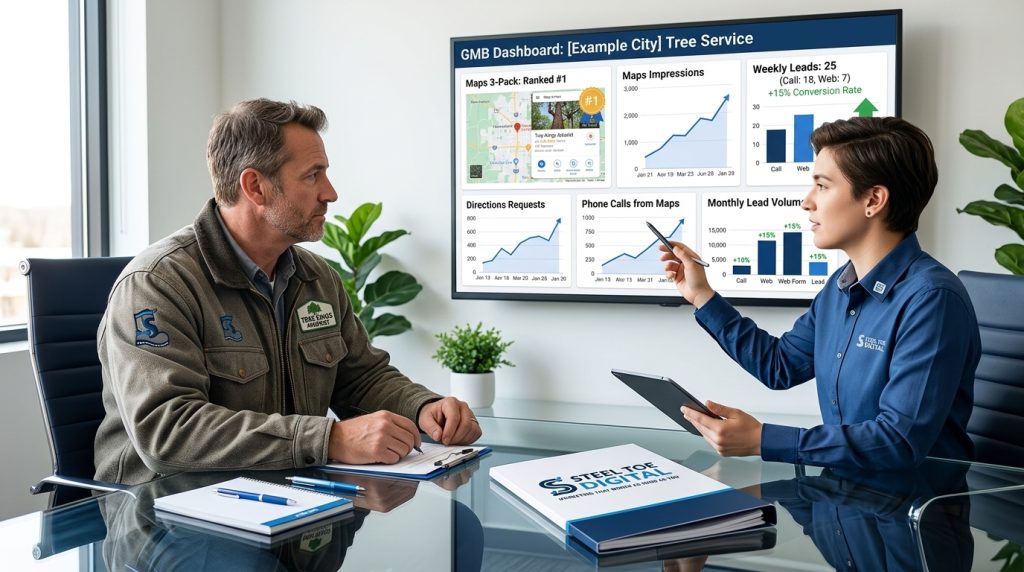
Google uses three factors to decide who shows up in the Maps 3-pack: relevance, distance, and prominence.
Distance is fixed. You can’t move your business address to rank in a city you’re not in. Focus on the other two.
Relevance is whether your Google Business Profile matches what someone searched for. If someone searches “emergency tree removal” and your profile doesn’t list emergency tree service as a service, you won’t rank for it. Simple.
Prominence is the big one. It’s how well-known and trusted Google thinks you are. Reviews, citations, website authority, backlinks, time in business: all of it feeds prominence. This is where the real work happens.
Most tree service companies lose the Maps 3-pack because of prominence, not distance. They’re close enough to rank. They just haven’t built the trust signals Google needs to put them there.
How to Set Up Your Google Business Profile to Win
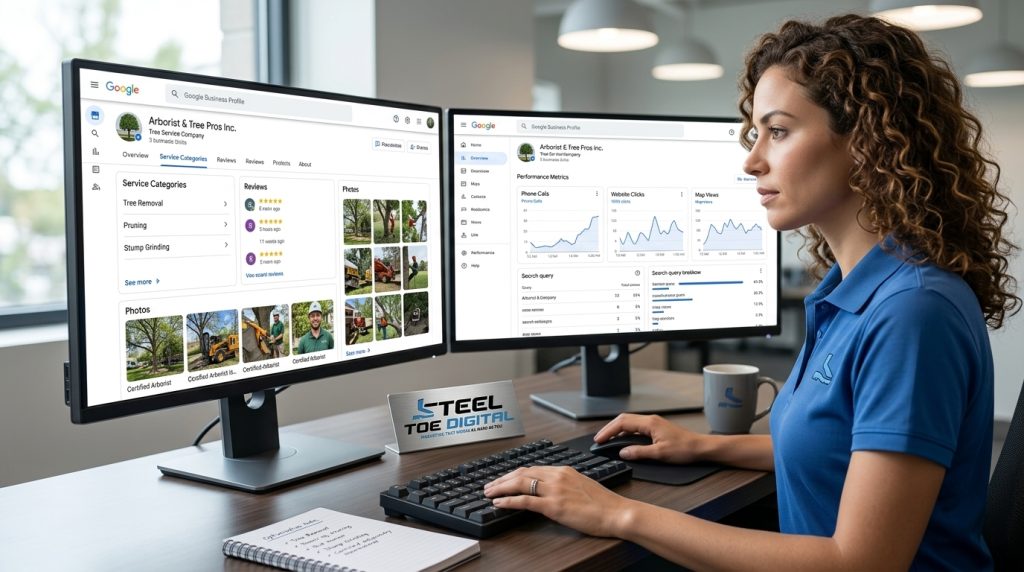
Your Google Business Profile (GBP) is the single most important asset in local SEO for tree service. Get this wrong and nothing else matters.
Primary category: “Tree Service.” Not “Contractor.” Not “Landscaper.” Not “Arborist.” The primary category has the biggest impact on which searches you appear for. If yours is wrong, fix it today before you do anything else.
Services. List every service you offer as a named service in your GBP:
- Tree removal
- Tree trimming
- Stump grinding
- Emergency tree service
- Land clearing
- Crown reduction
- Cabling and bracing
The more complete your service list, the more searches you’re eligible to appear in. This takes 20 minutes and most tree services skip it.
Business description. Write 200-250 words. Include your city name, your primary services, and what makes you worth calling. Mention your ISA Certified Arborist credential if you have one. This is real estate. Use it.
Photos. Upload at least 20. Equipment, crew, before-and-after shots, job sites, your trucks with your logo visible. GBPs with more photos get more views, and more views feed the relevance signal. Shoot 5-10 photos per job for the first few months until you have a library.
GBP posts. Post once a week. Storm alerts during severe weather. Seasonal trimming reminders in spring and fall. Special offers during your slow season. Posts don’t move the ranking needle much directly, but they signal an active business, and active businesses rank better than dormant ones.

The Review Strategy That Actually Works
Fifty Google reviews is the minimum competitive baseline in most markets. In a major metro, you may need 100 or more to be competitive with established companies. Check what the top-ranked tree service in your city has. That’s your first target.
The fastest way to get reviews is a text message sent within one hour of job completion. Not an email. Not a follow-up card in the mail. A text, sent while the crew is still wrapping up or driving to the next job.
Keep it short. Something like: “Jake, great working with you today. If you have 60 seconds, a Google review would mean a lot. [direct link]” That’s it. The longer the ask, the lower the response rate.
Storm seasons are your review goldmine. When a major storm rolls through your market, you might run 3-5 times your normal job volume over two or three weeks. Most tree services are so busy during that stretch that they forget to ask for reviews. Don’t. A storm season where you pick up 30-50 reviews can move your ranking more than six months of normal operations.
Respond to every review. Positive ones: thank them by name and mention the specific job. Negative ones: stay calm, acknowledge, and offer to fix it. Google watches your response rate. So do the people reading your reviews before they call.
What Your Website Needs for Local SEO
Your website and your GBP work together. When someone clicks through from the Maps pack to your site, Google watches what happens. If your site loads slow, looks broken on mobile, or doesn’t answer the basic questions a customer has, they bounce. High bounce rate signals to Google that your listing wasn’t the right result. Your ranking drops.
Here’s what the site needs to do:
Separate service pages. One page per service. “Tree Removal,” “Tree Trimming,” “Stump Grinding,” “Emergency Tree Service,” and so on. Not one page that lists all your services in a paragraph. Each page should be 600-1,000 words covering what the service is, what the process looks like, pricing context, and a call to action.
City pages. One page per major city or town you serve. If you cover 8 cities, you should have 8 city-specific pages. Each one should be unique. Google can tell when you’ve swapped the city name and left everything else the same. Describe something specific about each area: the tree species common there, the local permit requirements, the neighborhoods you work in.
Mobile-first, fast load. Most of your customers are searching from a phone. Your site needs to load in under 3 seconds. If it doesn’t, you’re losing calls before they ever happen. Run a Google PageSpeed Insights test. If your mobile score is below 70, it needs work.
Trust signals above the fold. ISA Certified Arborist credential, license number, insurance proof, and years in business. Put them where someone sees them without scrolling. People hiring a tree service are trusting you to not drop a limb through their roof. Credentials aren’t a nice-to-have. They’re the reason someone calls you instead of the lowest bidder.
Schema markup. Add LocalBusiness and TreeService structured data to your site. This tells Google exactly what type of business you are, where you’re located, and what you do. It’s a back-end code element. Your developer can add it in an hour. If you don’t have a developer, it’s a one-time fix worth paying for.
For a full look at what a tree service website should accomplish, see our guide to tree service website design.
Citations: The Part Everyone Ignores
A citation is any mention of your business name, address, and phone number (NAP) on a website other than your own. Yelp, Angi, HomeAdvisor, the Better Business Bureau, local chamber of commerce directories, Nextdoor: these all count.
Citations build prominence. The more places Google can find consistent information about your business, the more it trusts that you’re real, established, and relevant.
The key word is consistent. If your business name is “Jake’s Tree Service LLC” on your GBP but “Jakes Tree Service” on Yelp and “Jake’s Tree & Landscaping” on Angi, Google sees three different businesses and trusts all three less. Audit every directory listing you have. Get the name, address, and phone number identical across all of them.
Target the big general directories first: Google, Yelp, Bing, Apple Maps, Facebook, BBB. Then go after the industry-specific ones: the Tree Care Industry Association (TCIA) member directory, ISA chapter directories, and your local chamber of commerce. For more on the full citation-building process, see our guide to local SEO for contractors.
Seasonal Local SEO: Playing the Whole Calendar
Tree service is seasonal. Most owners know this in their bones. Local SEO should reflect it.
Spring (March-May): This is your push for trimming, deadwood removal, and tree health assessments. Update your GBP description to mention spring services. Publish a blog post about spring tree care. Run a GBP offer for free estimates. Your competitors are sleeping on this content calendar.
Storm season: When a major storm is forecast, post on your GBP the day before. “Serving [City] after [Storm Name]: emergency tree removal available 24/7.” Do the same post the day after. Searches for “emergency tree service [city]” spike 10x during and after major storms. Your GBP post puts you in the conversation when it’s happening.
Fall (September-November): Promote trimming before winter. Content about tree safety and wind load resonates. Seasonal demand is real. Capture it in your content.
Winter (December-February): This is your slow season. Push GBP offers. Run price promotions. Publish evergreen content that will rank in spring when it matters. The blog post you publish in January can be ranking on page 1 by March when the phones start ringing again.
How Local SEO for Tree Service Compares to Paid Ads
Most tree service owners have run Google Ads at some point. Some are running them now. Here’s the honest comparison:
Google Ads get you in front of people immediately. You pay for every click. The moment you stop paying, the calls stop. In a competitive tree service market, cost-per-click can run $8-$20, and cost-per-lead can hit $80-$150 depending on the service and market.
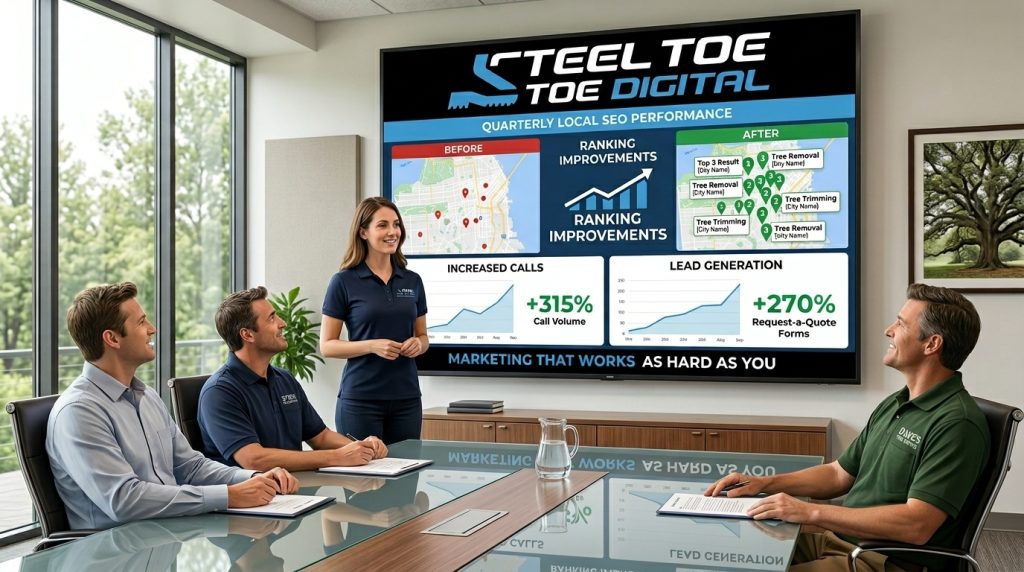
Local SEO builds a position that compounds. Month 1-3 is mostly setup. Month 4-6 is when rankings start to move. Month 6-12 is when you start owning the 3-pack consistently. After that, the leads keep coming without the per-click cost. The tree service that owns the 3-pack in a mid-size market is pulling in 40-80 inbound calls a month from organic search alone.
The two aren’t mutually exclusive. Many of the tree services we work with run LSAs or Google Ads during ramp-up while the SEO builds. Once local SEO is producing, they dial back the ads. The math changes fast when you stop paying $100 per lead for calls your rankings now deliver for free.
For a broader look at tree service marketing beyond search, see our full guide to tree service marketing. And if you want the complete SEO picture, our guide to tree service SEO covers everything beyond local Maps rankings.
What’s Actually Stopping You From Ranking
Most tree service companies that aren’t ranking in the Maps 3-pack have one or more of these problems:
Wrong primary category. Fixed in two minutes on your GBP.
Incomplete service list. Fixed in 20 minutes.
Under 30 reviews. Requires consistent follow-up. Takes 3-6 months to fix if you’re starting from scratch.
Website on a shared template with no service pages or city pages. This one takes real work. But it’s the difference between ranking in one zip code and ranking across your entire service area.
NAP inconsistencies across directories. An afternoon of cleanup fixes most of it.
None of these are hard. They’re just work most tree service owners haven’t done or haven’t had someone do for them. Every week they go unfixed, a competitor who has done them is taking calls that should be yours.
That’s not a future problem. That’s this week.
FAQ
How do I get my tree service to show up on Google Maps?
Claim and fully complete your Google Business Profile with the correct primary category (“Tree Service”), a complete services list, photos, and a description that includes your city name and primary services. Build your review count to 50 or more and get your NAP consistent across all major directories. These steps, combined with a website that has service pages and city pages, are what move you into the Maps 3-pack.
How many reviews do I need for local SEO as a tree service?
Fifty is the minimum in most markets. In larger metros or against well-established competitors, 100 or more may be needed to compete. Check the top-ranked tree service in your area and treat that number as your first benchmark. Two to four new reviews per month is a realistic baseline rate if you’re asking consistently after every job.
Can I rank in multiple cities as a tree service?
Yes. You rank in your primary city based on your GBP location. You extend into surrounding cities by building city-specific pages on your website, maintaining citations that reference your service area, and generating reviews from customers across those cities. You won’t rank in the Maps 3-pack for a city 40 miles away, but you can rank in organic search results for those cities with strong service area pages.
How long does local SEO take for a tree service?
In most markets, you’ll see meaningful movement in your Maps ranking between months 3 and 6. Months 1-3 are setup and foundation: GBP optimization, citations, review generation, website work. The compounding starts in months 4-6. A tree service in a less competitive market can reach the 3-pack in 3-4 months. A competitive metro market may take 6-12 months. Anyone who tells you they can get you there in 30 days is not telling you the truth.
Does my tree service need a website to rank on Google Maps?
You can rank with GBP alone in very low-competition markets. But in any market with more than two or three competitors who have websites, you need a website. It validates your business to Google, provides the service pages and city pages that extend your geographic reach, and it’s what customers land on when they click your listing. A bad website costs you the lead even when local SEO gets you the click.
Own the 3-Pack in Your Market
If you’re not in the Google Maps 3-pack right now, someone is taking calls that should be yours. Local SEO for tree service is how you fix that. The system works. The math is straightforward. It just takes consistent execution over 6-12 months.
SteelToe Digital builds local SEO systems for tree service companies. We look at where you rank, what your competitors have done, and what it takes to beat them in your specific market. Then we do the work.
Get a Free Local SEO Audit
No pitch. No contract. Just a real look at where you stand and what it would take to get you into the 3-pack.