
Word of mouth built your business. It won’t scale it.
Referrals are great until they slow down. You can’t control the volume. You can’t predict which months will be packed and which will be quiet. When a slow winter hits, there’s nothing to turn up and nothing to fall back on.
The good news is that most contractors have almost no digital presence. The bar is genuinely low. A clean Google Business Profile, 50 good reviews, and a website that loads fast on a phone puts you ahead of most of the market. This guide covers every channel that’s actually moving the needle for contractors right now, in order of impact.
The Contractor Marketing Funnel: How Customers Actually Find You
Before you pick a channel, understand how customers move from “I need a contractor” to “I’m calling this one.”
Awareness: They don’t know you yet. They find you on Google Maps, through a social post a neighbor shared, or via a job sign in front of your truck.
Consideration: They’re comparing you to 2-3 other options. They’re looking at your reviews, your website, your photos, how many years you’ve been around. This is where most contractors lose jobs they never even knew they were competing for.
Decision: They’re ready to call. Whether they call you or someone else comes down to trust signals: star rating, number of reviews, a website that looks like a real business, and a phone number they can find in under 5 seconds.
Retention: The job is done. Now what? Most contractors do nothing. The contractors who build a real marketing engine follow up, ask for a review, and stay in front of past customers so the next job comes back to them instead of a competitor.
Every channel in this guide fits somewhere in that funnel. The strongest contractor marketing programs cover all four stages. Most contractors cover one.
Channel 1: Local SEO – Your Long-Term Lead Machine
Local SEO is the highest-ROI channel for most contractors when measured over a 12-month horizon. The math is straightforward: once you rank, you pay nothing per lead. The calls come in because you’re visible, not because you’re buying your way to the top.
Google Maps and organic search results together account for the majority of how customers find local service businesses. If you’re not in the Maps 3-pack when someone in your city searches your trade, you’re invisible to most of that traffic.
Local SEO for contractors has four core components. Your Google Business Profile needs to be fully built out with services, hours, photos, and regular posts. Your website needs service pages with real content, not thin generic copy. Your review count needs to grow consistently, at least 2-4 new reviews per month. And you need citations: your name, address, and phone number listed consistently across directories.
Results typically take 3-6 months to show meaningful movement. Anyone who tells you faster is either selling something or working in a market with zero competition. The contractors who commit to it for 12 months and stay consistent are the ones who stop paying per lead by month 18.
See the full breakdown in our Contractor SEO guide and our post on Local SEO for Contractors.
Channel 2: Google Ads – Pay to Be at the Top Immediately
SEO builds your foundation. Google Ads buys you time while it’s building.
Paid search puts you at the top of results immediately. No waiting for organic rankings. No 6-month ramp. You spend money, you get visibility. The tradeoff is that the moment you stop spending, you disappear.
There are two Google paid options worth knowing. Local Services Ads (LSAs) put you at the very top of the page with a “Google Guaranteed” badge. You pay per lead, not per click. Typical cost per lead runs $30-$90 depending on your trade and market. LSAs work well for plumbers, electricians, HVAC, and similar trades where Google has verified the category.
Standard Google Search Ads give you more control. You bid on keywords, set your budget, and pay per click. Budget reality for most contractor markets: $500-$2,000 per month to generate meaningful lead volume. Less than that and you don’t have enough data to know what’s working.
The most common Google Ads mistake is sending traffic to your homepage. Your homepage is not a landing page. Send ad traffic to a dedicated page that matches what the ad said, has one clear call to action, and loads in under 3 seconds on a phone.
Track every lead. Use call tracking. Know which keywords are generating calls and which are burning budget. Without tracking, you’re flying blind and you’ll never know whether the spend is working.
Channel 3: Your Website – The Hub Everything Points To
Every channel you build eventually points somewhere. That somewhere is your website. If your website doesn’t convert visitors into calls, every dollar you spend on ads and every hour you spend on SEO is partially wasted.
A high-converting contractor website doesn’t need to be complicated. It needs to do a few things well.
Your headline should say exactly what you do and where you do it. “Plumbing Services in Columbus, Ohio” beats “Welcome to Mike’s Plumbing.” Your phone number belongs in the header, visible without scrolling, every page. Most people searching for a contractor on their phone want to call, not fill out a form. Make it one tap.
Your site needs an easy way to request service. A short contact form or a request-a-quote form works. The simpler the form, the higher the completion rate. Don’t ask for 14 pieces of information before you’ve earned the relationship.
Social proof matters more than you think. Real reviews on your site, photos of your actual work, and a count of years in business all build trust in the first 10 seconds. Stock photos of smiling homeowners do the opposite.
Build individual service pages, not one catch-all page. A plumber who serves Columbus needs separate pages for drain cleaning, water heaters, sewer repair, and emergency plumbing. Each page targets a different search and gives Google something specific to rank.
More than 70% of contractor searches happen on a phone. If your site is slow, hard to read on mobile, or buries the contact button, you’re losing leads before they even get started. Check your mobile experience today. You’ll likely find something that needs fixing.
Our guide to home service website design covers what separates sites that generate calls from sites that just exist.
Channel 4: Reviews and Reputation Management
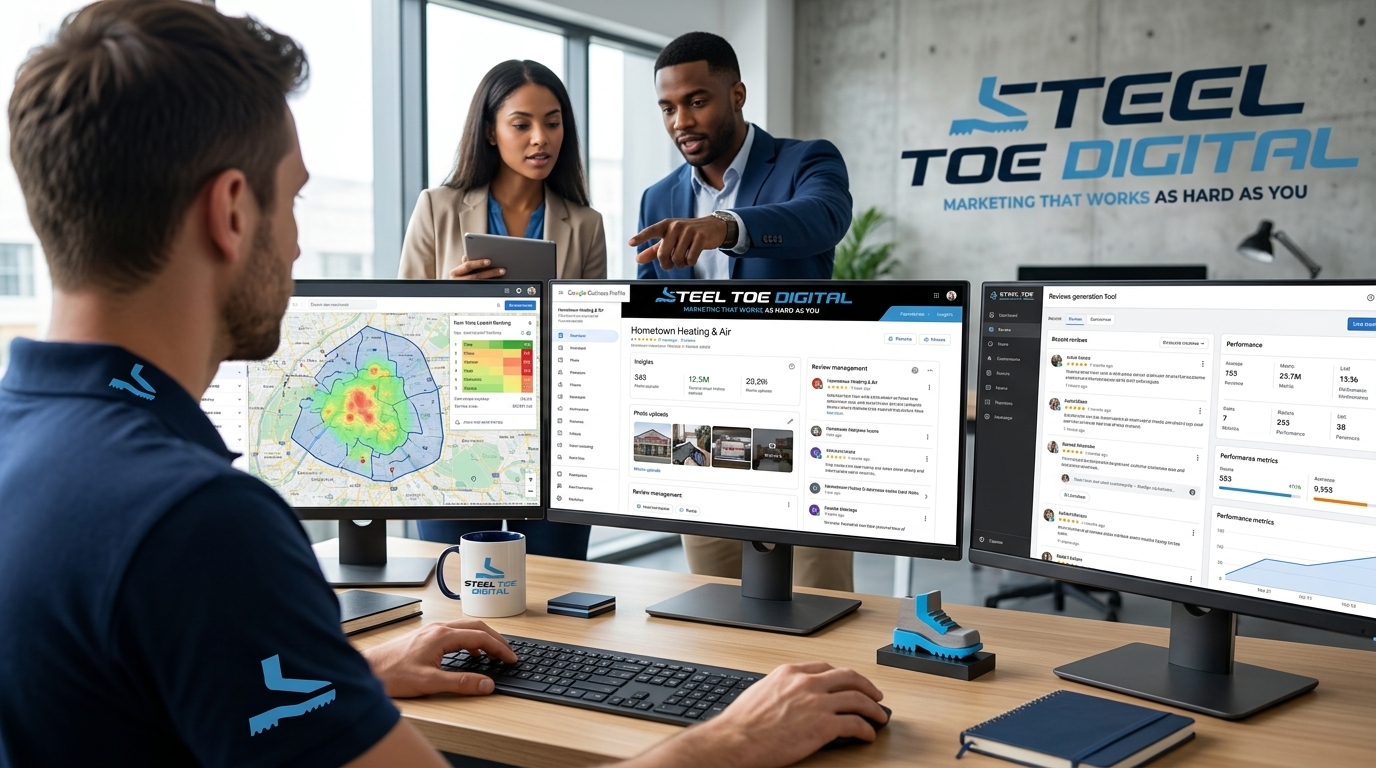
Reviews do two things. They convince customers to call you instead of a competitor. They also affect where you rank in Google Maps.
Google’s local ranking algorithm takes review count and review velocity into account. A contractor with 80 reviews and a 4.7 rating outranks a contractor with 20 reviews and a 4.9 rating in most cases. More reviews, earned consistently over time, beat a perfect score with low volume.
The goal is a steady flow, not a burst. Two to four new reviews per month is a realistic and sustainable target for most contractors. That’s 24-48 new reviews per year. After two years, you’re hard to beat.
The most reliable system for getting reviews is simple. You finish the job. The customer is happy. You or your crew says, “Hey, would you mind leaving us a Google review? It takes about a minute.” Then you text them the direct link. That’s the system. No complicated software required.
Google is the priority. But Yelp, Facebook, and Angi matter too depending on your trade and market. Home inspectors get more traction on Yelp and Facebook. Tree services see strong traffic from Angi and Google equally. Know where your customers are looking.
Negative reviews happen. Respond to every one of them. Keep it short, professional, and specific. Offer to make it right. Don’t argue. Anyone reading a response to a negative review is evaluating how you handle problems, not whether you had one.
Channel 5: Social Media Done Right, Not Just Done
Most contractor social media falls into one of two traps: posting too rarely to matter, or posting stock photos that look nothing like the actual business.
Facebook and Instagram are the two platforms that consistently generate results for contractors. Nextdoor is the most underused. Facebook reaches homeowners in your service area with both organic posts and paid ads. Instagram is visual: before/after photos, time-lapse video of a big job, quick clips that show your crew working. Nextdoor is where homeowners go specifically to ask for recommendations in their neighborhood. A strong Nextdoor presence costs nothing and generates some of the highest-trust leads you’ll ever get.
Post content that shows your work. Before and after photos of a job well done. A video walk-through of a completed project. A quick tip that saves a homeowner money. A photo of your crew on a job site. These posts build familiarity, and familiarity builds trust.
Frequency matters more than production value. Posting 3 times a week with your phone camera beats posting one perfectly edited video per month. Consistency tells the algorithm you’re active. It also tells potential customers you’re running a real business.
Social media’s primary role in contractor marketing is trust-building, not direct lead generation. Don’t measure it by how many calls it drives next week. Measure it by whether your profile looks like a legitimate, active business when a customer checks you out before calling.
Channel 6: Email Marketing and Past Customer Follow-Up
Most contractors do nothing after a job closes. That’s one of the biggest missed opportunities in the business.
A past customer already trusts you. They’ve seen your work. They know your crew showed up on time. The barrier to rehiring you is almost zero compared to the barrier for a new customer who’s never met you. But if you never follow up, they forget you exist by the time they need you again.
A simple email sequence can change this without much time or money. Send a thank-you email the day after the job is complete. Send a 30-day check-in asking if everything is working properly. Send a seasonal reminder when your service is relevant: “Spring is coming, time to inspect your gutters” or “It’s been a year since we serviced your system.” Request a review after the check-in if they haven’t left one yet.
Tools like Jobber and ServiceTitan have built-in email automation for exactly this use case. For smaller operations, Mailchimp or even a Gmail template and a consistent habit will do the job.
Reactivation campaigns work well for trades with repeat service needs. A simple email that says “It’s been 12 months since we were last out, want to schedule a visit?” will bring back a percentage of past customers who had simply forgotten to book. That’s revenue with no ad spend attached.
Own a plumbing company? The companies above are ranked where they are because they invested in their online presence. If you want to show up on lists like this one, we can help.
Channel 7: Referral Programs and Strategic Partnerships
You’ve been getting referrals for years. The question is whether you’re doing anything to increase them or just hoping they keep coming.
A referral program formalizes the behavior your best customers are already doing. Give them a reason to actively send people your way. A $50 gift card, a discount on their next service, or a small donation to a local charity in their name are all options. The incentive doesn’t have to be large. It has to exist and it has to be communicated clearly.
Strategic partnerships are a separate and often more reliable source. Realtors and property managers work with contractors constantly and can send a steady stream of referrals if they trust your work and remember your name. Home inspectors and general contractors are natural partners depending on your trade. A plumber who partners with a home inspector gets calls every time an inspection finds a problem. A land clearing company that partners with a GC gets calls every time a lot needs clearing before a build.
Approach partnerships the same way you’d approach any relationship. Show up, do good work, follow up. Send a card after the first referral. Check in once a month. Remember their names. You don’t need a formal program. You need to stay in front of people who can send you work.
Check out our guides on plumber marketing, tree service marketing, and septic company marketing for trade-specific partnership strategies that work in those markets.
Offline Marketing That Still Works for Contractors
Digital gets most of the attention. But a few offline channels still deliver real ROI for contractors, and skipping them entirely is a mistake.
Truck wraps are probably the highest-impact passive marketing a contractor can run. Your truck is already driving through neighborhoods, parked in front of jobs, and sitting in parking lots. A clean, legible wrap with your name, trade, and phone number turns every job into an advertisement for the next one. The cost is a one-time investment that pays for itself over years.
Yard signs at active job sites work the same way. Someone on the block needs the same service you’re providing right now. They walk past your sign every day for two weeks. When they’re ready to call, they already know your name.
Door hangers around a recently completed job are a direct and low-cost way to reach nearby homeowners who’ve already watched you work. One side of the block saw your truck in front of their neighbor’s house for three days. A door hanger with “We just finished a job on your block” is relevant, timely, and hard to ignore.
Community sponsorships, youth sports team jerseys, and local event tables put your name in front of homeowners who live in your service area. The ROI is harder to measure than a Google Ad. The brand recognition it builds in a local market compounds over time in ways that are real but not always traceable.
How to Build a Contractor Marketing Plan: The Simple Version
You can’t run every channel at once. You shouldn’t try. Here’s the sequence that makes sense for most contractors.
Step 1: Fix your Google Business Profile and your website. These are the foundation. Everything else builds on them. If your GBP is incomplete and your website is slow, ads and social media will underperform. Fix the foundation first.
Step 2: Get to 50 Google reviews. Fifty reviews at 4.5 stars or better puts you in a competitive position in most markets. Run a review campaign with your past customers. Text the link to everyone who’s had a positive experience with you in the last two years.
Step 3: Start capturing leads with Google Ads. Once your GBP and website are solid, paid search gives you immediate lead volume while your organic rankings build. Start with LSAs if your trade qualifies. Add Search Ads once you have budget and tracking in place.
Step 4: Let SEO build in the background. SEO is not fast. But the work you do in months 1-3 starts paying off in months 6-12 and continues to compound after that. The contractors who win the SEO game are the ones who started earlier and stayed consistent.
Step 5: Add email follow-up. Once you’ve got new customers coming in from ads and SEO, you need a system for keeping them. Set up a basic email sequence. It takes a few hours to build and runs automatically after that.
Step 6: Layer in social, partnerships, and offline over time. These channels build momentum and reinforce your brand in your local market. They’re not urgent, but they matter at scale. Add them once the core lead generation system is working.
This sequence takes 12-18 months to fully implement. It’s not a sprint. Contractors who want results this week use Google Ads. Contractors who want a business that generates leads without constant paid spend invest in the full stack and wait for the engine to run.
See our complete guide to digital marketing for home services for a broader view of how these channels work together across different trade categories.
What Contractor Marketing Actually Costs in 2026
Budget questions are the ones nobody answers honestly. Here’s an honest breakdown.
Google Business Profile: Free to set up. Takes 2-4 hours to optimize correctly. Ongoing time investment: 30-60 minutes per month to post updates and respond to reviews.
Website: A professional contractor website built by a real agency runs $2,500-$8,000 depending on size and complexity. DIY builders like Wix or Squarespace run $200-$500 per year but rarely convert as well. Ongoing costs: hosting runs $20-$80/month, depending on your setup.
Local SEO services: Most agencies charge $750-$2,500 per month for ongoing SEO. The lower end covers the basics. The higher end includes content, local page builds, and link acquisition. Results in 3-6 months for low-competition markets, 6-12 months for competitive ones.
Google Local Services Ads: No monthly management fee from Google. You set a weekly budget and pay per lead. Typical cost per lead: $30-$90 in most contractor markets. Budget $500-$1,000/month to generate meaningful volume.
Google Search Ads: Management fee from an agency typically runs $400-$800/month on top of your ad spend. Ad spend: $500-$2,000/month for most markets. Total commitment: $900-$2,800/month all in.
Email marketing tools: $20-$100/month depending on your list size and tool.
Social media management: $400-$1,200/month if you hire it out. Free if you do it yourself with your phone camera.
Yard signs and door hangers: $50-$200 for a batch of yard signs. $100-$300 for 500 door hangers.
Truck wrap: $1,500-$4,000 for a full wrap, one-time cost.
A contractor who invests $1,500-$3,000/month across SEO, ads, and the basics of reputation management is operating a real marketing engine. At that investment level, in most markets, you should expect to see 20-60 inbound leads per month by month 6-12 depending on your trade and competition level.
How to Know If Your Marketing Is Working
Most contractors have no idea whether their marketing is working. They know roughly how busy they are, but they can’t say which channel drove which jobs.
This matters because without attribution, you can’t make good decisions about where to invest more and where to cut. You end up guessing, or worse, canceling the thing that was actually working.
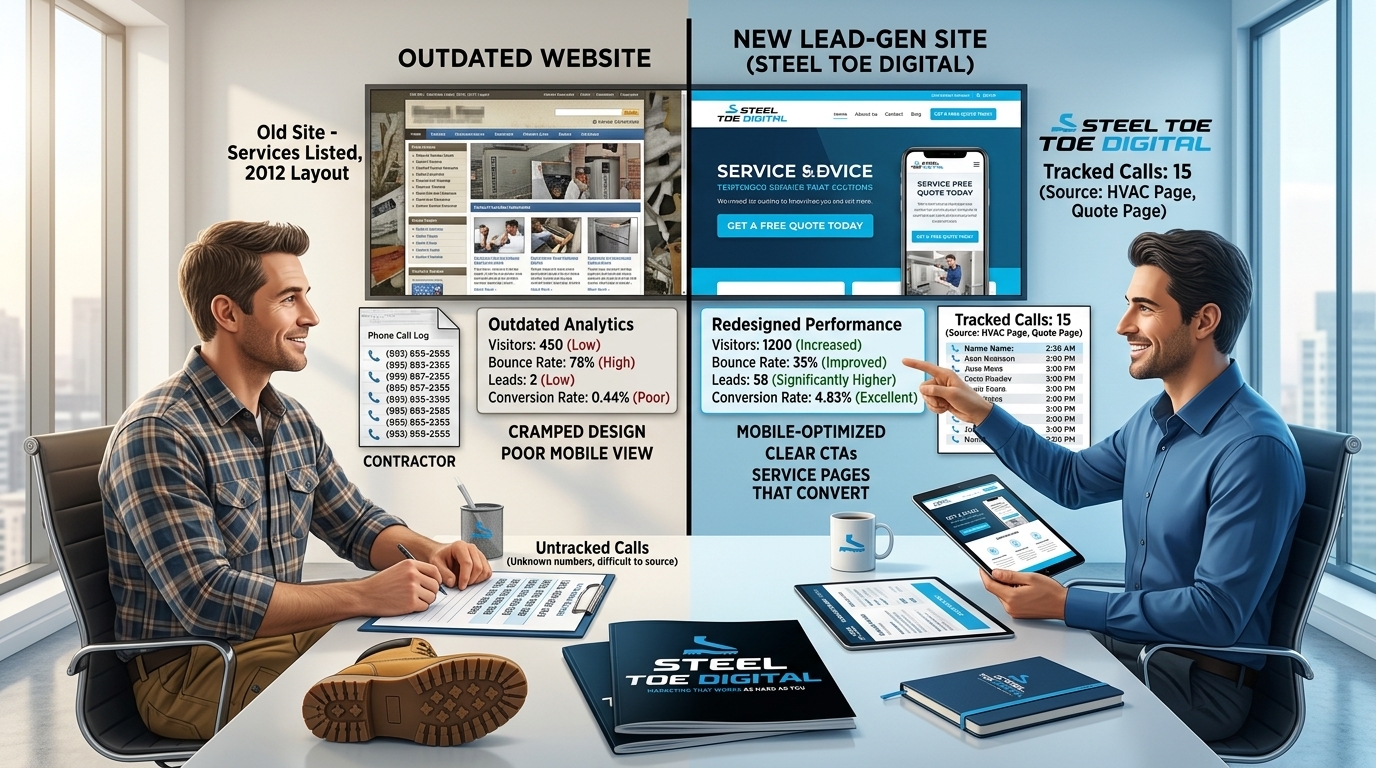
Set up call tracking. A tool like CallRail gives each marketing channel its own phone number. Calls to your Google Ads number came from ads. Calls to your GBP number came from Maps. Calls to your website came from organic search or social. Basic call tracking runs $50-$100/month and pays for itself in the first month.
Track form fills. Your website contact form should have Google Analytics or a similar tool recording every submission and which page or source drove it.
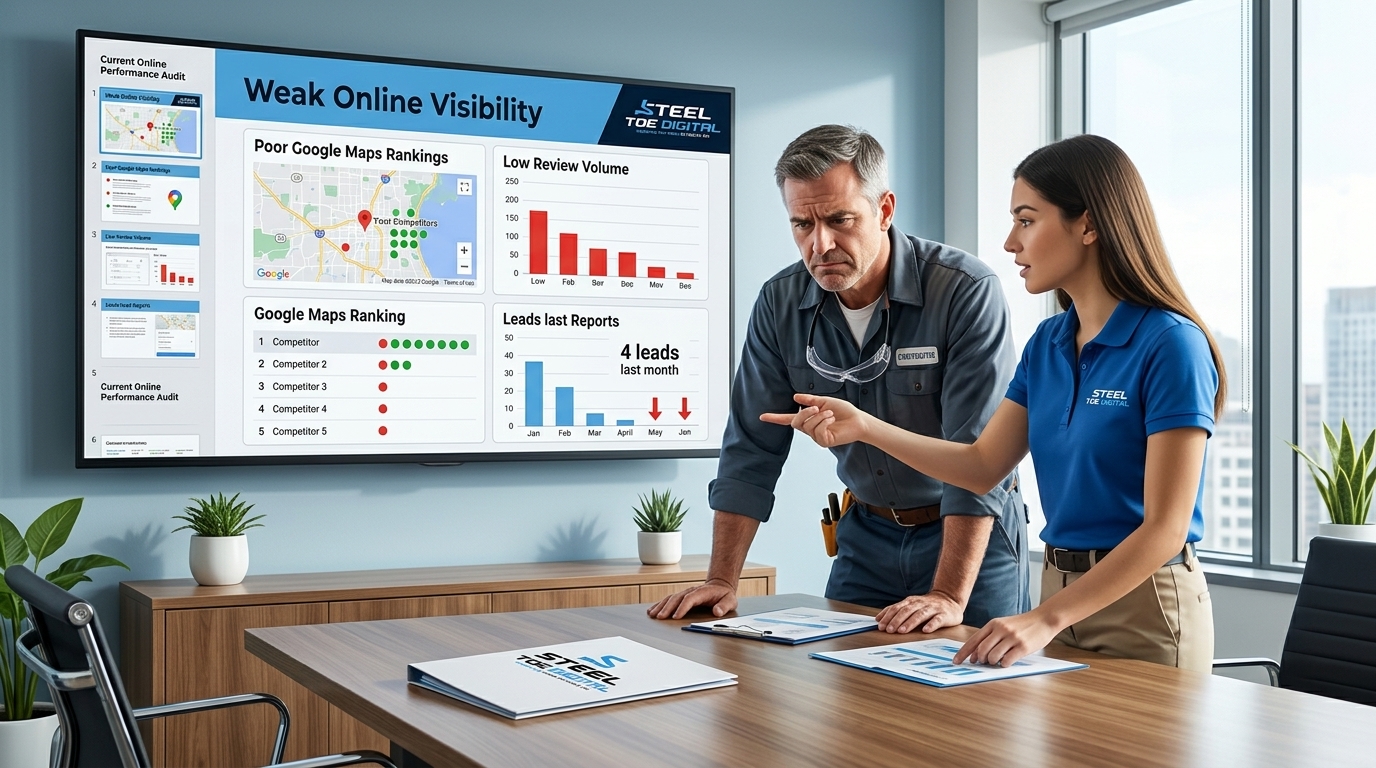
Review your Google Business Profile Insights monthly. GBP shows you how many people searched for you directly, how many found you through discovery searches, how many clicked for directions, and how many clicked to call. These numbers tell you whether your local presence is growing.
Set a cost per lead target. If your average job is worth $800 and you close 40% of leads, your average lead is worth $320. Paying $80 per lead gives you a 4-to-1 return before overhead. Know your numbers so you can make rational decisions about budget.
Frequently Asked Questions
How much should a contractor spend on marketing?
A common benchmark is 5-10% of revenue reinvested in marketing. A contractor doing $500,000 in revenue should expect to spend $25,000-$50,000 per year to maintain and grow that number. Newer businesses and those targeting aggressive growth often spend closer to 10-15% in the early years to build their pipeline. The right number depends on your market, your growth goals, and what each lead is worth in closed revenue.
What is the most effective marketing for contractors?
For most contractors, local SEO combined with a strong Google Business Profile generates the best long-term cost per lead. Google Local Services Ads and Search Ads generate the best short-term volume when you need leads now. The most effective marketing programs use both: paid search for immediate volume, SEO for long-term compounding. Neither works well without a website that converts visitors into calls.
Should I hire a marketing agency or do it myself?
DIY works when you’re early, have limited budget, and are willing to spend 10-15 hours per month on it. Most contractors with growing businesses don’t have that time. The cost of doing it poorly or inconsistently is usually higher than the cost of hiring someone who knows what they’re doing. The key is finding an agency that actually understands contractor businesses, not one that runs the same playbook they use for dentists and law firms.
How do I track whether my marketing is working?
Start with call tracking. A service like CallRail assigns different phone numbers to different channels so you can see exactly where calls are coming from. Add Google Analytics to your website so you can track form fills and traffic sources. Check your Google Business Profile Insights monthly. Ask new callers how they found you. It’s not a perfect system, but knowing that 60% of your calls come from Google Maps and 30% from ads tells you where to protect and where to invest.
How long does contractor marketing take to work?
Google Ads can generate leads within days of launching a campaign. Local SEO typically takes 3-6 months to show meaningful movement in rankings and 6-12 months to generate consistent organic lead volume. Reputation building is a 12-24 month investment before you have enough reviews to dominate your local market. The contractors who ask “how long” and then quit before the answer arrives are the same ones who keep paying Angi forever. Set a 12-month timeline and measure at the 6-month mark.
Ready to Build a Marketing System That Works While You’re on the Job?
Your business doesn’t need more marketing tactics. It needs a system built around how your customers actually find contractors in your market, one that generates leads consistently without you having to babysit it.
SteelToe Digital builds marketing engines for contractors: local SEO, Google Ads, websites that convert, and reputation systems that compound over time. We work exclusively with trades businesses, which means we know what a P-trap is, what ISA certification means, and why your slow months aren’t random.
No pitch. No contract. Just a look at where you stand right now and what it would take to get you where you want to be.