
Every home service company knows they need to “do digital marketing.” Most have tried something. A Facebook ad here. A website refresh there. Maybe a few months with an agency that promised results and delivered a report full of numbers that didn’t connect to a single booked job.
This guide is not that.
What follows is a breakdown of what’s actually producing calls and closed jobs for plumbers, tree services, septic companies, and other trades businesses right now. You’ll get the full stack: what to build first, what’s worth real money, what to stop wasting time on, and how to measure whether any of it is working.
No theory. No guesswork. Just the systems that move the needle.
Why Digital Marketing Is Different for Home Services
You are not selling software. You are not competing nationally. Someone three states away has never once searched for your company name, and they never will.
Home services live or die in a radius. Your customer is someone within 20-40 miles of your shop who needs a problem fixed, usually today. That changes everything about how marketing works for you.
A few things make home services marketing different from every other category:
Customer intent is high. When someone searches “water heater replacement near me,” they are not browsing. They have cold water and a problem. Compare that to someone scrolling Facebook ads. Night and day.
Trust is the primary barrier. A customer buying shoes online can return them if they’re wrong. A customer hiring you is letting you into their home. That’s a different kind of decision. Your digital presence either earns that trust or it doesn’t. There’s no middle.
Most of your competitors are asleep. The average home service company has a website built in 2017 and a Google Business Profile they set up once and haven’t touched. That’s not a threat. That’s an opportunity. The bar for winning in home services SEO is lower than almost any other industry, because most of the players haven’t shown up yet.
Your service area is your market. You don’t need millions of impressions. You need the right 200 people in your zip codes to know your name before anyone else’s.
The Home Services Digital Marketing Stack
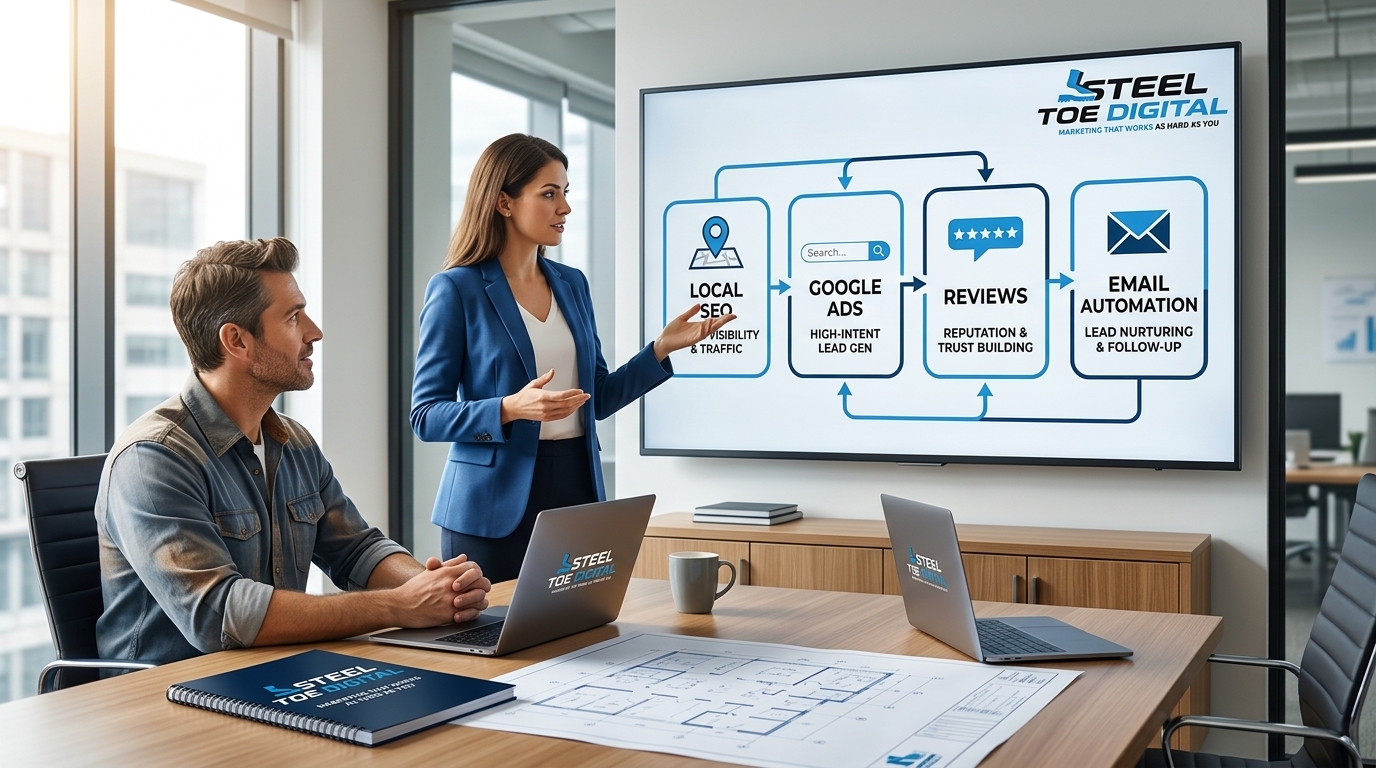
Most agencies will sell you whatever service they make the most margin on. That’s not how to build a marketing engine. The right stack depends on your stage, your market, and your goals. Here is what actually forms the foundation for a home service business that wants consistent inbound leads.
1. Google Business Profile
This is the first thing you build and the last thing you let go stale. Your Google Business Profile (GBP) is what shows up in the map pack when someone searches “plumber near me” or “tree removal [your city].” That map pack is the most valuable real estate in local search. Not your website. Not Facebook. The map pack.
A complete GBP means: verified address and service area, accurate hours and phone number, all relevant service categories selected, photos updated at least monthly, and posts going out consistently. Most companies set theirs up, get the verification postcard, and never touch it again. That’s how you lose the map pack to someone worse than you.
Reviews live here too. More on that in a minute.
2. A Website That Actually Converts
Your website has one job: turn visitors into phone calls or form submissions. Not impress you. Not win design awards. Convert.
That means fast load times (under 3 seconds on mobile), a phone number visible above the fold, service pages that actually describe what you do, and location pages if you serve multiple cities or counties.
The single biggest website mistake I see in home services is trying to rank a single homepage for every keyword in every city. It doesn’t work. Build a service page for every major service you offer. Build location pages for every city you want to rank in. That’s how you build coverage that actually shows up.
For a full breakdown of what a high-converting contractor site needs, see our guide to home service website design.
3. Google Reviews
Fifty reviews is the threshold where things start to move. Below 50, you’re invisible to a large portion of buyers. Above 50 with a 4.8 or better, you’re in contention. Above 100, you start to own your market.
The math is simple. People check reviews before they call. If you have 11 reviews and your competitor has 94, you lose before the phone ever rings.
Two to three new reviews a month keeps you moving. Five or more a month pulls you away from the competition. The companies getting 5+ new reviews a month right now are the ones who’ll own their markets in 2 years. The ones waiting for happy customers to leave reviews on their own will still be waiting.
Ask. Every job. Every time. Text them the link while you’re still on their driveway.
4. Local SEO
SEO is the long-game channel. You will not see results in 30 days. You will not see results in 60 days. Most home service companies start seeing meaningful movement between months 3 and 6, assuming consistent execution.
What makes that movement happen: service and location pages with real content, review velocity, accurate citations across directories (Google, Yelp, Bing, Apple Maps, Angi), backlinks from local organizations and trade associations, and a site that loads fast and doesn’t break on mobile.
Local SEO compounds. Month 6 is better than month 3. Month 12 is better than month 6. The companies that started 18 months ago are now getting 30-50 organic leads a month without paying per click. That doesn’t happen overnight. But it does happen, and it keeps producing after the work is done.
Our full breakdown of the tactics is in the contractor SEO guide and the local SEO for contractors post.
5. Google Ads and Local Services Ads
Paid search fills the gap while SEO builds. It’s not the long-term answer, because you stop the moment you stop paying. But if you need calls now, Google Ads and Local Services Ads (LSAs) are the most direct path.
LSAs are the Google Guaranteed listings at the top of search results. You pay per lead, not per click. The cost per lead varies by trade and market: plumbers and HVAC typically pay $25-$80 per lead. Tree service and landscaping tend to run $15-$50. The Google Guaranteed badge earns you more trust than a standard ad placement.
Traditional Google search ads cost more per lead in most markets, but give you more control over keywords, ad copy, and targeting. Use LSAs to get verified and capture the easy leads. Use search ads when you need more volume or want to target specific services.
6. Email Follow-Up
This is the most underused tool in home services. You already have a list of people who hired you, trusted you, and paid you. Those people are more likely to call you again than any stranger clicking an ad.
A simple email sequence tied to your job history does more for repeat revenue than most companies realize. Service reminders. Seasonal check-ins. A short note after a job with a review request and a referral ask. None of this is complicated. Most home service companies just never set it up.
What’s Actually Working in 2026
The playbook above is the foundation. Here’s what’s producing results specifically right now.
Local Services Ads are still underpriced. A lot of contractors still aren’t running them, which keeps competition lower than it should be. If you qualify for Google Guaranteed in your trade, get verified and get in. The cost per lead is lower than traditional search ads for most trades in most markets.
GBP video posts drive more engagement than static photos. Not dramatically. But consistently. A short video of a completed job, a crew at work, or before-and-after footage gets more clicks and calls than a static photo. This is something you can shoot on your phone in 30 seconds.
Nextdoor converts better than Facebook for local trades. Nextdoor reaches homeowners who are already neighborhood-focused and trust local recommendations. Trades businesses with an active Nextdoor presence report higher-quality leads and better close rates than Facebook traffic. It’s free. Use it.
Review velocity is pulling companies apart. The gap between a company getting 5+ reviews a month and one sitting at 23 total reviews is widening. Google’s local algorithm gives weight to recent review activity, not just cumulative count. Getting reviews consistently isn’t a nice-to-have anymore.
“How much does X cost” content is driving warm inbound traffic. A blog post that clearly answers what a service costs in your area brings in people who are actively comparing prices and close to a decision. They’re not cold traffic. They’ve already decided they want the service. They’re choosing who to call. See our post on home service marketing for more on content that converts.

What’s Not Worth Your Time in 2026
This list matters as much as the list above. Every dollar and hour you put into the wrong channel is a dollar and hour not building something that works.
Organic-only Facebook and Instagram. Organic social reach for business pages is near zero without a paid budget behind it. Posting photos of your crew to a 200-follower Facebook page is not marketing. It’s content creation for an audience that isn’t there. If you’re going to use Facebook, run targeted ads with a real budget or don’t bother.
Yellow Pages and print directories. This is not 2005. No one picks up the Yellow Pages to find a plumber. Digital directories like Yelp and Angi can be worth managing for reputation purposes. The print version of anything is dead for trades marketing.
Old-school SEO tactics. Keyword stuffing, exact-match domain names, low-quality article spinning, buying backlinks from link farms. These are the tactics that got people to page 1 in 2015 and get them penalized today. If your current SEO agency is doing any of this, stop. It will hurt you.
Angi and HomeAdvisor as a primary lead source. Buying leads from these platforms works for some companies in some situations. But the leads are shared with 3-5 competitors simultaneously, the cost per lead runs $40-$150 in most markets, and there’s no long-term asset being built. You pay once, you get one lead. You stop paying, the leads stop. For most home service companies, this should be a stopgap at most, not a strategy.
The Home Services Marketing Budget Guide
How much to spend depends on your revenue stage, your market size, and what you’re trying to accomplish. Here’s a framework that holds up in most markets:
Business Stage | Monthly Budget | Where to Spend It |
|---|---|---|
Getting started (under $500K revenue) | $500-$1,500/mo | GBP optimization, review system, website fundamentals |
Growing ($500K-$1.5M revenue) | $1,500-$4,000/mo | Local SEO, LSAs, email follow-up |
Scaling ($1.5M+ revenue) | $4,000-$10,000/mo | Full stack: SEO, PPC, content, social, reputation |
These are ranges. Your actual number depends on how competitive your market is, what you’re starting with, and how fast you need results. A plumber in a major metro needs more budget than a land clearing company in a rural county. A company starting from zero needs more upfront than one with 80 Google reviews and a solid website already.
The principle that matters more than the number: marketing is an investment, not an expense. A system that costs $3,000 a month and generates $18,000 a month in new revenue is not a cost center. It’s a machine. Build it that way.
The One Thing Most Home Service Companies Get Wrong
You put 100% of your marketing budget toward finding new customers and 0% toward keeping the ones you already have.
Think about what that means. If you’ve been in business for 5 years and run 200 jobs a year, you have 1,000 people who already trust you enough to let you into their home. They paid you. They liked the work. They’d hire you again or refer you to a neighbor.
Are you staying in front of them? Probably not.
A simple email list with a twice-a-year check-in, a seasonal service reminder, and a birthday or anniversary discount will generate more revenue from existing customers than most companies realize. I’ve seen home service businesses add 20-30% more revenue annually just by building a follow-up system for their existing customer base, without spending a dollar more on ads.
New customer acquisition costs 5-7 times more than selling again to someone who already knows you. The math is not close.
Build both. Most companies only build one.
How to Measure Whether Any of This Is Working
If you can’t measure it, you can’t manage it. Most home service companies running marketing have no idea which channel drove which call. They know their phone is ringing (or it’s not), but they can’t tell you whether the ring came from Google Ads, organic SEO, their GBP, a Nextdoor post, or a referral.
Here’s the basic measurement stack:
Call tracking. Tools like CallRail or CallScaler assign unique phone numbers to each marketing channel. When someone calls your “Google Ads” number, you know it came from Google Ads. When they call your “website” number, you know it came from organic. This is not optional if you’re spending real money on marketing.
Google Analytics. Track organic sessions, goal completions (form submissions, click-to-call events), and traffic by source. You want to know how many people are finding you through Google, how long they’re staying, and whether they’re converting.
GBP Insights. Your Google Business Profile dashboard shows impressions, website clicks, calls, and direction requests. Check it monthly. Impressions going up means your map pack ranking is improving. Calls going up means the work is converting.
Monthly KPI dashboard. Every month: total leads by channel, cost per lead by channel, close rate, revenue from new customers vs. returning customers. If you don’t have this, you’re flying blind.
The companies that measure this properly make better decisions about where to spend next month’s budget. The ones who don’t keep pouring money into channels that aren’t working and cutting the ones that are, because they can’t tell the difference.
Digital Marketing by Trade
The fundamentals above apply to every home service business. But the execution differs by trade: who your customer is, how they search, what they care about, how competitive your local market is, and what kind of content builds trust.
We’ve built individual guides for the trades we work with most:
Plumbing: The most competitive home services category in most markets. GBP dominance and LSAs are essential. See our plumber marketing guide.
Tree Service: Highly seasonal with storm-season spikes. Nextdoor and word-of-mouth are strong but need digital backup. See the tree service marketing guide.
Septic: Niche but high-ticket. Most customers search when they have a problem, not before. Local SEO and reviews do the heavy lifting. See the septic company marketing guide.
Land Clearing: Longer sales cycles and larger jobs. Content marketing and email follow-up matter more here than in break-fix trades. See the land clearing marketing guide.
Home Inspection: Built around referrals from realtors, but digital is increasingly important. See the home inspection marketing guide.
For the full picture of how to approach contractor marketing as a category, the marketing for contractors guide covers the strategic framework before you get into trade-specific execution.
What Happens If You Wait
This is the part most marketing content skips. They lay out the strategy and leave it at that, as if the consequence of not acting is nothing.
It’s not nothing.
Every month you’re not building your GBP presence, someone else is. Every month you’re not generating reviews, the competitor across town is. Every month you’re not showing up on page 1 for your core keywords, the calls that should have been yours went somewhere else.
That’s not a future problem. That’s this week’s jobs.
The companies that started building 18 months ago are now getting calls without paying for them. The ones who waited are still paying Angi $80 a lead for calls they share with 4 other companies. The gap is not closing. It’s widening.
I’ve seen this play out with plumbers, tree services, land clearing companies, septic contractors, and home inspectors across multiple markets. The ones who moved early own their territories. The ones who waited are fighting for scraps in the paid channels.
This is not a threat. It’s what the data shows.
Frequently Asked Questions
How much does digital marketing cost for a home service company?
It depends on your stage and your market. A starting budget runs $500-$1,500 per month and covers the fundamentals: GBP optimization, a review-generation system, and basic website improvements. A growing company investing in SEO, LSAs, and email follow-up typically spends $1,500-$4,000 per month. Full-stack marketing for a company scaling past $1.5M in revenue runs $4,000-$10,000 per month depending on market size and competition. These are real ranges, not guarantees.
What digital marketing channels work best for local service businesses?
Google Business Profile and local SEO are the highest-ROI long-term channels for most home service businesses because the leads are free once you rank. Local Services Ads and Google search ads are the best short-term paid channels. Email follow-up to your existing customer base generates revenue from people who already trust you, at almost no cost. Facebook and Instagram have their place, but only with a real paid budget behind them.
Should I hire a marketing agency or do it in-house?
Most home service companies don’t have the time or in-house expertise to run digital marketing well. An in-house hire who knows SEO, paid ads, content, and reputation management is expensive and hard to find. A good agency that specializes in home services costs less than a full-time hire and brings more expertise. The key is finding one that actually knows your industry. An agency that’s never heard of a P-trap, an ISA certification, or a hydrostatic test will build you a beautiful website that gets no calls.
How long before I see results from digital marketing?
Paid ads (LSAs, Google Ads) can generate leads within the first week of launch. Local SEO takes longer. Most home service companies see meaningful ranking improvements between months 3 and 6, with stronger momentum by month 9-12. Review generation compounds: you’ll see the effect of consistent reviews faster than you might expect, usually within 60-90 days of a consistent ask system. Anyone who promises you page 1 rankings in 30 days is lying.
What’s the difference between Google Ads and Local Services Ads?
Google Ads are traditional pay-per-click ads where you pay for every click to your website. Local Services Ads (LSAs) are the Google Guaranteed listings at the top of search results where you pay per lead, not per click. LSAs require a verification process through Google (background check, license verification, insurance verification depending on your trade), but once you’re verified, the Google Guaranteed badge builds trust with customers and typically lowers your cost per lead compared to standard search ads.
Let’s Build a System That Actually Drives Calls
If you’ve been burned by agencies that promised results and delivered reports, you’re not alone. Most of the home service companies we work with tried 2-3 agencies before us and got nothing but invoices to show for it.
SteelToe Digital builds full-stack marketing for home service businesses. We’ve been in the trades. We know what your day looks like, what your customer cares about, and what actually produces a booked job. We’re not selling you a service. We’re building you an engine.
See what we do at our services page or take the next step below.
No pitch. No contract. Just a look at where you stand and what it would take to move the needle.