
A single land clearing job can run anywhere from $3,000 to $50,000. Google Ads can generate those leads for $50-$150 each. That math works. The question is whether you’re set up to make it work.
This guide is for land clearing companies that have never run Google Ads before, or tried and got burned. You’ll get campaign structure, the right keywords, realistic budgets, and what ROI to expect in your market.
Should a Land Clearing Company Run Google Ads?
Not every company should be running paid search right now. Before you spend anything, check three things.
First: your website. If someone clicks your ad and lands on a page that looks like it was built in 2012, you’re buying traffic for your competitors. The click goes to you. The job goes somewhere else.
Second: your response time. Google Ads leads are hot. Someone filling out a quote form at 9am expects a call back by noon. If you can’t respond same-day, paid leads won’t close at a rate that makes the math work.
Third: your budget. You need at least $500-$1,000 per month to get meaningful data in most markets. Less than that and you’re flying blind.
If all three are in order, Google Ads should be one of your first paid channels. Land clearing has high average job values and relatively low keyword competition compared to plumbing or HVAC. That’s a good combination for paid search.
If your site isn’t ready, fix that first. Here’s what a strong land clearing website needs to convert paid traffic.

Start Here: Local Services Ads for Land Clearing
Before building a standard Google Search campaign, check whether Local Services Ads (LSAs) are available in your area for land clearing.
LSAs run above regular search ads. They include the Google Guaranteed badge, which signals to homeowners and developers that Google has verified your business. Cost per lead is typically lower than standard PPC, and you only pay when someone calls or messages directly through the ad.
Check availability at ads.google.com/local-services-ads{:target=”_blank”}. Land clearing isn’t available in every region yet. Google’s coverage for home service categories expands regularly.
If LSAs are available in your market, set those up first. They’re simpler to manage and generally produce cheaper leads. Run standard Search campaigns alongside them once the LSA account is verified and active.
How to Structure Your Google Search Campaigns
Don’t put everything in one campaign. Land clearing covers multiple services, and the people searching for them have different needs and different budgets.
Build three separate campaigns:
Campaign 1: General Land Clearing This captures broad demand. Homeowners and developers searching for land prep before a build or property cleanup. Keywords here are higher volume, slightly more competitive.
Campaign 2: Forestry Mulching This is a specific service with its own search intent. People who know the term “forestry mulching” are further along in the buying process. They’re not comparing options. They want a price. Competition is lower, cost per click is lower, close rates are higher.
Campaign 3: Lot Clearing and Site Prep This targets construction-adjacent work: clearing before a home build, commercial development, or agricultural expansion. These jobs skew larger. The leads are worth more and the keywords are different.
Keep budgets separate by campaign so you can see which one produces the best cost per lead in your market. After 60-90 days, shift budget toward whatever’s performing.

Best Keywords for Land Clearing PPC
The goal is high intent. You want people who are ready to hire, not people researching the topic.
Keywords that convert:
- “land clearing near me”
- “lot clearing [your county or city]”
- “forestry mulching [your state]”
- “brush clearing service”
- “land clearing company [city]”
- “acreage clearing [county]”
- “site prep clearing contractor”
Negative keywords you need from day one:
This is where most first-time land clearing advertisers bleed money. Add these as negatives before you launch:
- “land clearing jobs” (people looking for employment)
- “land clearing equipment for sale” (equipment buyers)
- “land clearing salary” (job seekers)
- “DIY land clearing” (not hiring anyone)
- “land clearing cost per acre” (research, not buying yet)
- “how to clear land” (same)
- “land clearing license” (aspiring contractors)
Without a solid negative keyword list, you’ll pay for clicks from people who will never become customers. Set it up before you spend your first dollar.
Use phrase match and exact match keywords, not broad match. Broad match sounds convenient. In practice it burns budget on irrelevant searches before you have enough data to know what’s happening.
Budget and ROI: What to Expect
Here’s an honest breakdown based on typical performance in land clearing markets. Actual results vary by region, competition, and close rate.
| Monthly Budget | Estimated Leads | Revenue Potential (at $5K avg job, 30% close) |
|---|---|---|
| $500/mo | 5-10 leads | $7,500-$15,000 |
| $1,000/mo | 10-20 leads | $15,000-$30,000 |
| $2,000/mo | 20-40 leads | $30,000-$60,000 |
A 30% close rate assumes you’re answering leads fast and your pricing is competitive. In less competitive rural markets, cost per lead runs lower. In metro areas with more Google Ads competition, it runs higher.
Most land clearing operators see cost per lead between $50 and $150 depending on how tight their keyword targeting is and how well their landing page converts.
One thing that matters more than most people expect: job size. If your average clearing job is $8,000 instead of $3,000, the same ad spend returns dramatically more revenue. For companies in that range, even a higher cost per lead produces strong ROI.
Compare those numbers to what most people are used to paying. If you’re buying leads from lead aggregators, you’re often paying $80-$200 per lead while the same lead goes to four or five other companies. Google Ads sends that same person exclusively to you.
For more context on how paid ads compare to other land clearing lead channels, read our land clearing leads guide.

The Landing Page Makes or Breaks Your Campaign
Your ad gets the click. Your landing page gets the job. Most land clearing companies lose money on Google Ads because they send clicks to their homepage.
A homepage is designed to explain your company. A landing page is designed to generate one action: a quote request.
Each campaign should have its own dedicated landing page:
- General land clearing campaign sends to a land clearing page
- Forestry mulching campaign sends to a forestry mulching page
- Lot clearing campaign sends to a site prep page
What every landing page needs:
A quote request form above the fold. Name, phone, job address, what they need, when. Keep it short. Five fields max.
Your phone number, clickable. This is a mobile-heavy audience. Make it a tap-to-call link.
Before and after photos. Three to five is enough. Show the actual scale of work: full acreage, wooded lots, overgrown fields. Stock photography kills credibility instantly.
Your service area. Counties, zip codes, or a map. People want to know you cover their area before they fill out the form.
A fast load time. If the page takes more than three seconds to load on a phone, you’re losing half your traffic before they see anything. Use Google PageSpeed Insights to check.
If you want a deeper look at what converts for land clearing, read our guide to land clearing website design.
What Google Ads Can’t Fix
This is worth saying directly. Google Ads is not a substitute for a weak business foundation.
If you have no reviews, a thin website, and slow follow-up, paid ads will make your problems more expensive, not better. The ads bring in leads. Your site, your reviews, and your sales process determine whether those leads become jobs.
Get your Google Business Profile clean and reviewed before you launch a campaign. Check what your competitors’ profiles look like. If they have 80 reviews and you have 6, someone searching your name after clicking your ad is going to pick up the phone and call them instead.
Google Ads runs fastest. Land clearing SEO runs longer. The companies doing both together are the ones that build a sustainable lead pipeline, not just a cycle of paid traffic. And a complete land clearing marketing strategy covers how both fit together.
FAQ
How much does Google Ads cost for land clearing?
Most land clearing companies spend $500-$2,000 per month on Google Search ads. Cost per click varies by region and keyword competition, typically $5-$20 per click for land clearing terms. Markets with fewer advertisers see lower CPCs.
What is the average cost per lead for land clearing PPC?
In most markets, cost per lead runs $50-$150 for land clearing. Tighter keyword targeting and a dedicated landing page push that number toward the lower end. Broad targeting and a homepage that wasn’t built for conversion push it higher.
Should I hire an agency to manage my Google Ads?
It depends on your budget and your capacity to learn the platform. Google Ads is not complicated, but it punishes mistakes fast. If you’re spending more than $1,000 per month, professional management usually pays for itself in tighter targeting and lower wasted spend. Below that, the management fee can eat the savings.
Do Google Local Services Ads work for land clearing?
LSAs work well where Google has made them available for land clearing. They’re simpler to set up than Search campaigns, include the Google Guaranteed badge, and often produce lower cost per lead. Check availability in your area first.
How long before I see results from Google Ads?
Unlike SEO, Google Ads can produce leads in the first week. The first 30-60 days are data collection: you’re learning which keywords, ad copy, and landing page combinations drive calls. Budget accordingly. Expect to optimize through month two before you have a clear picture of what’s working.
Ready for Land Clearing Leads Starting This Week?
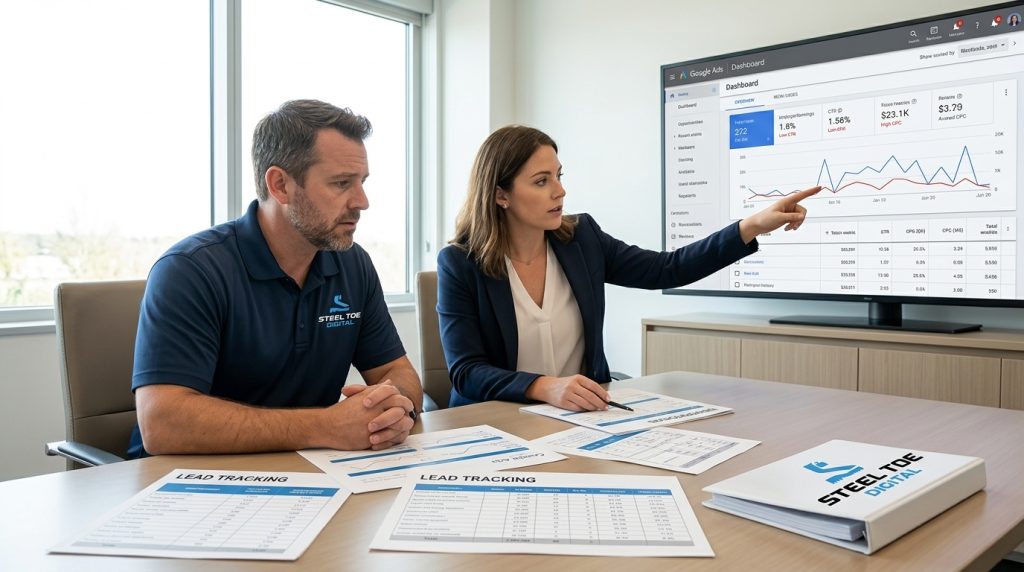
SteelToe Digital manages Google Ads for land clearing companies that want immediate project leads without burning budget on clicks that don’t convert. We’ve run campaigns for trades and land service companies and we know the difference between keywords that build pipelines and keywords that drain accounts.
We’ll look at your current setup, your market, and tell you exactly what a campaign would cost and what it should produce.
Get a Free PPC Audit
No pitch. No contract. Just a straight look at your numbers.