Google Ads for tree service can pay back $5-$10 in revenue for every $1 spent. Or they can drain your account with nothing to show for it. The difference isn’t luck. It’s setup.
Tree removal, storm cleanup, and trimming are high-ticket jobs. Average ticket runs $500-$2,000 depending on the job. That means your cost-per-lead tolerance is higher than almost any other home service. You can afford to pay $80-$120 for a booked lead and still come out way ahead. But only if the campaigns are built right.
This post walks through both types of Google Ads for tree services, how to structure campaigns, what keywords actually convert, and how to know whether your budget is working.
Local Services Ads vs. Search Ads for Tree Services
There are two different products inside Google, and most tree service companies don’t know the difference. Running the wrong one wastes money. Running both correctly is a strong one-two punch.
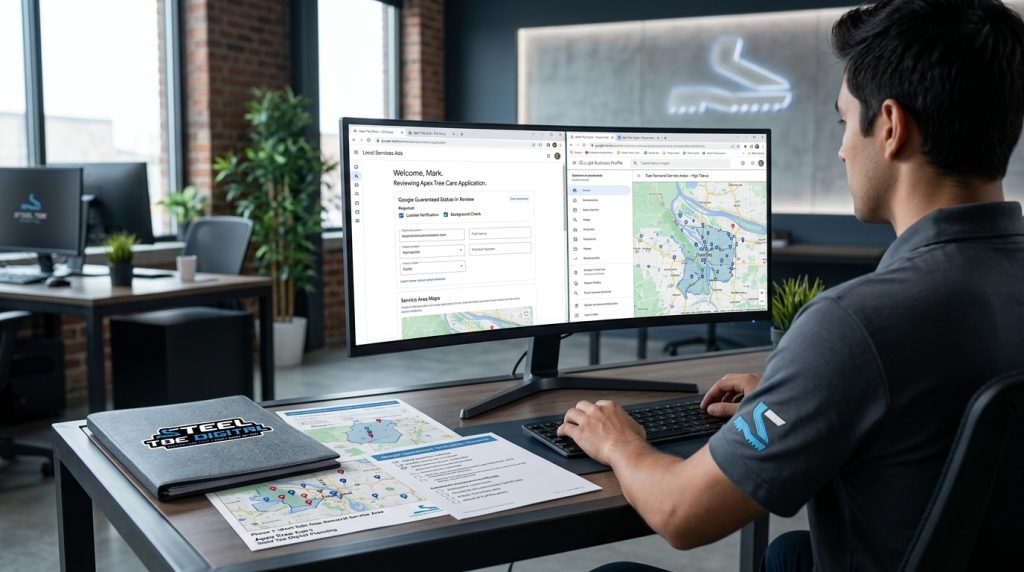
Local Services Ads (LSAs) appear above the regular search results. You pay per lead, not per click. Google runs a background check and verifies your insurance. Once you’re approved, your ad shows a “Google Guaranteed” badge. That badge matters: customers see it as a trust signal before they ever call you.
Search Ads are the traditional pay-per-click results. You write the ad, choose the keywords, set the bids, and pay every time someone clicks. More control, more complexity, higher volume potential.
The right starting point for most tree service companies: start with LSAs. Lower friction, easier to manage, and you’re only paying when someone actually contacts you. Once you have baseline data and your LSA campaigns are running clean, layer in Search Ads to capture more volume.
If budget is limited, LSA first. Every time.
How to Set Up Google Local Services Ads for Tree Services
Setup is straightforward. Execution determines whether you get leads or get outranked by the company next door.
The basic steps:
- Go to ads.google.com/local-services-ads and create an account
- Select “Tree Service” as your category
- Complete the background check and insurance verification process
- Set your weekly budget (start at $300-$500/week to gather data)
- Add your service area by city, zip code, or radius
- Write a short business description and upload photos
The part most tree services get wrong: response time. Google’s algorithm rewards businesses that respond to LSA leads fast. If a customer submits a contact request and you don’t respond within 2 hours, your ranking takes a hit. Call every lead the same day it comes in. Text if they don’t answer. Google is watching.
The Google Guaranteed badge requires passing their verification. That includes a business background check, license verification in states that require it, and proof of general liability insurance. TCIA members{:target=”_blank”} often have documentation ready that speeds this process up. If your paperwork is current, expect the verification to take 1-2 weeks.
How to Structure Google Search Ads for Tree Services
When you’re ready to run Search Ads, campaign structure determines everything. One big campaign with all your keywords lumped together is the fastest way to waste money.
Build separate campaigns by service type. Each one targets a different intent and a different ticket size.
Campaign 1: Tree Removal Highest CPC, highest margin job. Keywords: “tree removal [city],” “tree removal near me,” “tree removal service [zip code].” This is where you spend the most and get the most back.
Campaign 2: Emergency Tree Removal Emergency intent converts at the highest rate of anything in this industry. Someone searching “emergency tree service” at 11pm has a tree on their roof. They’re not price shopping. Keywords: “emergency tree removal,” “24 hour tree service,” “tree fell on house.”
Campaign 3: Tree Trimming and Pruning Lower ticket, higher volume. Good for filling the schedule in shoulder seasons. Keywords: “tree trimming [city],” “tree pruning service,” “tree trimming near me.”
Campaign 4: Stump Grinding Standalone upsell service. Customers who just had a tree removed often search separately for stump work. Keywords: “stump grinding [city],” “stump removal near me.”
Keep each campaign in its own geographic targeting. Set the radius or zip codes to your actual service area. Running ads 40 miles out when you only serve a 20-mile radius is money down the drain.

The Keywords That Actually Convert for Tree Service PPC
High-intent keywords produce leads. Low-intent keywords produce clicks you pay for that never become jobs.
Keywords worth bidding on:
- “tree removal [city name]”
- “emergency tree service near me”
- “tree cutting service [zip code]”
- “fallen tree removal”
- “large tree removal cost”
- “tree service company near me”
- “tree trimming [city name]”
Negative keywords you need from day one:
This list is not optional. Without negatives, you will pay for clicks that have zero chance of converting.
- tree service jobs
- tree service salary
- tree service technician salary
- how to remove a tree yourself
- DIY tree removal
- tree planting service
- tree identification
- tree disease treatment
- tree fertilization
- free tree removal (government programs)
- tree service training
Pull your search term report every week for the first month. You will find keywords you never anticipated that are eating budget. Add them to your negative list immediately.

Tree Service Google Ads Budget: What to Spend by Market Size
The question every tree service owner asks first is “how much do I need to spend?” The honest answer is: it depends on your market. But these ranges give you a working starting point.
| Market Size | Monthly Ad Budget | Expected Leads |
|---|---|---|
| Small market (under 100K population) | $500-$1,000 | 8-20 leads |
| Mid-size market (100K-500K population) | $1,000-$2,500 | 20-50 leads |
| Large metro (500K+ population) | $2,500-$5,000 | 50-100+ leads |
These are estimates. Your actual cost per lead depends on competition in your specific market, your quality score (which improves over time with a well-built campaign), and how well your landing page converts clicks to calls.
At a $1,000 average job and a $100 cost per lead, you’re looking at a 10:1 return before overhead. Even at $150 per lead, the math holds for most tree services. The ROI in this trade is better than most home service categories because of the average ticket.
If you’re getting leads at over $200 each and your average job is under $600, look at your campaign structure before raising budget.
How to Track Whether Your Google Ads Are Actually Working
Most tree service companies running Google Ads have no idea whether they’re profitable. They see money going out and some calls coming in and hope the math works. That’s not a strategy.
Set up call tracking from the start. CallRail{:target=”_blank”} is the standard tool for this. It creates a unique tracking number tied to your Google Ads traffic. Every call from an ad gets logged, recorded, and attributed. You’ll know exactly which keywords drove calls, which campaigns produced bookings, and what your actual cost per call is.
Connect Google Ads to your Google Analytics account and import conversions. A conversion should be a phone call that lasts at least 60 seconds, a form submission, or a booked appointment. Not a click.
Once call tracking is live, you can calculate your real numbers:
- Cost per lead = total ad spend divided by total leads
- Cost per booked job = total ad spend divided by jobs booked
- Revenue per dollar spent = total revenue from ad jobs divided by ad spend
Know these numbers before you decide whether to increase budget or cut it. Most tree service companies who say Google Ads “didn’t work” never tracked at this level. They saw a big spend number and no clear proof of return, so they stopped. Most of the time, the campaigns were producing, but no one was measuring.

What Goes Wrong When Tree Service Google Ads Fail
You’ve probably heard from someone that Google Ads “didn’t work” for their company. In almost every case, one of these was the problem.
No negative keywords. The budget went to clicks from people looking for tree trimming jobs, not tree trimming services. This is the most common waste in tree service PPC.
Sending traffic to the homepage. Your homepage is built for everyone. An ad for “emergency tree removal” should go to a landing page built specifically for emergency tree removal, with a phone number at the top, a short form, and nothing else competing for attention.
Bidding on too broad a geographic area. If your crew won’t drive 35 miles for a job, don’t run ads 35 miles out. You’ll pay for leads you can’t or won’t service.
No phone tracking. If you don’t know which calls came from ads, you can’t optimize. You’re flying blind.
Pausing campaigns too early. Google’s algorithm needs 4-6 weeks of data to optimize. Companies that run for two weeks, see uneven results, and pause are killing the campaign before it can learn.
See our full guide to tree service marketing for how paid ads fit into a broader strategy.
Google Ads vs. SEO for Tree Service: Which One First
This comes up every time. The short version: they solve different problems.
Google Ads produces leads immediately. Turn the campaign on Monday, get calls by Wednesday. Turn it off, the calls stop. It’s a faucet. Open it, water flows. Close it, it stops.
SEO builds over time. Most tree service companies see meaningful movement in search rankings between months 3 and 6. Once you’re ranking, those leads cost you nothing per click. That’s the engine that runs while you work.
The combination is what gets you. Ads fill your schedule now. SEO builds the foundation that makes ads less necessary later.
See our full guide to tree service SEO for what that build looks like.
If you’re choosing one and budget is tight: your local SEO and Google Business Profile should come first. They’re free to run once set up, and the leads they produce have no per-click cost. Ads come in when you need volume faster than organic can build it.
FAQ
Are Google Ads worth it for tree service?
For most tree service companies, yes. Tree removal and emergency service are high-ticket jobs with strong margins. At an average job value of $800-$1,500, you can afford a cost per lead of $80-$150 and still come out well ahead. The key is a properly structured campaign with negative keywords, call tracking, and a landing page that converts. Without those, the budget bleeds fast.
How much should I spend on Google Ads for tree service?
A reasonable starting point for a small to mid-size market is $1,000-$2,500 per month. Start at the lower end for the first 4-6 weeks while Google’s algorithm learns. Adjust based on your cost per lead and how many jobs you can handle. Don’t increase budget before you’re tracking calls and conversions accurately.
What is Google Guaranteed for tree services?
Google Guaranteed is a badge displayed on Local Services Ads after Google verifies your business. Verification includes a background check, license check (where required), and proof of insurance. If a customer is unhappy with a job booked through an LSA, Google will refund them up to a set amount. The badge signals trust to customers before they call. For tree services specifically, it can be a meaningful differentiator against companies that haven’t gone through the process.
What keywords should I target for tree service Google Ads?
Focus on high-intent, service-specific keywords with your city or zip code included: “tree removal [city],” “emergency tree service near me,” and “tree trimming [city]” are strong starting points. Add negative keywords for job seekers, DIY searches, and unrelated tree topics before you launch. Check your search term report weekly for the first month and keep adding negatives as you find them.
How do I know if my tree service Google Ads are working?
Set up call tracking through CallRail, connect Google Ads to Google Analytics, and define a conversion as a phone call over 60 seconds or a form submission. Then calculate your cost per lead and cost per booked job. If your cost per booked job is well below your average job value, the campaigns are working. If it’s not, look at your keyword list, your landing page, and your geographic targeting before cutting budget.
Ready to Run Google Ads That Actually Book Jobs?
Most tree service companies that have tried Google Ads before didn’t have the campaign structure, the tracking, or the negative keyword list to make it work. The budget went fast and the calls didn’t come.
SteelToe Digital manages Google Ads for tree service companies that want jobs on the schedule now, not in six months. We also build the tree service lead generation system that makes paid traffic worth running.
Get a Free PPC Audit
No pitch. No contract. Just a look at what your current setup is doing and where you’re losing budget.