
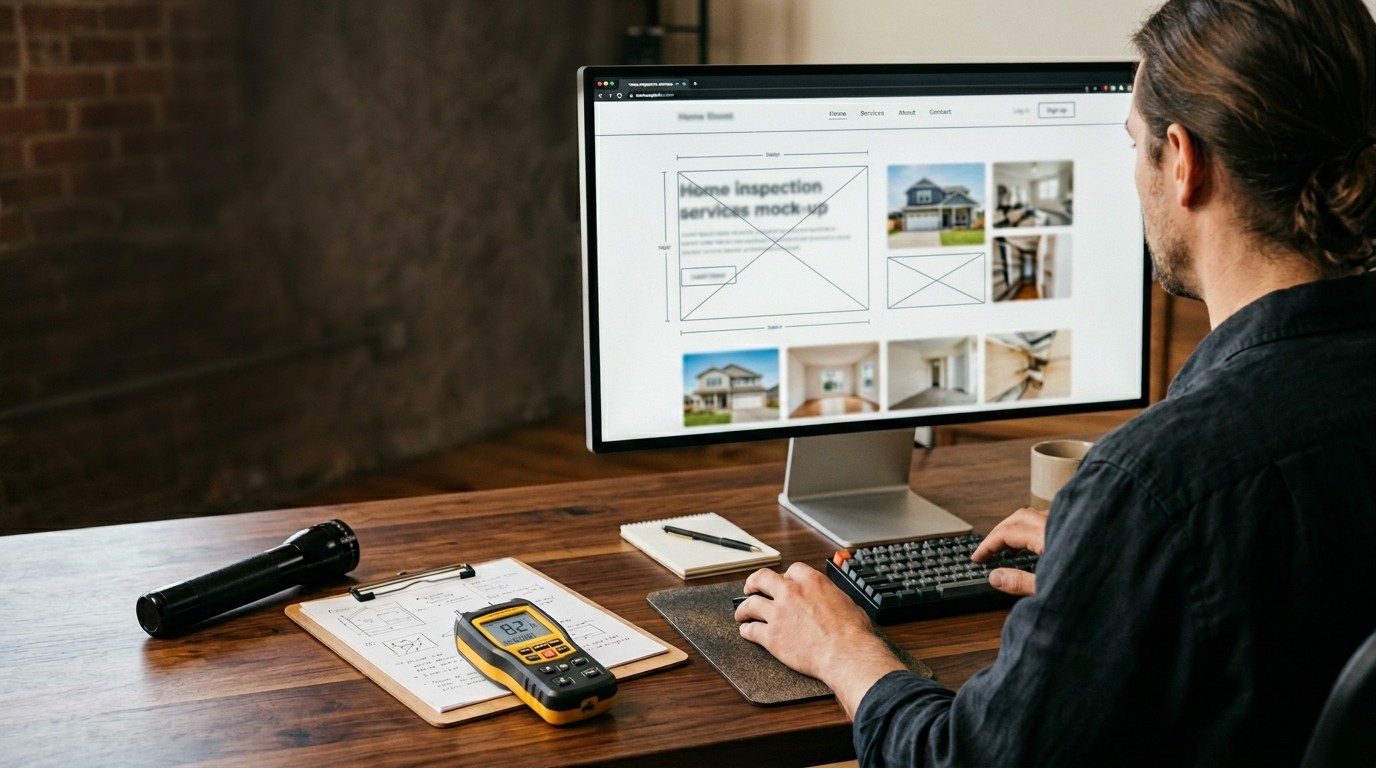
A homebuyer lands on your site with one question: “Can I trust this person with the most important purchase of my life?”
Your website has about five seconds to answer that. If it doesn’t, they hit the back button and book the next inspector in the search results.
This post covers what your website actually needs to turn visitors into booked inspections. Not a redesign checklist. Not a list of nice-to-haves. The specific elements that determine whether your phone rings or doesn’t.
What Visitors See First Determines Whether They Stay
The moment someone lands on your homepage, three things need to be visible without scrolling: who you are, where you work, and how to book you.
That sounds obvious. Most home inspector websites still miss at least one of them.
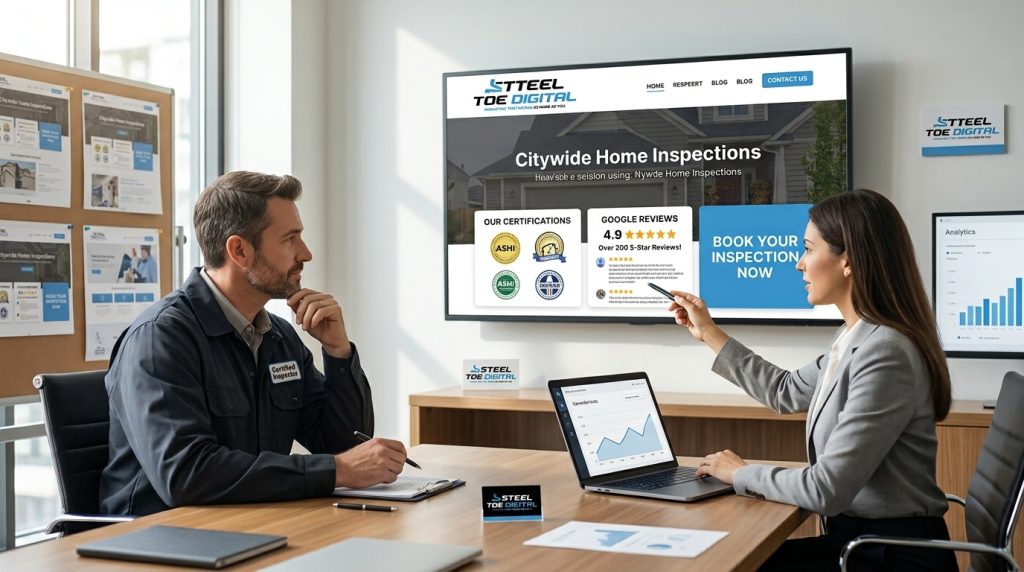
Your above-the-fold section should include a clear headline like “Certified Home Inspector in [City/Area]: Book Online,” your professional photo (more on this below), and your certification badges: InterNACHI, ASHI, your state license number. These don’t belong buried in an About page. They belong front and center, because they’re the first thing a skeptical buyer is looking for.
Add your Google star rating and review count next to your name. If you have 75 five-star reviews, that number should be the first thing someone sees. That’s 75 people who trusted you with a major purchase and came back satisfied. Show it.
Online Booking Is Your Highest-Impact Conversion Feature
Most home inspectors don’t offer online booking. That’s not a problem for them. It’s an opportunity for you.
A buyer under contract has a short inspection window. They’re stressed. They’re juggling a realtor, a mortgage broker, and a moving company. The inspector who lets them book a specific date and time at 10pm on their phone, without having to call and leave a voicemail, wins the job.
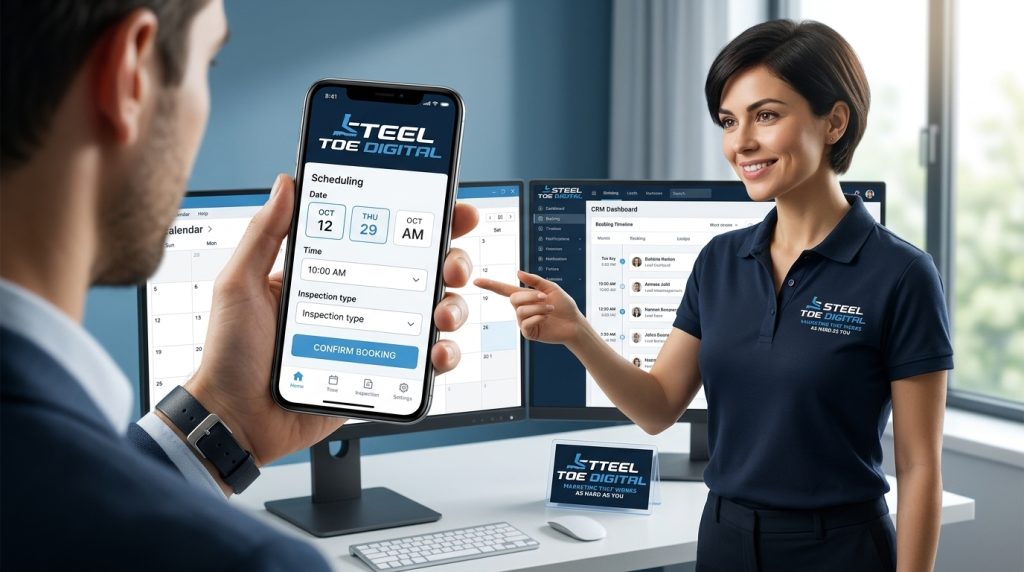
Three platforms are built specifically for home inspection scheduling: Spectora, HomeGauge, and Inspector Nexus. Spectora is the one I see most home inspectors move to when they want to clean up their booking workflow. It includes address input, inspection type selection, date and time picker, payment or deposit collection, and automatic confirmation by text and email.
That confirmation text matters. It reduces no-shows and gives the client confidence the booking went through. Small detail, real impact.
If your site currently says “call or email to schedule,” you’re leaving bookings on the table every week.

The Pages Your Website Needs
Home inspection is a multi-service business. Buyers searching for radon testing, mold testing, or sewer scope inspections are using those exact terms in Google. If you don’t have dedicated pages for each service, you won’t rank for those searches, and visitors who land on a generic homepage won’t know you offer them.
Here’s the page structure that covers your services and captures search traffic:
- Home: trust-first design, booking CTA, certifications, reviews
- Standard Home Inspection: what’s included, how long it takes, what they receive
- Radon Testing: why it matters, what the test involves, your turnaround time
- Mold Testing / Air Quality: when it’s needed, how you test, what you report
- Sewer Scope Inspection: what you’re looking for, what problems you catch
- Thermal Imaging: how infrared works, what it finds that visual inspection misses
- Pre-Listing Inspection: pitched to sellers, not just buyers
- Sample Report: a full downloadable or interactive example of what clients receive
- About: your credentials, certifications, years in business, your story
- Service Area: every city, county, and zip you cover, written out
- FAQ: the questions buyers actually search before booking
- Book Online / Contact: frictionless, mobile-friendly, no forms that ask for 12 fields
- Blog: builds local SEO over time
Each service page targets a keyword. Each page gives a buyer who searches that specific service somewhere to land and book. This is the structure behind home inspector SEO, and it applies directly to how your site is built.
Your Sample Report Page Does More Selling Than Any Sales Copy
This is the most underused page in home inspection website design.
A buyer who has never hired a home inspector doesn’t know what they’re getting. They don’t know if your report will be two pages of vague notes or a 60-page document with photos, severity ratings, and clear recommendations. The uncertainty makes them hesitate.
A sample report removes that uncertainty completely.
Post a real report, with identifying information removed. Let them download a PDF. Or use an interactive viewer if your software supports it. Show them photo documentation, clear severity ratings (safety issue vs. monitor vs. maintain), and narrative descriptions a non-expert can actually read.
Inspectors who post a sample report convert at a higher rate than those who don’t. The buyer can see exactly what they’re paying for. That removes the comparison question: “Is this inspector worth the extra $50 over the cheaper guy?”
Trust Signals That Make Buyers Book Instead of Bounce
Home inspection is personal. The buyer is trusting you inside their home, and they’re relying on your judgment for a decision that may be the largest of their life. Your website needs to signal trustworthiness on every screen.
These are the trust elements that move buyers from “considering” to “booked”:
Your photo. Not a stock image of a house. Your face, on the job or looking at the camera, professional but approachable. Inspectors are hired for trust. The buyer wants to know who’s showing up. A real photo of you closes that gap immediately.
Certification badges. InterNACHI and ASHI are the two recognized national certifications in the industry. Display them prominently. InterNACHI{:target=”_blank”} and ASHI{:target=”_blank”} both provide member badges for display on your website. If you’re state-licensed, show your license number.
E&O insurance. Errors and Omissions insurance tells the buyer that if you miss something, there’s coverage. Many buyers don’t know to look for this. Many realtors do. Mention it.
Years in business and inspections completed. “2,400 inspections completed” is more specific and more convincing than “experienced inspector.” If you have the number, use it.
Google reviews, live. A widget that pulls your current Google rating shows reviews you didn’t handpick. That’s more credible than three quotes on a testimonials page.
Video introduction. 30-60 seconds. You on camera, talking directly to the buyer. Where you work, what you check, what they’ll get. This is the single biggest differentiator I’ve seen in home inspector websites. Almost nobody does it. The inspectors who do convert measurably better.

Mobile Optimization Isn’t Optional
Most home inspection searches happen on a phone. Buyers searching “home inspector near me” at 9pm after getting an accepted offer are not sitting at a desktop.
If your site loads slowly, your booking button is hard to tap, or your phone number isn’t click-to-call in the header, you lose that buyer to the next result.
Three things your site needs to handle on mobile:
- The booking button needs to be visible without scrolling. On mobile, that means it appears in the first screen they see.
- Your phone number needs to be a tappable link. Not plain text. A tel: link that opens the dialer.
- Load time under 3 seconds. Use Google’s PageSpeed Insights to check. Images that aren’t compressed are the most common cause of slow load times on home inspector sites.
This connects directly to your home inspection marketing results: traffic that lands on a slow mobile site doesn’t convert, no matter how good your Google rankings are.
What Platform Should You Build On
For most home inspectors who want a professional site without hiring a developer every time something needs to change, WordPress with a page builder gives you the most flexibility. Pair it with Spectora or HomeGauge for booking, and you have a system you can update yourself.
If you want to avoid the technical side entirely, Squarespace and Wix can work for a simple, professional presence. The trade-off is that your SEO ceiling is lower, and you have less control over page structure. For inspectors building long-term lead generation, that matters.
What doesn’t work: a free GoDaddy site builder, a homepage your cousin built, or whatever your inspection software company offers as a “free website.” These look like what they are, and buyers notice.
See our home service website design guide for a deeper look at platform choices across the trades. The same principles apply here.
What a Home Inspector Website Actually Costs to Build
Home inspector website costs vary based on what you need and who builds it.
DIY (Squarespace, Wix): $200-$400 per year in platform costs. Your time and the result depend entirely on your design skills. Most DIY sites look like DIY sites.
Template-based professional build: $1,000-$2,500. A designer or agency takes a quality template, customizes it to your brand and service area, sets up your pages, and integrates your booking software. This is where most home inspectors should start.
Custom build: $3,500-$7,000+. A fully custom design built from scratch. Worth it if you’re running a multi-inspector operation or competing in a dense metro market where differentiation matters.
Ongoing costs to budget: hosting ($15-$30/month), booking software subscription (Spectora runs around $149/month for full features), and occasional maintenance.
If you want your site to generate leads through search, pair the build with SEO from the start. A beautiful website that doesn’t rank is just an expensive brochure. Our guide to home inspection leads breaks down where those leads actually come from.
FAQ
How much does a home inspector website cost?
A professionally built home inspector website typically runs $1,000-$2,500 for a template-based build and $3,500-$7,000 for a fully custom design. Add $200-$400 per year for hosting and platform costs, plus your booking software subscription if you go with Spectora or HomeGauge.
Should a home inspector have online booking?
Yes. Most home inspectors still rely on phone and email to schedule. Adding online booking through Spectora or HomeGauge lets buyers book a specific time without calling, which converts more late-night and weekend searches into actual jobs. It’s one of the few website changes with a direct, measurable impact on booking rate.
What platform is best for a home inspection website?
WordPress gives you the most flexibility and the best SEO ceiling for inspectors building long-term search traffic. Squarespace works for a clean, simple site with less technical maintenance. Avoid free site builders offered by inspection software companies. They limit what you can do and typically won’t rank well in competitive local search.
How do I get more home inspection bookings from my website?
Three changes move the needle fastest: add online booking if you don’t have it, add a sample report page, and make sure your Google reviews are visible on your homepage. Most home inspector websites are missing at least two of these. Fix them before spending money on ads or SEO.
Do I need a blog on my home inspector website?
Not immediately. Get your core service pages and booking flow right first. Once those are solid, a blog targeting local questions, like “how long does a home inspection take in [city]” or “what does a home inspector check,” builds search traffic over time without any ad spend. It compounds.
A Website That Books Inspections While You’re on the Job
Your site should be working while you’re 40 feet up in an attic with a flashlight. That means online booking, clear trust signals, service pages that rank, and a mobile experience that doesn’t lose the buyer between the search and the confirmation email.
SteelToe builds websites for home service businesses that rank on Google and convert visitors into customers automatically. We’ve done this across the trades. We know what works and what’s a waste of budget. If your current site isn’t pulling its weight, we’ll show you exactly where it’s losing you bookings.
Get a Free Website Review
No pitch. No pressure. Just a straight look at what your site is doing and what it isn’t.