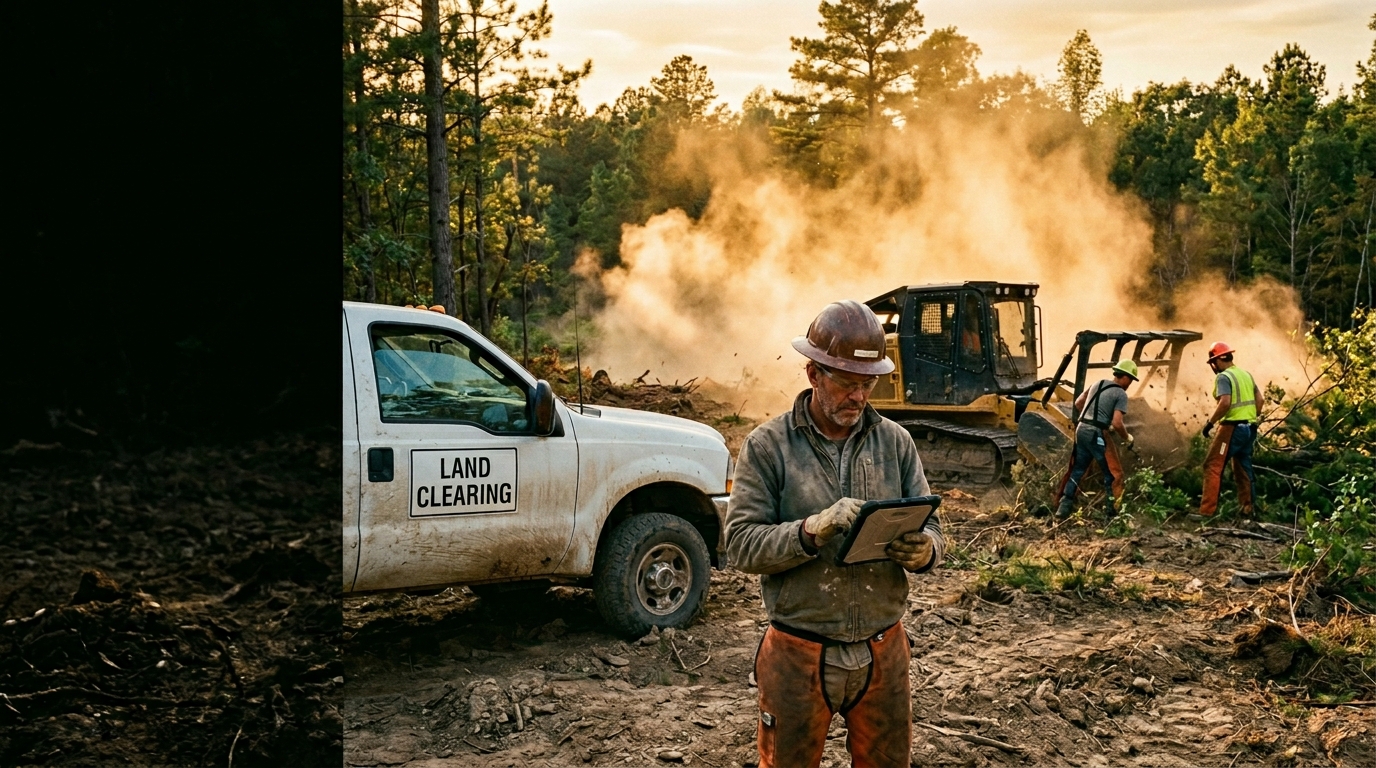
Most land clearing companies grow the same way: do good work, get a referral, repeat. It works until it doesn’t. One builder slows down. One relationship dries up. Suddenly you’ve got machines sitting and crew to pay.
This guide covers every channel worth your attention in 2026: from Google rankings and paid ads to builder relationships and direct mail to land buyers. Two customer types, six channels, one system that doesn’t depend on who you happen to know.
Understanding Your Two Customer Types
Land clearing isn’t one market. It’s two, and they behave completely differently.
Homeowners just bought five acres and have a vision. They’re searching Google at 9pm: “land clearing near me,” “lot clearing cost,” “forestry mulching [state].” They don’t know who you are. They’re going to look at your website, read your reviews, and call whoever feels most trustworthy. They’re comparing you to three other companies they found on the same page.
Builders and developers already have their guy. That’s the problem and the opportunity. When they find a land clearing company they can count on, they stick with them. One developer relationship can mean 10-50 jobs per year at project values that would take months to generate through homeowner inquiries. But you don’t win that relationship from a Google search. You earn it over time.
Your marketing system has to work for both. The channels overlap more than most people think, but the message and approach are different. Know who you’re talking to before you open your mouth.
Channel 1: Local SEO and Content Marketing
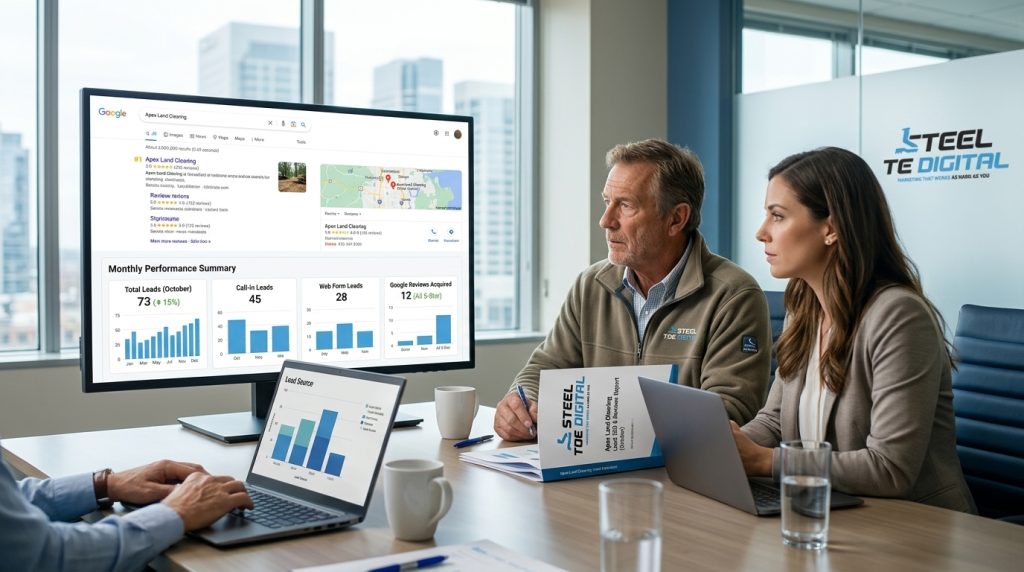
Homeowners search Google. Builders in a new market search Google too. Local SEO is the foundation because it puts you in front of both.
The basics: your Google Business Profile, consistent citations, and a website that tells Google exactly where you work and what you do. Most land clearing companies are missing at least one of these. Some are missing all three. The bar to rank in this niche is lower than most contractors realize.
Beyond the basics, content earns rankings. Pages that answer the questions people actually search: what does land clearing cost in [state], what’s the difference between forestry mulching and traditional clearing, do I need a permit to clear land in [county]. These aren’t just SEO plays. They demonstrate that you know your trade and educate the customer before they ever call you.
Our full breakdown of the SEO side is in our land clearing SEO guide. It covers keyword targeting, Google Business Profile optimization, and what to prioritize first.
Channel 2: Builder and Developer Relationships
You can’t outrank your way into a builder relationship. That’s earned through showing up, following through, and being easier to work with than the next guy.
Start with the National Association of Home Builders (NAHB). Your local chapter has monthly meetings full of the exact people who need reliable land clearing crews. County planning meetings are another underused venue. When a subdivision plat gets approved, that’s a development project that needs land prep. The people in that room know it before anyone else does.
LinkedIn is worth your time if you work in a market with active development. Connect with general contractors, civil engineers, land developers, and site work PMs in your region. Don’t pitch them. Comment on their projects, follow what they’re working on, and be visible. When they need someone, you want your name in their head.
The number one thing builders value is reliability. Not price. Not equipment. Reliability. Show up when you say you will, finish on schedule, communicate when something changes. That’s the entire pitch. A land clearing company that answers texts and hits deadlines can take work from competitors who are technically better but operationally inconsistent.
Channel 3: Your Website and Portfolio
Most land clearing websites are the same: a stock photo of a mulcher, a list of services, a phone number, and nothing else. That’s not a marketing asset. It’s a placeholder.
Your website has one job for homeowners: make them trust you enough to call. For builders visiting after a referral, it has a different job: confirm they made the right call by reaching out. Both need to see scale, professionalism, and proof.
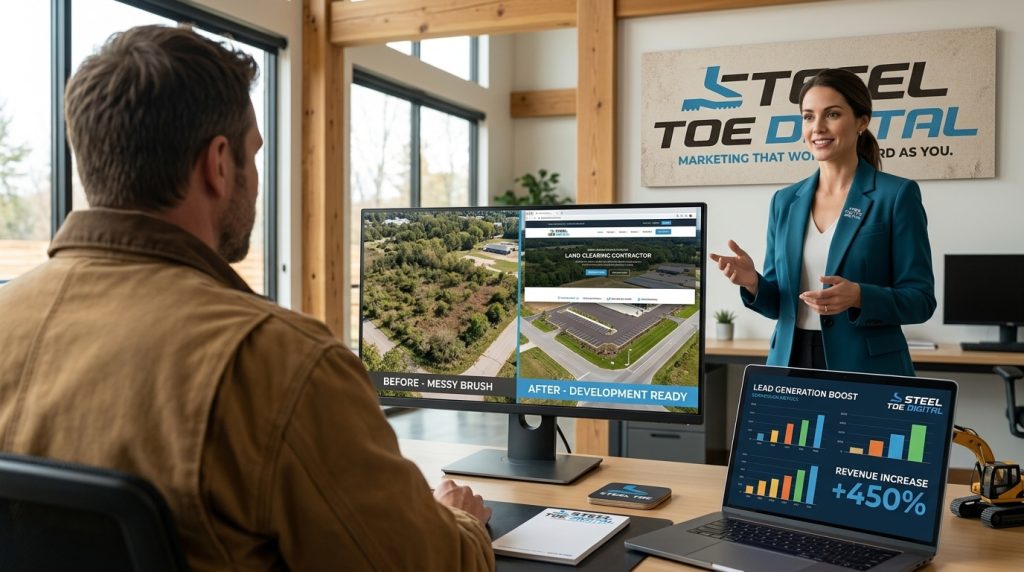
The most important page most land clearing companies don’t have: a real portfolio. Not a gallery of 12 undated photos with no context. Project case studies with acreage, project type, timeline, and before/after photos. “10 acres cleared and graded in Blount County, TN. Pre-build site prep for residential subdivision, completed in 11 days.” That’s a builder reading that and thinking: this is someone I can use.
Drone footage changes what’s possible here. A three-minute aerial video of a 15-acre clearing project gets shared in rural Facebook groups, construction industry pages, and YouTube searches. It also sits on your portfolio page and does more conversion work than anything else you could put there.
See our guide to land clearing website design for a full breakdown of what your site needs.

Channel 4: Google Ads
Land clearing jobs run $1,500 on the low end. Large site prep projects for developers can hit $80,000-$200,000. At those ticket sizes, Google Ads math works even when cost per lead is high.
A homeowner searching “land clearing company near me” in a rural market might cost $8-$25 per click. Convert one in ten clicks and you’re spending $80-$250 per lead. Convert one in four leads to a booked job at a $5,000 average ticket and you’re spending $320-$1,000 to acquire a $5,000 job. That’s a machine worth running.
The catch: your landing page has to convert. If you’re sending Google Ads traffic to a generic homepage with no portfolio and a contact form buried three scrolls down, you’re wasting money. The landing page needs to match what the searcher expected, show proof fast, and make the call easy.
Start with exact-match keywords for high-intent searches: “land clearing [city],” “lot clearing near me,” “forestry mulching [county].” Skip broad keywords until you’ve verified what converts. The broader you go, the more budget you burn on irrelevant clicks.
Our Google Ads guide for land clearing covers campaign structure, bid strategy, and what a converting landing page looks like.
Channel 5: Direct Mail to Land Buyers
County deed records are public. When someone buys five or more acres, that transaction is on file. In most counties, you can pull recent land purchases by acreage and address. Those buyers are your best prospects.
A targeted mailer to recent land buyers works because the timing is right. They just acquired land. They don’t have a land clearing company yet. They’re actively figuring out what to do with the property. A simple postcard: “Just bought land in [county]? We’ll clear it, prep it, and have it ready for your build. [Phone number]. [Website].” Photo of a cleared lot on one side. That’s the whole campaign.
In rural markets, don’t overlook local agricultural publications and farm bureau newsletters. These aren’t digital plays but in areas where print still moves, they put you in front of landowners who have clearing needs and no Google habit.
Direct mail doesn’t scale the way digital does. But for a land clearing company building its first customer base or entering a new county, it’s one of the most targeted channels available.
Channel 6: Equipment and Project Photography
Land clearing is one of the most visually compelling trades there is. A tracked mulcher going through dense timber, a cleared parcel revealing a ridgeline view, a 20-acre job that transformed overgrown scrub into build-ready land. That content stops people in their feed.
Most land clearing companies are not using this. The ones that are get shares, followers, and calls from people who didn’t know they needed clearing until they saw what was possible.
Instagram and Facebook are both worth attention here. Facebook reaches rural and suburban homeowners and gets heavy engagement in local community groups. Instagram skews younger but reaches the demographic of people buying land to build on. Post the work. Aerial before and after. The machine in action. A timelapse of a two-day job compressed into 60 seconds.
You don’t need a social media strategy. You need someone on the crew taking phone video and photos on every major job. Edit it, post it, tag the location. That’s a $0 content budget that compounds over months.
Land Clearing Marketing Budget Guide
Where you put money depends on where you are.
| Stage | Monthly Budget | Priority |
|---|---|---|
| Starting out | $200-$600 | Google Business Profile + website + reviews |
| Growing | $600-$2,000 | SEO + content + builder outreach |
| Scaling | $2,000-$6,000 | Google Ads + social + direct mail |
The starting stage is non-negotiable before anything else. If your Google Business Profile is incomplete and your website doesn’t build trust, paid traffic is money out the door. Fix the foundation before you pour fuel on it.
The scaling stage budget assumes you’ve proven your conversion rate. You know what a booked job is worth and you know your close rate from phone calls. Once you have those numbers, the budget question answers itself. If you’re spending $2,000/month and generating $30,000 in new contracts, the only question is how high you want to turn it up.
For a deeper look at what’s worth spending money on, see our land clearing leads guide and our overview of marketing for contractors.
What Happens When You Don’t Build the System
Right now there’s a land clearing company in your market that’s been doing this for 15 years on referrals. They’re good at the work. They don’t have a real website, they have 12 Google reviews, and they don’t run ads.
You can take their customers. Not because you’re better at clearing, but because you’re easier to find. A homeowner with five acres searching Google at night isn’t going to call someone they’ve never heard of unless they find proof first. If you have a real website, 40+ reviews, a visible Google profile, and photos of work at scale, you get the call. They don’t.
That’s the math of inaction: your competitor’s weak marketing is your opportunity. Every month you’re not building this system, someone else is filling the gap. And once a homeowner has a clearing company they trust, they refer their neighbors, their coworkers, their relatives buying rural land. You lose those calls before they ever happen.
The builder side is worse. One competitor who shows up at NAHB meetings, makes the calls, and follows through consistently can lock in developer relationships that run for years. That’s volume no amount of Google Ads budget replaces.
For more on how this plays out across the land clearing niche, see our full land clearing marketing hub and our overview of contractor SEO.

Frequently Asked Questions
How do land clearing companies get customers?
Most land clearing companies get their first customers through referrals from builders, neighbors, and real estate contacts. Growing beyond referrals requires a Google Business Profile with consistent reviews, a website that shows your work, and either organic SEO or Google Ads to reach homeowners actively searching. Builder and developer relationships require in-person networking through NAHB chapters and local construction industry events.
How do I find land clearing leads?
The highest-quality homeowner leads come from Google search, either through organic rankings or paid ads. For commercial leads, county deed records let you identify recent land buyers who likely need clearing. Local builder relationships are the highest-volume source of repeat work. See our land clearing leads guide for a full breakdown by channel and cost.
What marketing works best for land clearing?
Local SEO and Google Ads work best for reaching homeowners actively searching for a clearing company. Project photography and before/after content on Facebook and Instagram builds awareness with rural audiences. Direct mail to recent land buyers is effective and low-cost. For builders and developers, in-person networking and consistent follow-through beats any digital channel. The right mix depends on your market size and whether you’re targeting homeowners, builders, or both.
How long does it take to see results from land clearing marketing?
Google Ads can generate leads within the first two weeks of a live campaign. Local SEO takes longer: most companies see meaningful movement in search rankings between months 3 and 6, assuming consistent review generation and optimized on-page content. Builder relationships take longer still, typically 6-12 months of consistent presence before a developer trusts you enough to put you on a project.
How much should a land clearing company spend on marketing?
Budget varies by market and business stage. Starting out, $200-$600/month covers the fundamentals: a working website, a complete Google Business Profile, and a process for getting reviews. Growing companies typically spend $600-$2,000/month adding SEO and content. Scaling companies running Google Ads alongside SEO and social typically invest $2,000-$6,000/month. The number that matters is return: if you’re spending $1,500/month and generating $25,000 in new contracts, the question is how to spend more, not less.
Ready to Build a System That Generates Jobs Beyond Referrals?
Right now you’re doing good work. The problem is people who need that work can’t find you. SteelToe Digital builds marketing systems for land clearing companies that want consistent leads from homeowners and builders, not just whoever happened to call a friend. We know the trades from the inside: this isn’t our first rodeo with heavy equipment and project seasonality.
Let’s look at your current Google presence and show you exactly where the gaps are.
Get a Free Strategy Call
No pitch. No contract. Just a clear picture of where you stand and what’s worth fixing first.