
Most land clearing companies don’t show up on Google at all. That’s not a knock. It’s an opportunity. While your competitors are still relying on the same builder referrals they’ve had for ten years, homeowners and developers are searching for land clearing services online right now and finding nobody.
One job from Google can pay for six months of SEO. That’s not a stretch. Land clearing is a high-ticket, project-based trade where a single search leads to a $5,000-$40,000 contract. The math is different here than in most trades. And the online competition is almost nonexistent.
This guide covers exactly what it takes to rank: your Google Business Profile, your website, reviews, content, and backlinks. If you follow this and your competitors don’t, you win by default.
Why SEO Works Better for Land Clearing Than Almost Any Other Trade
The job sizes are large. A residential lot clearing runs $1,500-$8,000. An acreage clearing for a new home build runs $5,000-$30,000. A commercial clearing project can go well past $50,000.
That means one lead from Google can generate more revenue than most trades see in a week of paid ads. You don’t need volume. You need a handful of the right jobs. SEO can get you there.
The other factor: almost nobody in land clearing is doing this. Most companies in the trade are built on referral networks. Builders, civil engineers, real estate developers. That’s a good business. It’s also fragile. If your main referral source retires, slows down, or starts using someone else, your pipeline dries up.
The homeowner market is also growing. More people are buying rural land. More people are building on lots that haven’t been touched in twenty years. They’re searching Google because they don’t have a builder relationship. They just need someone to clear their property so they can start.
That someone can be you, if you show up.
Google Business Profile: Your Most Important SEO Asset
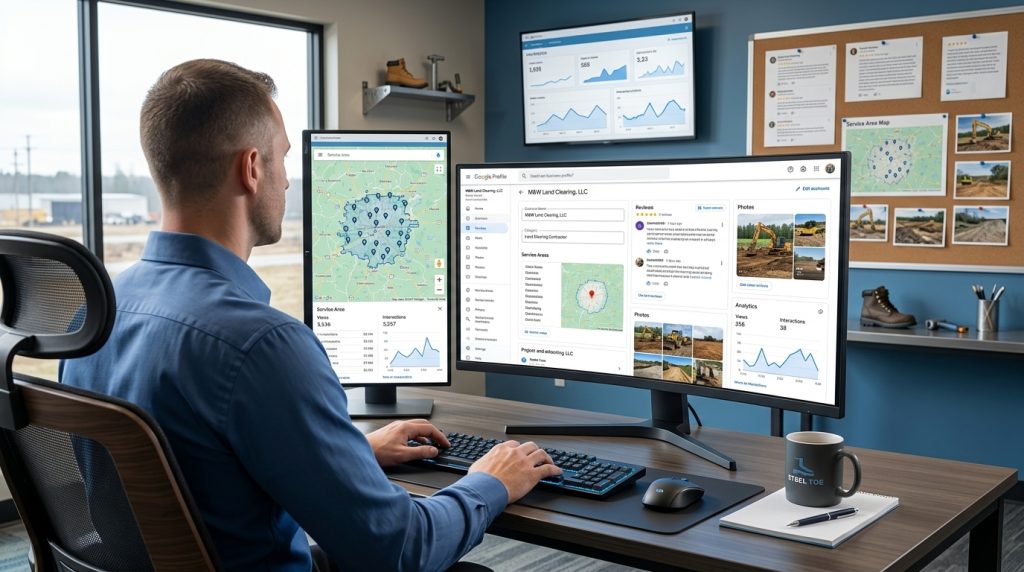
Your Google Business Profile (GBP) is where most of your local search traffic is going to come from. When someone searches “land clearing near me” or “land clearing in [county],” Google shows a map with three listings at the top. That’s the 3-pack. Getting into it is the single highest-value thing you can do for your search visibility.
Category. Your primary category should be “Land Clearing Service.” If that’s not available in your area, “Excavating Contractor” is your next best option. Your secondary categories can include “Demolition Contractor,” “Grading Contractor,” or “Landscaping Service” depending on what you actually do.
Services. List every service you offer. Full land clearing, forestry mulching, brush clearing, stump grinding, lot clearing, grading, timber removal. Be specific. Google uses this to match your profile to relevant searches.
Service area. Land clearing companies often cover wide areas. List every county and region you serve. Don’t just put your city. If you’re clearing property 60 miles away, make sure those counties are in your service area settings.
Photos. This matters more than most people think. Before-and-after shots of completed jobs are the most effective. Equipment photos show scale and credibility. If you have aerial shots of large projects, use them. Profiles with strong photo libraries consistently outperform thin ones.
Posts. Use the GBP posts feature for seasonal content. Land clearing is seasonal in most markets. Spring is high demand. Post about it. “Spring is land clearing season. If you’re planning to build or develop this year, now is the time to schedule your site prep.” Three to four posts per month keeps your profile active.
Q&A. Seed your own questions and answers. “Do you clear land in [county]?” “Do you handle forestry mulching?” Answer them yourself. This fills out the profile and captures searches you might not be ranking for elsewhere.
Reviews: The Trust Signal That Closes the Job
Land clearing companies have fewer customers than plumbers or electricians. You’re not doing ten jobs a day. You might do ten jobs in a month. That changes the math on reviews. You can’t generate the same volume. But you don’t need to.
Most land clearing companies on Google have 5-15 reviews. Getting to 25-40 reviews at 4.7 stars or higher puts you in a different category from every competitor in your market. The bar is low because almost nobody has cleared it.
Ask for reviews from every single customer. Homeowners, builders, developers, real estate agents who referred the job. Send a follow-up text the day after the job wraps. “Thanks for trusting us with your project. Would you mind leaving us a review on Google? It helps people find us.” That’s all it takes.
Contractor and developer reviews carry weight. When a general contractor leaves a review that mentions the scope of the project, the timeline, and how the site looked when you were done, that review closes jobs. Property owners reading it can see that builders trust you. That’s a different kind of credibility than a homeowner saying “great job.”
Respond to every review. The positive ones, keep it brief. Thank them, mention what you did. The negative ones, respond professionally. Other prospects are reading how you handle problems as much as they’re reading the positive reviews.
For more on review strategy across the contractor trades, see our full guide to local SEO for contractors.

Building a Land Clearing Website That Ranks
Your website has one job: rank for the searches your customers are making and convert them into a call or form submission. Most land clearing websites fail at both. They’re either thin brochure sites with no real content, or they’re built without any thought given to what Google needs to see.
Service pages. Every service you offer should have its own page. Full land clearing, forestry mulching, stump grinding, brush clearing, lot clearing, acreage clearing, and grading. Each page should be 600-1,000 words with real content about what the service involves, how you do it, what equipment you use, and what the customer should expect. Not keyword stuffing. Actual useful information.
Location pages. If you serve multiple counties or regions, build a page for each. “Land Clearing in [County] [State]” is exactly the kind of search people make when they’re looking for someone local. A well-built location page can rank for those searches even if you’re competing against companies that have been around longer.
Project portfolio. Before-and-after photos with project details are your most powerful sales tool on the website. Note the acreage, the project type, the location (general, not a private address), and how long it took. This shows scale. A developer looking at a 20-acre commercial clearing job wants to see that you’ve done that before, not just backyard lots.
Equipment list. This closes commercial jobs. A page that lists your equipment: dozers, forestry mulchers, excavators, brush cutters, dump trucks, and their capacities tells the serious buyer whether you can handle their project. Most competitors don’t have this. It’s a differentiator.
Schema markup. Your developer or SEO provider should add LocalBusiness schema and, where applicable, Excavating Contractor or related contractor schema. This helps Google understand what you do and where you do it. It’s a technical detail, but it matters.
For a full breakdown of what a high-performing land clearing website needs, see our land clearing website design guide.
Content Strategy: The Jobs Nobody Else Is Targeting
Land clearing has a search problem and an opportunity at the same time. The search volume for “land clearing SEO” is low. But the searches property owners make around the buying decision are substantial, and very few land clearing companies are answering them.
Here are the searches that convert to real jobs:
“How much does land clearing cost per acre” is one of the most searched questions in the category. Write a real pricing guide. Give real ranges by project type. Reference your market. If you’re not willing to discuss pricing publicly, your competitor who is will get the search traffic and the call.
“Forestry mulching vs. traditional land clearing” catches buyers who are comparing methods. This is typically a higher-budget buyer: someone planning a bigger project who has already done some research. A well-written comparison puts you in front of them as the credible expert.
“How to prepare land for building a home” reaches buyers before they’ve even started searching for a specific contractor. If you’re the company that helped them understand the process, you’re the company they call.
“How long does land clearing take” is a practical question from someone who is actively planning. Answer it specifically. “A one-acre residential lot typically takes one to two days depending on density. A five-acre forested lot might take a week.” Real numbers.
“Do you need a permit to clear land in [state]” is a high-intent, location-specific search. This varies by state and county. Write it for your market. If someone in your county searches that question and your post answers it, you’ve earned the next call.
This kind of content builds the organic traffic that runs while you’re in the field. You write it once. It works for years.

Backlinks: How to Build Authority for a Land Clearing Website
Backlinks are links from other websites to yours. Google treats them as votes of confidence. The more credible websites that link to you, the more authority your site has and the easier it is to rank.
Land clearing is niche. You’re not going to build 200 backlinks. You don’t need to. In a low-competition category, 20-40 high-quality links can put you at the top of your market.
Builder associations. Local chapters of the NAHB (National Association of Home Builders) often maintain member directories. If you’re doing work alongside builders, a listing on those directories is a credible backlink and a direct referral source.
Landscape architects and civil engineers. These professionals refer land clearing jobs regularly. Reach out, introduce yourself, and see if there’s a referral arrangement. Many firm websites have contractor or preferred partner pages. A link from a civil engineering firm carries real authority.
Local agricultural and rural publications. County extension offices, rural land publications, and agricultural associations often cover topics relevant to land clearing. Writing a guest post or being mentioned in a local resource earns a relevant backlink.
Equipment manufacturers. Some equipment manufacturers and dealers maintain “find a contractor” directories or feature operators who use their equipment. If you run a specific brand of forestry mulcher or dozer, check whether that brand has a contractor network you can be listed in.
Backlinks from credible sources in related industries are worth far more than generic directory listings. Focus on quality over quantity.
For a full treatment of the contractor SEO fundamentals that apply across the trades, read our contractor SEO guide.
How Land Clearing SEO Fits Into Your Bigger Marketing Picture
SEO is a long play. You’re not going to post your Google Business Profile today and get calls next week. Most land clearing companies see meaningful movement in local rankings between months 3 and 6. Website content rankings often take 6-12 months to compound. That’s the honest timeline.
What makes it worth it: unlike Google Ads or lead services, the traffic doesn’t stop when you stop paying. You build the asset once and it keeps working. A plumbing company paying $80 per lead from Angi is renting their pipeline. A company ranking organically on Google owns it.
The other thing SEO does is change who’s calling. Paid lead services sell the same lead to 3-5 contractors. You’re competing on price before the conversation even starts. Organic search brings in someone who searched specifically for land clearing in your area and clicked on you. That’s a different buyer. They’re not comparing three quotes. They’re calling you.
For the companies that have already tried paid ads without great results, see how Google Ads for land clearing can work alongside an SEO strategy rather than replacing it.
And if you want the full view of what a complete land clearing marketing strategy looks like beyond just SEO, the land clearing marketing guide covers it.

FAQ
How do I get my land clearing company to rank on Google?
Start with your Google Business Profile. Make sure your category, services, service area, and photos are all complete. Then build out your website with individual service pages and at least a few location pages. Get into the habit of asking for reviews after every job. These three things, done consistently, are what move the needle in most markets. SEO for a land clearing leads strategy builds from this foundation.
What keywords should a land clearing company target?
Your core keywords are “land clearing [city],” “land clearing [county],” “lot clearing near me,” “forestry mulching [city],” and “land clearing company [state].” Beyond those, target informational searches your potential customers make: land clearing cost per acre, how long does land clearing take, permit requirements for clearing land. These capture buyers early in the process.
How much does land clearing SEO cost?
Most land clearing companies pay $750-$2,500 per month for professional SEO depending on how competitive their market is, how many service areas they want to target, and how much content needs to be built. In most rural and suburban markets, this is on the lower end because the competition is thin. Your cost to get to page 1 is lower here than it would be for plumbing or HVAC in a major metro.
How long does it take to rank for land clearing keywords?
Local map pack rankings (the Google Maps 3-pack) typically move in 2-4 months with consistent effort on your GBP and reviews. Website rankings for keyword-targeted service and location pages take longer: 4-9 months in most markets. The timeline depends on how competitive your specific market is and what your starting baseline looks like.
Is SEO worth it for a land clearing company that already gets referrals?
Yes, because referrals are not predictable. Your builder contacts retire. Development projects slow down. A market downturn hits the construction sector. Companies that have organic search traffic alongside their referral network don’t feel that as hard. One high-ticket job from Google every month pays for the SEO and adds margin on top of what you’re already doing.
Be the First Land Clearing Company Property Owners Find
Right now, people in your area are searching for land clearing. Most of them aren’t finding a local company. They’re finding out-of-state directories, generic contractor lists, or nothing useful at all.
SteelToe builds SEO systems for land clearing companies that want real project leads, not cold calls and lead-sharing services. We’ve worked with trades businesses from the ground up and know what it takes to get a specialized contractor to page one in markets where almost nobody else is competing.
Let’s look at where you rank right now and what it would take to change it.
Get a Free SEO Audit
No pitch. No contract. Just a free look at your numbers.