

Most homeowners don’t think about their septic system until something goes wrong. When the alarm goes off or the yard starts smelling, they grab their phone and search Google. The company that shows up first gets the call. Right now, is that you?
Septic is one of the most undermarketed home services in the country. Most of your competitors have no SEO strategy, a GBP profile they set up and forgot, and five reviews from 2021. That’s not a threat. That’s an opening.
This guide covers what it actually takes to rank: your Google Business Profile, your website, your reviews, your content, and your citations. Follow it and you’ll be ahead of most of the market within 6-9 months.
Why SEO Is the Best Marketing Channel for Septic Companies
When someone searches “septic pumping near me,” they are not browsing. They have a problem and they need someone today. That’s the highest-intent lead you can get. They’re already sold on needing the service. The only question is which company they call.
Paid leads from Angi or HomeAdvisor run $80-$200 per lead for septic services, and that same lead is sent to 3-5 other companies at the same time. SEO leads cost $15-$50 per lead once the system is built, and you’re the only one who gets the call.
The other reason septic SEO works: low competition. Plumbing companies have been investing in SEO for years. Septic companies mostly haven’t. In most mid-size markets, you can rank in the Google Maps 3-pack within 4-8 months with consistent execution. That’s not common in other trades. Take the window while it’s open.
SEO also solves the seasonality problem. Slow months hit every septic company. A library of content targeting “how do I know if my septic system is failing” or “how often should I pump my septic tank” keeps your phone ringing in February, not just in the spring rush.
For a deeper look at how SEO works across trade businesses, see our guide to contractor SEO.
Your Google Business Profile Is the Foundation
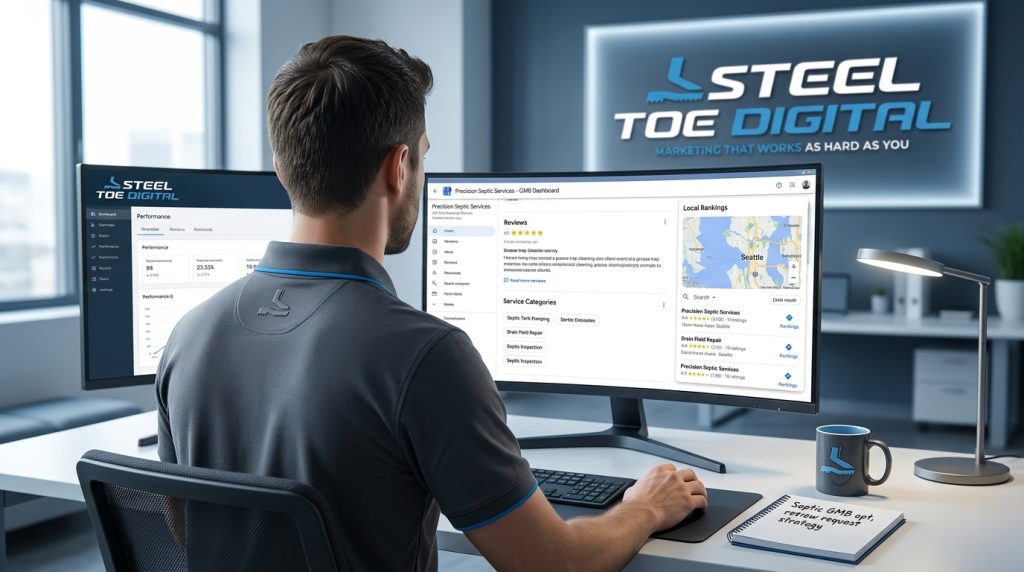
Your Google Business Profile (GBP) is the single most important ranking factor for local search. It determines whether you appear in the Google Maps 3-pack when someone in your service area searches for septic services. Most septic companies have a GBP. Most of them set it up once and left it alone.
Primary category: Set it to “Septic System Service.” Not “Plumber.” Not “Contractor.” The primary category tells Google what you do, and the right one is more specific and less competitive. If you also do portable toilet rental or excavation, add those as secondary categories.
Services section: Fill it out completely. List every service: septic pumping, septic inspection, septic installation, drain field repair, grease trap pumping, septic riser installation. Each service entry is a ranking signal. Empty entries are a missed opportunity.
Photos: Upload real job photos. Trucks with your logo, equipment on a job site, before-and-after shots of field work where appropriate. Not stock photos. Profiles with 20 or more real photos consistently outperform profiles with 3-5 generic images. Aim for one new photo per week.
GBP Posts: Use them. A post every 2-3 weeks signals that your profile is active. Seasonal posts work well: “Spring is peak pumping season. Book now before scheduling fills up.” Or: “Thinking about annual septic service before the ground freezes? We’re scheduling October and November now.” These also show up in search results and give people a reason to click.
Q&A section: Don’t wait for customers to ask questions. Seed your own. Add the questions homeowners actually ask: “Do you offer emergency septic service?” “What areas do you serve?” “Are you licensed and insured in [state]?” Then answer them clearly.
Reviews Win Septic Jobs
Homeowners trust their neighbors more than any ad. When someone searches for a septic company, they look at the reviews before they dial. A company with 60 reviews at 4.8 stars wins over a company with 8 reviews at 4.2, every time, even if the second company has been in business longer.
The good news: the bar is low. Most septic companies have almost no reviews. Thirty quality reviews can make you the dominant company in your local market. That’s 30 customers out of however many jobs you’ve run this year. You already have them.
The target is 40+ reviews at 4.7 stars or higher to be competitive in most markets. In smaller or rural markets, 20-25 reviews at 4.8+ is often enough to own the 3-pack.
How to get reviews consistently: Text every customer after service is complete. The message should be short: “Thanks for trusting us with your septic service today. If you have a minute, a Google review would mean a lot to our team. [link]” Texting beats email. Immediacy beats a follow-up three days later.
If a job goes sideways, call the customer before they post. Most people don’t want to leave a bad review. They want to feel heard. A callback within an hour of a complaint resolves more situations than you’d expect.
Do not offer discounts or incentives for reviews. Google’s terms prohibit it, and the risk isn’t worth it.

Building a Septic Website That Earns Rankings
Your website has one job before it has any other job: it has to rank. A beautiful website that lives on page 3 of Google doesn’t generate calls. Structure and technical execution matter as much as design.
Service pages: Build a dedicated page for every core service. Septic pumping, septic inspection, septic system installation, drain field repair, riser installation, and grease trap pumping each deserve their own page with 400-600 words of real content. One page that says “we do it all” ranks for nothing. Six specific pages each rank for something.
Location pages: If you serve multiple cities or counties, build a page for each one. “Septic pumping in [City Name]” is a search. If you don’t have a page that matches it, someone else will show up instead of you. These pages should include local context: county regulations, local health department contacts, anything specific to that service area.
Schema markup: Add LocalBusiness schema to your homepage and service-area schema to your contact page. This tells search engines exactly what you are, where you operate, and what you do. A developer can add this in a few hours. It pays off in visibility.
Technical basics: Your site needs to load in under 3 seconds on mobile. More than half of homeowner searches happen on a phone. A slow site loses customers before they ever read a word. Run your site through Google’s PageSpeed Insights and fix whatever is red.
Licensing information: Post your state license number prominently. Septic work is regulated in every state. Homeowners know this. Showing your license number immediately removes a concern they’d otherwise have to go looking for.
For more on what a trades website needs to convert, see our guide to septic company website design.
Content That Captures Septic Searches Year-Round
Service pages rank for transactional searches. Content ranks for informational searches, and informational searches are where most of the volume is. Someone searching “how often should I pump my septic tank” isn’t ready to book yet, but they will be soon. If your content is what they read, you’re already the company they trust.
These are the content topics worth building:
“How often should a septic tank be pumped?” This is a high-volume, low-competition search in almost every market. The answer is 3-5 years for a typical household, but it depends on household size and tank capacity. Write it well, with a table that breaks down size vs. frequency, and you can rank for it within a few months.
“Signs of a failing septic system” captures homeowners who have a problem but don’t know what it is yet. Slow drains, gurgling pipes, wet spots over the drain field, sewage odor in the yard. Write this with real detail and you become the expert before they ever call.
“How much does septic pumping cost in [state]?” Homeowners want to know before they call. Being the source of that information builds trust. Keep it accurate: septic pumping typically runs $300-$650 depending on tank size, access, and market. Avoid vague language. Give real ranges.
“What not to flush with a septic system” performs well year-round and positions you as the company that educates, not just services. Wipes, grease, medications, garbage disposal overuse. Real advice, not a product pitch.
“How long does a septic system last?” A well-maintained concrete or fiberglass tank lasts 40+ years. The drain field is the variable: 20-30 years with proper care, less if it was installed poorly or overloaded. This topic naturally leads to inspection and maintenance service calls.
One blog post per month on topics like these builds a library that generates calls without any ad spend. Month by month, that library compounds.
Citations and Directories That Matter
Citations are mentions of your business name, address, and phone number across directories and websites. Consistent citations tell Google your business is real, established, and operating at the location you claim. Inconsistent citations, where your address is listed differently across five platforms, create doubt that hurts rankings.
Start with these directories:
- Google Business Profile (your anchor)
- Yelp
- BBB (Better Business Bureau)
- Angi
- HomeAdvisor
- Facebook Business
Industry-specific directories:
- NOWRA (National Onsite Wastewater Recycling Association) maintains a contractor directory. If you’re a member, your listing there carries weight.
- Your state health department may publish a licensed contractor directory. Many do. Get listed.
- State licensing databases often have a public-facing search. Make sure your entry matches exactly what you list everywhere else.
The rule with citations is consistency. Your business name, address, and phone number need to be identical across every listing. Not close. Identical. “St.” vs. “Street” matters. Suite number present on one listing and absent on another creates a conflict. Run an audit through BrightLocal or Whitespark and fix every discrepancy you find.
Twenty to thirty consistent citations across quality directories is enough. You do not need to be listed on 200 directories. Focus on the ones that matter and make sure they’re clean.

What Septic SEO Actually Costs and How Long It Takes
Septic SEO typically costs $750-$2,500 per month depending on your market, the scope of work, and whether you need a new website or are working with an existing one. In less competitive rural markets, a lighter investment gets results. In suburban markets around major cities, you need a more complete strategy.
Timeline: most septic companies see meaningful movement in their local rankings between months 3 and 6. Reaching the top 3 in Google Maps in a typical market takes 6-12 months of consistent execution. That means publishing content, generating reviews, building citations, and keeping the GBP active every single month.
Anyone who tells you they can get you to page 1 in 30 days is selling you something. Septic SEO, done right, is a 6-12 month build with compounding results after that. The leads you get in month 12 cost a fraction of what paid leads cost, and they keep coming without running an ad.
For a full look at how septic marketing channels compare, see our septic company marketing guide.
FAQ
How do I get my septic company to rank on Google?
Start with your Google Business Profile: correct primary category, complete services list, and active photo uploads. Then build your review count to 30+ at 4.7 stars or higher. Pair that with service pages for each thing you do and location pages for each area you serve. Those four moves put you ahead of most competitors in the market.
What keywords should a septic company target?
Start with high-intent local terms: “septic pumping near me,” “septic company in [city],” “septic tank service [county].” Then add informational terms: “how often should I pump my septic tank,” “signs of a failing septic system,” “septic pumping cost [state].” The local terms drive immediate calls. The informational terms build long-term traffic that converts at a lower rate but costs nothing once you rank.
How long does septic SEO take?
Expect 3-6 months to see meaningful movement in local rankings and 6-12 months to reach a top-3 position in Google Maps in a competitive market. In less competitive rural or small-city markets, the timeline is shorter. The speed depends on your starting baseline, how active your competitors are, and how consistently you execute on reviews, content, and GBP management.
How much does septic company SEO cost?
Most septic companies spend $750-$2,500 per month on SEO depending on market size and scope. That includes GBP management, content creation, citation building, and technical work. Compare that to $80-$200 per lead from Angi or HomeAdvisor, where the same lead goes to 3-5 competitors. SEO leads cost less per conversion once the system is built, and you don’t pay every time the phone rings.
Does a septic company really need a website?
Yes. Your GBP can rank you in Maps, but a website reinforces that ranking and converts the visitors who want more before they call. Service pages, licensing information, and customer reviews on your site close the gap between “found you on Google” and “calling you now.” A weak website costs you jobs you already earned through SEO.
Be the First Septic Company Customers Find in Your Area
Every month your competitors aren’t showing up on Google, you could be. Septic SEO works precisely because most companies in this trade haven’t touched it yet. That window won’t stay open.
SteelToe Digital builds SEO systems for septic companies that want a steady stream of inbound calls without paying $150 per lead. We’ve been in the trades. We know what a working marketing engine looks like and what a waste of money looks like. Let’s look at where you rank right now.
Get a Free SEO Audit
No pitch. No contract. Just a free look at your numbers.