Your nephew built it. Or you paid $800 to someone on Fiverr. Either way, it’s up there, and you’re not sure it’s doing anything.
Here’s the problem: most tree service websites look like websites. They don’t act like salespeople. A visitor lands, spends 4 seconds looking around, doesn’t see what they need, and calls someone else. You never know they were there.
Tree service customers need three things the moment they land: you’re local, you’re insured, and you’ve done this work before. If your site doesn’t answer all three above the fold, you’re losing jobs before anyone picks up the phone. This post covers what actually converts visitors into quote requests, and what kills that conversion before it starts.
What Happens in the First 5 Seconds
A homeowner Googles “tree removal near me” on their phone. They get three results. They tap yours. They have one question: “Is this the right company to call?”
If your site takes more than 3 seconds to load, they’re already gone. If it loads and there’s no phone number at the top, no sign of where you operate, no proof you’re insured, they tap back and call your competitor.
Your above-the-fold section needs to answer four questions before the visitor scrolls:
- What you do: Not “We love trees.” Something like “Licensed Tree Removal and Trimming in Columbus, OH.”
- Where you do it: City or service area, visible in the headline or sub-headline.
- Why trust you: ISA certification badge, insurance badge, years in business, or star rating.
- What to do next: One clear CTA. “Get a Free Estimate” or “Call Now.” Not both.
The phone number should be a tap-to-call link. On mobile, nobody wants to copy and paste a number. Make it a button. Put it at the top and in the sticky header so it follows the visitor as they scroll.
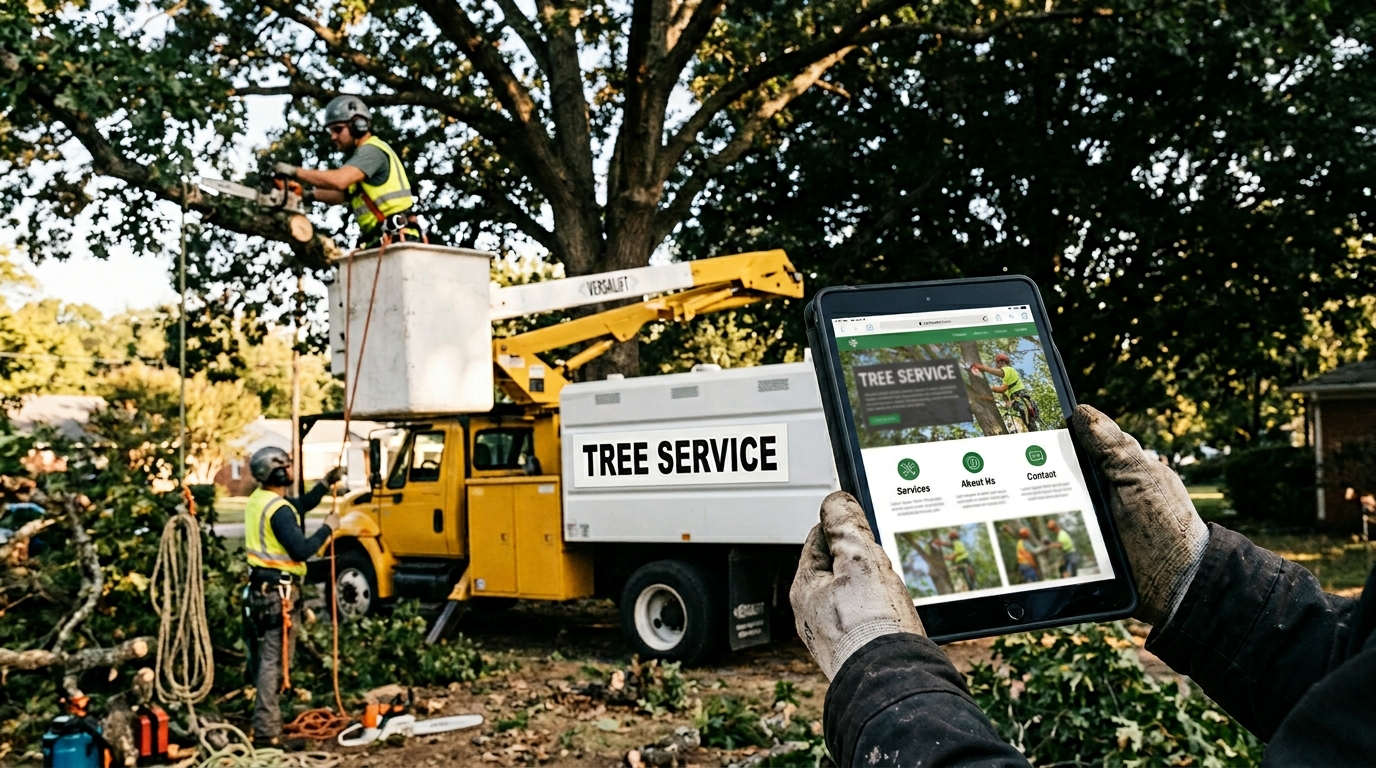
Real photos of your crew and equipment matter here. Homeowners can spot stock photos of a generic arborist in the same second they spot a fake review. Use your actual trucks, your actual team, a job site you cleaned up last week. That’s credibility a stock library can’t buy.

The Pages Your Tree Service Website Actually Needs
Most tree service sites have a homepage, a contact page, and one “Services” page that lists everything in two paragraphs. That structure doesn’t rank, and it doesn’t convert.
Google wants depth. Homeowners want specifics. You need a separate page for every major service:
- Home: Overview, trust signals, primary CTA
- Tree Removal: Your most searched, highest-ticket service
- Tree Trimming and Pruning: Different intent than removal, needs its own page
- Stump Grinding and Removal: Homeowners search this separately
- Emergency Tree Service: Storm season, fallen trees, urgent calls
- Service Area: Every city and town you cover, ideally with individual location pages
- About: Your ISA credentials, years in business, your story
- Reviews and Testimonials: A dedicated page, not just a widget
- Contact and Quote Request: Fast form, phone number, response time expectation
- Blog: For SEO. Consistent publishing builds rankings over 6-12 months.
Each of these pages does a specific job. A homeowner searching “stump grinding in Akron” needs to land on a page about stump grinding in Akron, not a general services page where they have to hunt for it. See how this connects to your overall tree service SEO strategy. Page structure and content are the foundation.
What a High-Converting Service Page Actually Looks Like
Take your Tree Removal page. Most companies write 150 words and call it a page. That page won’t rank for anything and won’t convert anyone who lands on it.
A page built to perform looks like this:
H1 includes service and city: “Tree Removal in Nashville, TN” not just “Tree Removal.”
What the service is and when homeowners need it: Dead trees, storm damage, hazardous lean, roots threatening a foundation. Say it plainly. The homeowner needs to recognize their situation.
Your process: What happens when they call. “We schedule a free estimate within 24 hours. We show up, assess the job, give you a written quote. No pressure.” That removes friction. Most companies make people wonder what calling even gets them.
Why choose you: Your ISA certification if you have it. Years in business. Number of trees removed. Insurance coverage. Not as a wall of text. As a short, scannable list.
Before and after photos: From actual jobs in or near that city. Captions with the service type and location.
Testimonials for that specific service: “They removed a 60-foot oak that was leaning over my garage. Done in half a day, spotless cleanup.” That’s more convincing than a generic star rating.
FAQ section: 4-6 questions homeowners actually ask: cost ranges, how long it takes, whether they need to be home, how debris is handled.
CTA with a form or phone number: Not just at the bottom. In the middle of the page too, especially after the social proof section.

The Trust Signals That Actually Move People
Tree service is a high-trust purchase. A homeowner is hiring someone to bring a chainsaw 80 feet in the air near their house, their car, and their neighbor’s fence. Trust isn’t a nice-to-have. It’s the whole game.
Here’s what actually builds it on a website:
ISA Certified Arborist badge. If you have one, it needs to be visible on the homepage, in the header, and on every service page. The International Society of Arboriculture{:target=”_blank”} certification tells a homeowner that a trained professional assessed the tree, not just a guy with a saw.
TCIA membership. The Tree Care Industry Association{:target=”_blank”} credential signals you operate to a professional standard. Most of your competition doesn’t have it.
“Fully Licensed and Insured” with specifics. Don’t just say it. Say what: general liability, worker’s comp, and the coverage amounts if you’re comfortable sharing them. “Available on request” tells the careful buyer you have nothing to hide.
Years in business. “Serving Central Ohio Since 2009” is worth more than most marketing copy.
Number of jobs completed. “2,300+ trees removed” is specific and provable. It signals volume and experience without you having to claim it.
Video testimonials. A 60-second video of a homeowner in their yard saying what you did and how it went is the closest thing to a word-of-mouth referral your website can deliver. Most tree companies don’t have these. That’s your opening.
Your Before and After Gallery Is Your Best Sales Tool
Tree service is a visual business. A homeowner with a dead pine in their backyard wants to see that you’ve handled exactly that before. A before-and-after gallery does more selling than any paragraph you write.
Every photo set should have:
- A clear before shot: The tree at its worst. Leaning, dead, storm-damaged, overgrown.
- A clear after shot: Clean removal, trimmed canopy, ground cleared of debris.
- A caption: Service type, approximate location, and a brief description.
A caption like “Dead oak removal, Powell, OH, 2025” signals to Google that this is local content. It signals to the homeowner that you work in their area. Both matter.
Don’t use stock photography. Homeowners have seen the same Getty Images tree guy in a dozen websites. It reads as generic and immediately erodes trust. Pull out your phone after every job. 20 seconds of effort per site visit adds up to a gallery that closes jobs.

Mobile Performance Is Not Optional
Most tree service searches happen on a phone. A homeowner is standing in their backyard looking at a damaged tree, or sitting on their couch after a storm. They’re searching on a mobile device, and they’re going to call someone in the next 10 minutes.
Your mobile site needs to load in under 3 seconds on a 4G connection. If it doesn’t, Google downranks it and visitors leave. Most website speed issues come from uncompressed images, bloated plugins, or cheap shared hosting. Fix the images first. Use a host built for performance.
The tap-to-call button needs to be at the top of every page on mobile. The quote request form needs to work without zooming, scrolling sideways, or fighting with the keyboard. Test your own site on your phone right now. If you have to pinch and zoom to fill out the form, your conversion rate is suffering.
The rest: no horizontal scroll, readable text without zooming, buttons large enough to tap. These aren’t extras. They’re table stakes for a site that books jobs.
The Most Common Mistakes on Tree Service Websites
These are the patterns I see when I look at a tree service site before taking on a client. Most of them cost real money in missed jobs:
No credentials above the fold. If a visitor can’t see “licensed and insured” or an ISA badge in the first 5 seconds, they assume you’re a guy with a truck and a Craigslist ad. Even if you’re not.
Stock photos. Buyers know. Move on.
One catch-all services page. Can’t rank for “stump grinding in [city]” if that phrase doesn’t appear on a dedicated page.
No emergency service page. Storm season is your highest-demand, highest-margin work. If you don’t have a page for it, you’re not ranking for it when it matters most.
Not mobile-friendly. Slow load, broken forms, pinch-and-zoom text. All of these send the visitor to the next result.
Reviews buried or missing. Your Google rating should appear on your website. A dedicated testimonials page with real names and real job details builds trust that a sidebar widget never will.
These aren’t design problems. They’re revenue problems. Every one of them costs calls you don’t know you’re losing.

What to Budget for a Tree Service Website
| Option | Cost Range | What You Get |
|---|---|---|
| DIY (Wix, Squarespace) | $0-$50/mo | Functional but limited SEO, looks generic |
| Template agency build | $1,500-$4,000 | Faster turnaround, decent structure |
| Custom build | $4,000-$12,000 | Built for conversion, built for search |
The DIY route works if you’re just starting and your only goal is to have something online. It won’t rank, and it won’t convert like a professional site. But it’s better than nothing while you build revenue.
Template agency builds can be solid if the agency understands tree service specifically: the right page structure, the right trust signals, the local SEO fundamentals. Most don’t. They build the same site for every trade with swapped photos.
A custom build costs more upfront because it’s built around your specific services, your service area, and your conversion goals. The math on it: if your average tree removal job is $1,800 and a good website books 3-5 extra jobs a month, the investment pays for itself in 4-8 weeks.
For context on where website investment fits into a full marketing plan, see the tree service marketing guide. And if you’re running Google Ads alongside your site, the design decisions here directly affect your ad conversion rate. More on that in the Google Ads guide for tree services.
FAQ
How much does a tree service website cost?
A professionally built tree service website runs $1,500-$12,000 depending on scope. Template builds run $1,500-$4,000. Custom builds with individual service pages, location pages, and conversion optimization run $4,000-$12,000. Monthly hosting and maintenance typically adds $50-$200/mo depending on the platform.
What should a tree service website include?
At minimum: a homepage with trust signals and a clear CTA, separate pages for each major service (removal, trimming, stump grinding, emergency), a service area page, an about page with credentials, a reviews page, and a contact or quote request page. A blog supports long-term SEO.
Do I need a website if I’m already on Google Maps?
Yes. Your Google Business Profile gets you into the Maps results, but when someone clicks your listing, they check your website before they call. A weak or missing website costs you calls that your GBP ranking earned you. The two work together. See the tree service leads guide for how the full system connects.
How long does it take to build a tree service website?
A template build takes 2-4 weeks. A custom build with individual service and location pages takes 6-10 weeks depending on how quickly you provide photos, copy, and feedback. Cutting corners on the content and photo stage is where most delays happen.
What makes a tree service website rank on Google?
Page structure, local keywords on individual service and location pages, consistent reviews on your Google Business Profile, and a blog with relevant content over time. Most tree service sites rank poorly because they have one page per service with no local keyword targeting. Read the full tree service SEO guide for the complete breakdown.
Your Website Should Be Booking Jobs While You Work
If your site isn’t generating quote requests on its own, you’re doing the work twice: once to run the business, once to manually drum up every new customer. A site built for conversion changes that.
SteelToe Digital builds tree service websites that rank on Google and turn visitors into calls. We know the home service website design principles that matter, and we know tree service specifically: the seasonality, the trust signals that matter to homeowners, the services worth building individual pages for. Take a look at what we do at /services, then let us look at your current site.
Get a Free Website Review
No pitch. No contract. Just a straight look at what your site is doing and what it’s missing.