

Google Ads for plumbers can work incredibly well. They can also burn $2,000 a month and generate nothing you can point to.
The difference is not the platform. It’s the setup. Most plumbers running Google Ads are paying for clicks from people searching “how to plumb a bathroom” or “plumbing jobs near me.” They’ve got the wrong keywords, no call tracking, and ads pointing to a homepage that loads in 4 seconds. Then they conclude Google Ads doesn’t work.
It works. You just have to run it right.
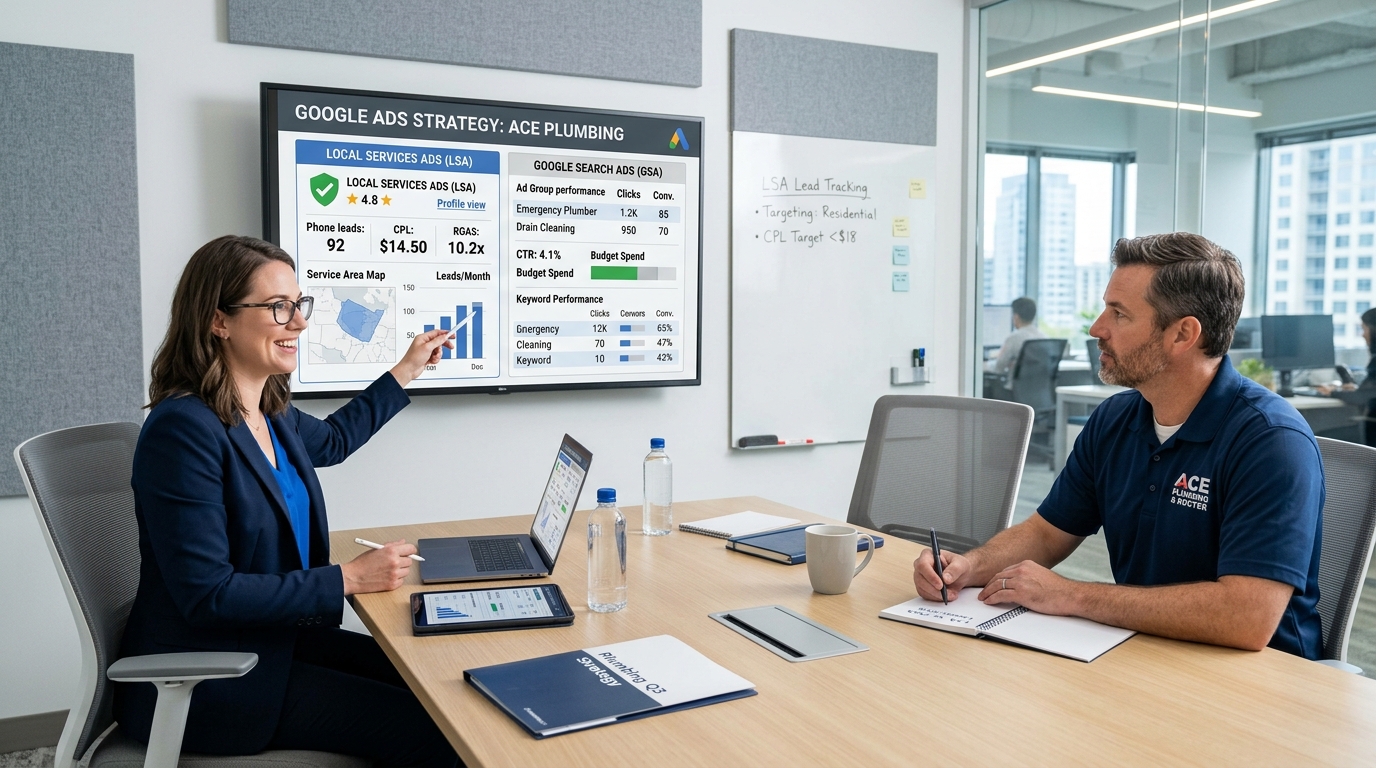
This guide covers both types of Google advertising for plumbers: Local Services Ads (LSAs) and Google Search Ads. If you’re considering either one, or you’re already spending money on them and not sure what you’re getting, this is what you need to know.
Local Services Ads vs. Google Search Ads: What’s the Difference?
These are two separate products inside the Google ecosystem. Most plumbers don’t know there’s a distinction. That matters because they work differently, cost differently, and target different stages of the buying process.
Feature | Local Services Ads (LSA) | Google Search Ads |
|---|---|---|
Position on page | Above everything, including Search Ads | Below LSAs, top of organic results |
What you pay for | Per lead (call or message) | Per click |
Google Guaranteed badge | Yes | No |
Setup complexity | Low | High |
Keyword control | Limited | Full |
Best for | Emergency and high-intent calls | Specific services, broader reach |
The Google Guaranteed badge on LSAs is not a small thing. It signals that Google has verified your license, insurance, and background check. Customers see it. It builds trust before they’ve read a single word on your website.
The recommendation: start with LSAs. Get them profitable. Then layer in Search Ads to fill the gaps LSAs don’t cover.
How to Set Up Google Local Services Ads for Plumbers
The setup process takes 1-2 weeks, mostly because of the verification step. Here’s what it involves.
Go to ads.google.com/local-services-ads and create an account. Select “Plumber” as your business category and define your service area by zip codes or radius. Then comes the part most people don’t expect: Google Guaranteed verification.
You’ll need to submit a background check, proof of license, and proof of insurance. Google reviews these. Once approved, the green badge appears next to your ads. This is what separates LSA plumbers from everyone else on the page.
Set your weekly budget based on how many leads you can realistically handle. Google charges per lead, not per click, so a $500/week budget in a mid-size market can generate a steady flow of calls without paying for browsers who never call.
One operational detail that directly affects how many calls you get: respond to leads within 2 hours. Google’s algorithm tracks your response rate. Slow responders get shown less. This isn’t optional if you want the ads to work.

Google Search Ads for Plumbers: Campaign Structure
Search Ads give you full control over keywords, bids, ad copy, and landing pages. That control is what makes them powerful. It’s also what makes them easy to waste money on if you don’t know what you’re doing.
Organize your campaigns by service type, not by geography. Here’s a structure that works:
Emergency Plumbing Campaign: “burst pipe,” “emergency plumber [city],” “plumber 24 hours”
Water Heater Campaign: “water heater installation,” “water heater replacement [city]”
Drain Cleaning Campaign: “drain cleaning,” “clogged drain,” “drain backup”
General Plumbing Campaign: “licensed plumber [city],” “plumber near me”
Within each campaign, create ad groups organized by service plus location. This keeps your ads relevant to the search, which keeps your Quality Score high, which keeps your costs lower.
For bidding: start with Maximize Clicks while you gather data. Once you have 30 or more conversions tracked, switch to Target CPA so Google’s algorithm optimizes toward your cost-per-lead goal.
Use phrase match and exact match keywords. Broad match burns budgets on irrelevant traffic.
The Best Keywords for Plumber Google Ads
High-performing keywords for plumbing Search Ads fall into two categories: emergency intent and service-specific intent.
Emergency intent keywords convert at the highest rate because the person needs help right now. “Emergency plumber [city],” “plumber near me,” “24 hour plumber,” and “burst pipe repair” are your top performers. These also have the highest CPCs, often $30-$80 per click in competitive markets. They’re worth it when your landing page and offer are right.
Service-specific keywords convert well because the buyer is comparison-shopping but still close to a decision. “Water heater installation cost,” “drain cleaning [city],” and “sewer line repair” are examples.
Negative keywords are where most campaigns bleed money. Add these before you run a single dollar:
- plumbing jobs
- plumbing salary
- plumbing school
- how to plumb
- DIY plumbing
- plumber resume
- free plumbing
These searches have nothing to do with hiring a plumber. If you don’t exclude them, Google will match to them, you’ll pay for the click, and the person will bounce in 3 seconds.
Writing Ads That Actually Get Clicked
Google Search Ads give you three headlines and two descriptions. Every character counts.
Headline 1: Include the keyword. “Licensed Plumber in [City]” or “Emergency Plumber [City]” depending on the ad group.
Headline 2: Your strongest differentiator. “24/7 Emergency Service,” “Same-Day Appointments,” or “Google Guaranteed.”
Headline 3: A direct call to action. “Call for a Free Estimate” or “Book Online Now.”
Descriptions: Address the pain point in the first description. “Burst pipe? We answer 24/7. Licensed, insured, and in your neighborhood.” Second description: a trust signal plus urgency. “Serving [City] for 12 years. Estimates in 30 minutes.”
Extensions you should always run on plumbing ads:
Call extension: your phone number clicks straight to a call on mobile
Location extension: shows your address, helps with local relevance
Callout extensions: “Licensed & Insured,” “No Dispatch Fee,” “Free Estimates”
Sitelink extensions: link directly to specific services (Water Heater Repair, Drain Cleaning, etc.)
Extensions expand your ad’s real estate on the page and give people more reasons to click without adding to your per-click cost.
Landing Pages for Plumber PPC
This is where most plumbing ad campaigns fail. They spend correctly on ads and send people to their homepage.
Your homepage is designed for visitors who want to learn about you. A PPC landing page is designed for people who want to hire a plumber right now. Those are different jobs. Don’t make the same page do both.
Build dedicated landing pages for each campaign. Each page should:
- Load in under 2 seconds on mobile. Most plumbing searches happen on a phone.
- Show the phone number above the fold, click-to-call on mobile.
- Have one clear call to action. Either call or fill out a form. Not both on the same page.
- Include trust signals: number of years in business, number of reviews, Google Guaranteed badge, license and insurance confirmation.
- Remove the navigation menu. Your job is to get them to call. Every link that goes somewhere else is a way out.
A $2,000/month ad budget sending traffic to a weak landing page will generate a fraction of the leads that a $1,000/month budget with a well-built page will. Fix the page before you scale the budget.
Plumber Google Ads Budget Guide
What you should expect to spend depends on your market size and how much competition there is for plumbing keywords. These are realistic ranges based on current 2026 market rates.
Market Size | Monthly Budget | Expected Leads |
|---|---|---|
Small market (under 100K population) | $500-$1,000 | 10-25 leads |
Mid-size market | $1,000-$2,500 | 25-60 leads |
Large metro | $2,500-$6,000 | 60-150 leads |
These are ranges. Your actual cost per lead depends on your keyword targeting, Quality Score, landing page conversion rate, and how competitive your specific city is. Plumbing is one of the more competitive verticals on Google Ads. Budget for it accordingly.
One rule that separates smart advertisers from the rest: don’t cut the budget after the first two weeks. Google’s algorithm needs data to optimize. The first 30 days are almost always less efficient than month two or three. Pulling the budget early is the single most common reason plumbing ad campaigns fail.

How to Track ROI on Plumber Google Ads
If you can’t measure it, you can’t manage it. Most plumbers running Google Ads have no idea what their cost per lead is. That makes every budget decision a guess.
Set up call tracking through CallRail or Google’s built-in call extensions with conversion tracking. Every call that comes through your ad should be tagged so you know it came from Google Ads, which campaign, and which keyword.
Set up conversion tracking in Google Ads and connect it to Google Analytics. This lets you see not just clicks but actual form submissions and calls.
Your core number is cost per lead: total ad spend divided by total leads generated. The benchmark that makes plumbing Google Ads profitable in most markets is $40-$80 per lead. If you’re above $100, your campaign has a problem that needs to be found. If you’re below $40, you’re either in a low-competition market or your setup is dialed in.
To calculate ROI from there: multiply your average job value by your close rate, then compare that to your cost per lead. A plumber with a $450 average ticket and a 60% close rate is generating $270 in revenue per lead. At $60 per lead, that’s a 4.5x return before overhead. Build that right and it runs while you’re on the job.
If you want to see how Google Ads fits into a broader strategy for getting plumbing leads, our guide to plumbing leads covers every channel side by side.
Should You Manage Google Ads Yourself or Hire Someone?
The honest answer: it depends on how much time you have and how much the mistakes will cost you.
Google Ads has a real learning curve. Keyword research, match types, Quality Score, bid strategies, landing page optimization, conversion tracking setup, negative keyword management: each of these is its own skill. Getting one wrong costs money.
If you’re a solo operator or running a lean 2-3 truck company, managing your own LSAs is doable. The platform is simpler, and the cost-per-lead model limits your downside.
Search Ads are harder. A poorly managed Search Ads account in a competitive metro can burn $3,000-$5,000 in 60 days with almost nothing to show for it. That’s the scenario where a competent manager pays for themselves quickly.
What to look for if you hire someone: they should be asking about your close rate, your average job value, and what services you want more of before they ever mention keywords. Anyone who leads with impressions and clicks but can’t show you cost per booked job doesn’t understand the actual goal.
See how ads connect to your full plumber marketing picture before you decide what to tackle first.
How Google Ads and SEO Work Together for Plumbers
Google Ads and SEO are not competitors. They serve different time horizons.
SEO builds your organic presence over 3-6 months. Once you’re ranking, the leads are essentially free and compound over time. But you don’t rank in month one. You don’t even rank well in month three in most competitive markets.
Google Ads gets you to the top of the page today. You’re visible the day the campaign goes live. The cost is ongoing, but the results are immediate.
The strategy that works: run Google Ads while your SEO builds. Once your organic rankings are generating consistent leads on their own, you can reduce ad spend or redirect it toward the services where you want to grow. You’re not choosing between the two. You’re sequencing them.
Our full guide to plumber SEO covers how to build the organic side of that equation. And if you want to see how local search fits in, the local SEO for plumbers guide goes deep on Google Business Profile rankings and the Maps 3-pack.
Frequently Asked Questions
How much should a plumber spend on Google Ads?
In a small market, $500-$1,000 per month is enough to generate 10-25 leads. Mid-size markets typically require $1,000-$2,500 per month for meaningful volume. Large metros with high competition can require $2,500-$6,000 per month to stay visible. Start at the low end for your market size, track cost per lead, and scale up what works.
Are Google Ads worth it for plumbers?
Yes, when set up correctly. Plumbing is one of the highest-intent service categories on Google. Someone searching “emergency plumber near me” is going to call someone within minutes. The question is whether they call you. A well-run Google Ads campaign with proper call tracking consistently produces leads at $40-$80 in most markets. At a typical plumbing ticket price, that math works. A poorly run campaign produces nothing at twice the cost.
What is Google Guaranteed and how do I get it?
Google Guaranteed is a verification badge that appears on Local Services Ads. It tells customers that Google has checked your business license, insurance, and passed a background check on your company. To get it, sign up for Local Services Ads at ads.google.com/local-services-ads, select “Plumber” as your business type, and complete the verification process. The process typically takes 1-2 weeks. Businesses with the badge get more clicks and more trust from customers comparing options.
Should I hire a Google Ads manager or do it myself?
LSAs are manageable on your own. Google Search Ads are harder to run profitably without experience. If you’re spending more than $1,000 per month on Search Ads and you don’t have conversion tracking set up, you’re flying blind and a manager will pay for themselves in waste reduction alone. Look for someone who talks about cost per booked job, not just clicks and impressions.
What’s the difference between Google Ads and Local Services Ads for plumbers?
Local Services Ads appear above everything else on the page, charge per lead, require Google Guaranteed verification, and are simpler to set up. Google Search Ads appear below LSAs, charge per click, require more setup and management, and give you full control over keywords and targeting. Most plumbers should start with LSAs and add Search Ads once LSAs are running profitably.
Ready to Get Calls Starting This Week?
Most plumbing companies that come to us are either not running ads at all or running them badly, paying for clicks from people who were never going to call. Either situation is fixable.
SteelToe Digital manages Google Ads campaigns for plumbing companies that want immediate leads while their SEO and website work builds for the long term. We set up conversion tracking, build the landing pages, write the ads, and manage the budget so you’re not guessing at what’s working.
No pitch. No contract. Just a look at what your campaigns are actually doing and where the money is going.